New Supercomputer Simulations Peer Past the Big Bang Testing Cosmic Bounce Ideas
Cutting‑edge simulations let researchers explore what might have occurred before the Big Bang, probing fundamental mysteries of the universe.
A fresh wave of high‑performance simulations is finally letting scientists peek behind the veil that has long obscured the moments before the universe’s explosive birth. By harnessing the full machinery of Einstein’s general relativity on modern supercomputers, researchers are now charting territories that were once deemed mathematically inaccessible, according to a comprehensive review in Living Reviews in Relativity.
What Makes the Primordial Epoch So Hard to Access
Standard cosmological calculations run into a wall when they are pushed back to the instant of the singularity, where density, temperature and spacetime curvature diverge to infinity. At that point the familiar equations that describe planets, stars and black holes cease to deliver meaningful predictions, leaving the very origin of the cosmos largely out of reach for empirical scrutiny.
Most conventional models treat the early universe as a smooth, nearly uniform expanse, an assumption that works remarkably well for describing large‑scale structures and the cosmic microwave background. Yet the first fractions of a second after the bang were probably anything but tranquil—gravity would have acted amid wildly fluctuating densities, violent spacetime warps, and patchy matter distributions. In such a chaotic setting, the simplifying approximations break down, and the tools for probing that era become inadequate.
These theoretical gaps have kept debates alive over competing ideas such as inflation, cyclic or bouncing cosmologies, and other proposals that attempt to explain how the universe transitioned from a pre‑existent state to the expanding cosmos we observe today.
Computational Relativity Opens a New Frontier
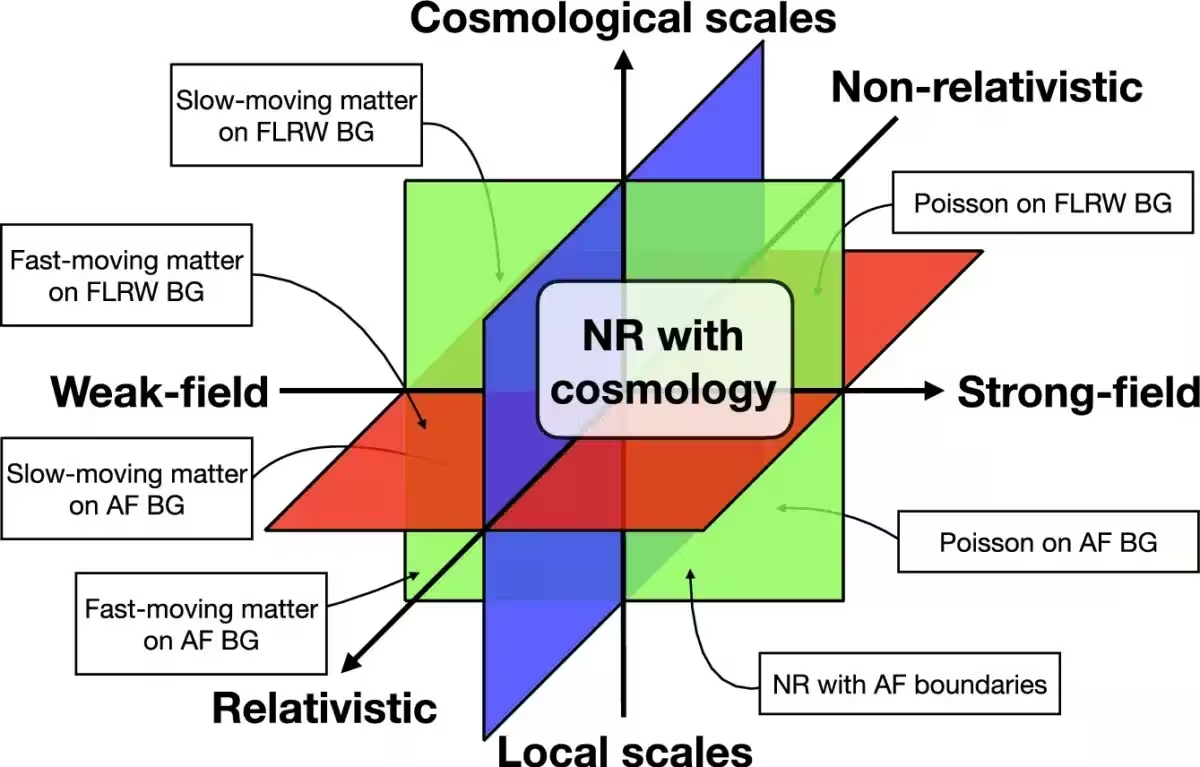
The discipline of numerical relativity bypasses the need for exact analytic solutions by employing massive computing power to approximate Einstein’s equations in regimes where hand calculations fail. This approach has already revolutionized our understanding of black‑hole mergers and the gravitational‑wave signatures captured by detectors like LIGO.
Now the same methodology is being redirected toward cosmology. By discarding the assumption of perfect symmetry, scientists can generate virtual universes riddled with irregularities and watch their evolution under the full, non‑linear dynamics of general relativity. The resulting simulations test whether speculative early‑universe models survive realistic gravitational stresses or collapse under their own complexity.
“You can search around the lamppost, but you can’t go far beyond the lamppost, where it’s dark—you just can’t solve those equations. Numerical relativity allows you to explore regions away from the lamppost,” says researcher David Lim. His comment captures the ambition of the field: extending inquiry beyond the mathematically illuminated zones into the shadows that have long eluded observation.
Putting Pre‑Big‑Bang Theories to the Test
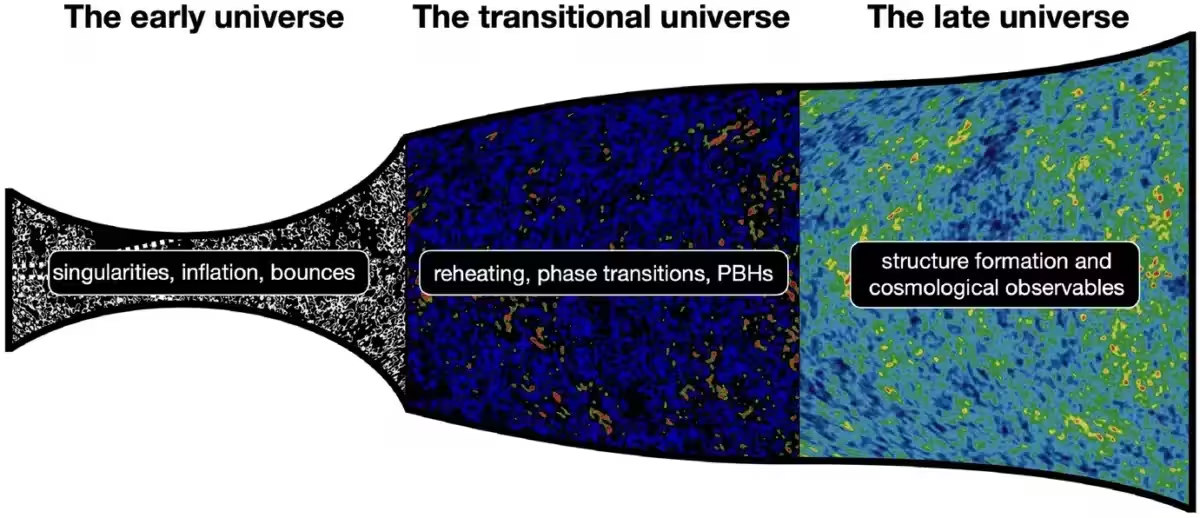
A growing number of speculative frameworks contend that the Big Bang was not the ultimate origin but rather a transition from a prior state. Some envision a universe that cycles through phases of contraction and expansion; others propose a collapse that bounces into the expansion we now measure.
These ideas have long struggled to demonstrate viability when full gravitational dynamics, matter inhomogeneities, and relativistic effects are taken into account. The review in Living Reviews in Relativity highlights how numerical experiments can evaluate the stability of bounce mechanisms, the natural emergence of inflation from chaotic beginnings, and the potential observational footprints of alternative origin scenarios.
The simulations also explore exotic phenomena such as cosmic strings, primordial black holes, collisions between bubble universes, and the turbulent “pre‑heating” phase that may have followed inflation. Many of these processes could imprint subtle signatures in gravitational‑wave backgrounds or in fine‑scale patterns of the cosmic microwave radiation, offering future avenues for empirical verification.
Merging Two Research Cultures
Beyond the technical hurdles, the review points out a sociological divide: cosmologists and numerical relativists have traditionally operated in parallel tracks, despite sharing a common interest in gravity’s role across cosmic history.
Bridging this gap could accelerate breakthroughs. Numerical relativists bring expertise in solving Einstein’s equations under extreme conditions, while cosmologists contribute deep knowledge of observational constraints and theoretical model building. “We hope to actually develop that overlap between cosmology and numerical relativity so that numerical relativists who are interested in using their techniques to explore cosmological problems can go ahead and do it,” Lim emphasizes. “And cosmologists who are interested in solving some of the questions they cannot solve, can use numerical relativity.”
As computational resources continue to expand and simulation codes become ever more sophisticated, the partnership between these communities may turn longstanding philosophical puzzles into testable scientific hypotheses.
This article has been fact checked for accuracy, with information verified against reputable sources. Learn more about us and our editorial process.
Last reviewed on .
Article history
- Latest version
Reference(s)
- Aurrekoetxea, Josu C.., et al. “Cosmology using numerical relativity.” Living Reviews in Relativity, vol. 28, no. 1, June 23, 2025 Springer Science and Business Media LLC, doi: 10.1007/s41114-025-00058-z. <https://link.springer.com/article/10.1007/s41114-025-00058-z>.
Cite this page:
- Posted by Aisha Ahmed