Ancient Fish Gene Rewiring Solves the Evolutionary Mystery of How Limbs Gained Top and Bottom Sides
New research shows how an old genetic toolkit for tail fins was repurposed to build the dorsal sides of paired limbs.
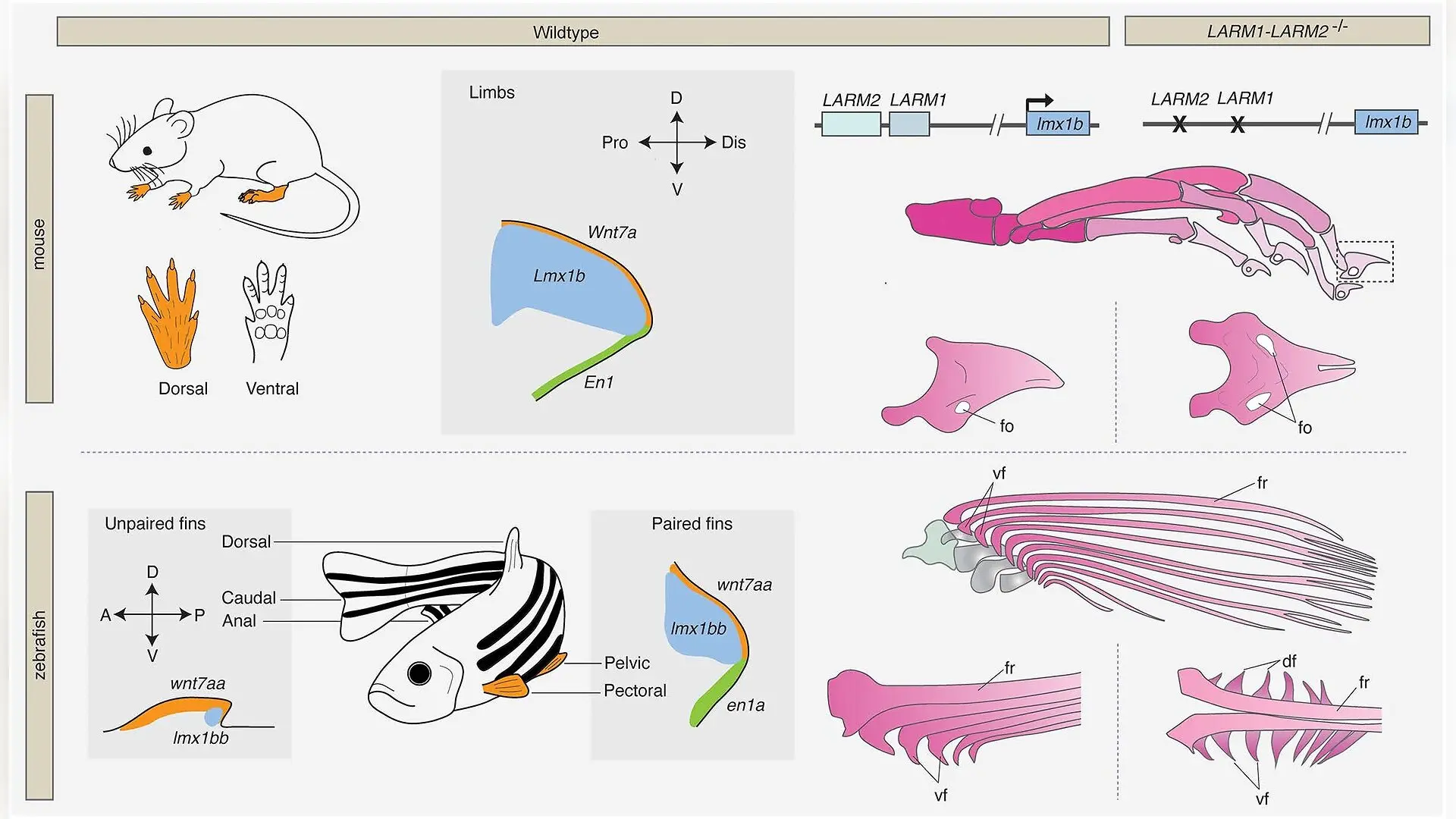
Ancient fish discovered a clever genetic shortcut to build limbs by turning an old tail-fin blueprint sideways. Researchers investigating the evolutionary origins of hands and feet have found that a master gene responsible for building top-versus-bottom surfaces in modern limbs was originally used to pattern the back ends of symmetrical median fins.
Human hands and tetrapod limbs possess distinct dorsal and ventral sides, featuring nails on top and hairless skin below, along with specialized muscles and bones. While scientists have understood for decades how this top-and-bottom difference, known as dorsoventral polarity, is maintained in embryos through a signaling network involving genes like Engrailed-1 and Wnt7a, the evolutionary origin of this genetic program has remained a major puzzle. Unpaired median fins, which include the dorsal, anal, and caudal fins found along the centerlines of fish, predate paired fins like arms and legs by millions of years and are completely symmetrical from left to right.
To unravel how fish made the evolutionary leap from symmetrical centerlines to protruding paired appendages, a team led by researchers examined genetic networks across multiple species, including zebrafish, paddlefish, and sharks. Their findings were published in PLoS Biology in November 2026. The authors demonstrated that while a duplicated version of the key dorsal patterning gene lmx1b, called lmx1bb, dictates the upper surface of paired fins in zebrafish, it is restricted purely to the posterior or back edge of symmetrical median fins.
How Genetic Enhancers Rewire Ancient Tissues
Genetic tracking experiments revealed that cells expressing lmx1bb in paired fins develop specifically into the bone-forming osteoblasts of the dorsal fin rays. By contrast, the same gene in median fins contributes symmetrically across the midline. This shift indicates that ancient developmental toolkits were systematically co-opted and repurposed as vertebrates began evolving lateral appendages.
Previous work in mice identified two specific DNA control regions, known as LARM1 and LARM2, that act as regulatory switches to drive Lmx1b expression in the upper surface of forelimbs. When the research team checked for these regulatory modules across various species, they found that LARM1 is conserved among ray-finned fishes and cartilaginous fishes, suggesting it evolved in their last common ancestor.

What Happens When Control Switches Are Deleted
To test the functional importance of these genetic switches, the investigators deleted both LARM control modules in zebrafish. The genetic deletion dramatically reduced enhancer activity in paired fins without disturbing median fins. Furthermore, losing both modules resulted in a bi-ventralized pectoral fin phenotype, where the bottom features of the fin rays were mirrored onto the top surface.
Independent studies confirmed this outcome, showing that disrupting lmx1bb and its associated regulatory regions converts upper fin structures into lower ones. This proves that lmx1bb serves as the primary genetic switch determining dorsal identity in fish paired fins. The evolutionary history of these limbs relied on hijacking an old posterior expression domain and shifting it upward to establish entirely new structural asymmetries.
Unresolved Questions in Appendage Evolution
Despite these clear genetic insights, many questions remain about the upstream triggers that activate these pathways. While mouse studies show that Lmx1b maintains its own expression through a feedback loop with its regulatory modules, the specific transcription factors that initially spark lmx1bb expression in fish fins remain unknown. Furthermore, the absence of the ventral restriction gene en1 in unpaired fins suggests that it was recruited into a brand-new ventral regulatory program during the emergence of paired appendages.
Future work mapping out these ancient gene networks will clarify how prehistoric fish transformed their bodies to conquer new habitats. By piecing together how nature rewired its genetic toolkit, scientists are steadily uncovering the deep evolutionary history written inside our own limbs.
The research was published in PLoS biology on November 11, 2026.
This article has been fact checked for accuracy, with information verified against reputable sources. Learn more about us and our editorial process.
Last reviewed on .
Article history
- Latest version
Reference(s)
- Schwaner, Caroline., et al. “A new asymmetry, an old toolkit: An emerging developmental enigma in appendage evolution.” PLOS Biology, vol. 24, no. 11, November 11, 2026, pp. e3004078 Public Library of Science (PLoS), doi: 10.1371/journal.pbio.3004078. <https://doi.org/10.1371/journal.pbio.3004078>.
Cite this page:
- Posted by Priya Sharma