Mysterious Repeating Fast Radio Burst Reveals a Hidden 120-Day Heartbeat
Analysis of over 6,000 deep-space radio flashes points to stellar wobbles or binary orbits driving a steady polarization cycle.
A mysterious repeating cosmic radio source is flashing with a hidden rhythm, displaying a steady 120-day heartbeat in its polarized light that could finally expose the violent physics of its central engine. Fast radio bursts are blindingly bright flashes of radio waves that last for only a few milliseconds, originating from deep space billions of light-years away.
While most of these cosmic screams appear just once and then vanish forever, a select few repeat their explosive activity. By studying 6,099 individual flashes from a repeating source known as FRB 20240114A, researchers found that the fraction of linearly polarized light swings back and forth in a strict cycle taking roughly 120 days. The findings are available on the arXiv preprint server, offering a fresh window into the invisible machinery powering these enigmatic deep-space beacons.
How Astronomers Tracked the 120-Day Cosmic Clock
To uncover this hidden cycle, an international team of researchers analyzed data gathered by China’s Five-hundred-meter Aperture Spherical radio Telescope, affectionately known as FAST. This colossal dish monitored the repeater across 95 observing days spanning a total timeframe of roughly 488 days. Because individual days featured wildly different numbers of flashes, the team grouped the data by calendar day and calculated both the daily mean and median degree of linear polarization.
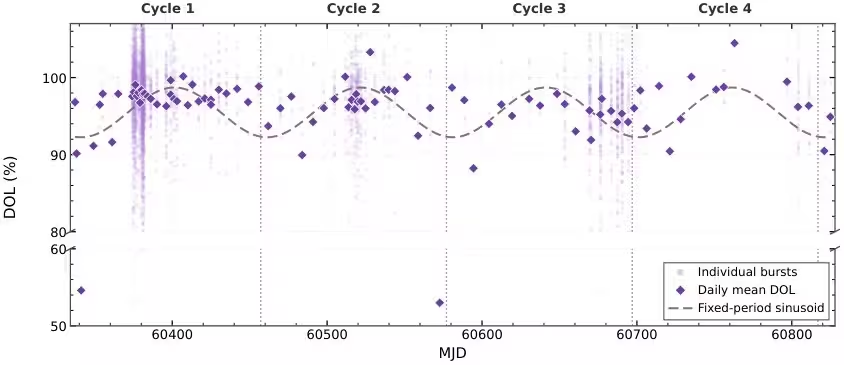
When the researchers ran this timeline through specialized statistical tools called phase distance correlation and generalized Lomb-Scargle periodograms, a sharp signal emerged. The strongest peaks settled precisely at 119.91 and 122.31 days. To make sure this rhythm was not just a statistical ghost, the team performed ten million random computer simulations shuffling the observation dates. The resulting false-alarm probabilities dropped below one in a thousand, giving the periodic signal an equivalent Gaussian significance of roughly 3.1 sigma.
What is Driving the Polarization Swing?
When the daily polarization measurements are folded into a single 119.91-day loop, they form a smooth wave with a semi-amplitude of 3.23 percent. The polarized fraction peaks near the middle of the cycle and dips near the boundaries. The authors suggest a couple of leading explanations for what might be steering this rhythm, centering on either stellar wobbles or orbital mechanics in a binary system.
The first possibility is that the source is a heavily magnetized neutron star, or magnetar, undergoing free precession. Just like a wobbling spinning top, the star’s crust could slowly tilt over time while its rotation axis remains fixed. As the stellar orientation shifts relative to Earth, our line of sight sweeps across different parts of the radio emission beam, capturing varying blends of polarized light.
Alternatively, the periodic modulation could arise from orbital motion if the magnetar lives with a companion star. In this scenario, passing through a stellar wind or a circumstellar disk could alter the surrounding plasma and magnetic fields, changing how the radio waves propagate across space. However, when the team tested standard plasma depolarization models against existing upper limits on Faraday rotation dispersion, the calculated effect fell short of explaining the full 6.46 percent peak-to-peak variation observed in the data.
Connecting Polarization With Central Frequency Peaks
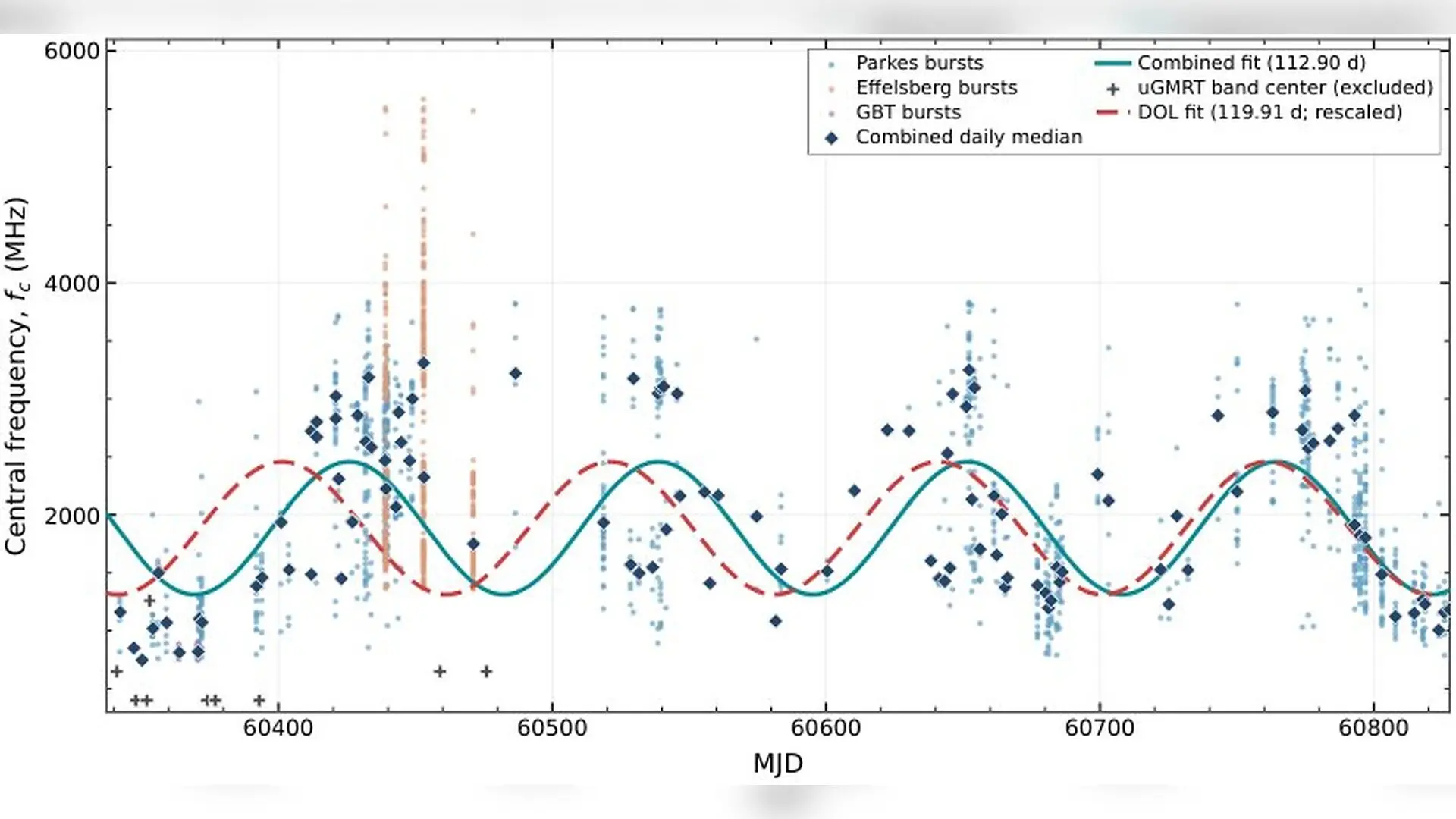
The 120-day polarization cycle also adds a new piece to a complex puzzle involving other repeating behaviors previously spotted in the same cosmic source. Other research groups have reported a 143-day cycle in overall burst activity and a separate 113-day modulation in the central frequency of the radio flashes. When the team aligned the polarization curve alongside a combined three-telescope dataset tracking central frequencies, local similarities stood out.
However, the peaks do not lock together perfectly. The offset between the polarization peaks and the frequency peaks shifts gradually across the nearly 500-day observing span, reflecting the slightly different periods at play. The authors note that while geometric viewing changes or frequency-dependent propagation effects could link these phenomena, the differences between individual burst samples must be accounted for before a unified model is confirmed.
Future observations capturing simultaneous wideband polarimetry will be crucial to separate pure geometric shifts from environmental plasma effects. Until then, the steady 120-day heartbeat of FRB 20240114A remains a tantalizing clue pointing toward the extreme internal dynamics of universe-spanning neutron stars.
The study was posted to the arXiv preprint server on November 13, 2026.
This article has been fact checked for accuracy, with information verified against reputable sources. Learn more about us and our editorial process.
Last reviewed on .
Article history
- Latest version
Reference(s)
- Sun, Fang. “Periodic Modulation of Linear Polarization Fraction in Repeating FRB 20240114A.” arXiv.org <http://arxiv.org/abs/2611.17805v1>.
Cite this page:
- Posted by John Williams