Galaxy Cluster Lenses Reveal Decades of Hidden Fast Radio Burst History
Natural gravitational delays allow a brief telescope campaign to sample decades of activity from distant repeating fast radio bursts.
Massive galaxy clusters can stretch and bend the light of distant repeating fast radio bursts, allowing a single observation campaign to sample bursts separated by decades in source time. A team of researchers recently calculated that this gravitational lens effect can provide a direct physical window into the active lifetimes of repeating fast radio burst sources, which normally remain hidden behind years of quiet intervals. The study is available on the arXiv preprint server and outlines how bent light paths help decode extreme cosmic engines.
How Lensing Magnifies Decades of Cosmic History
Fast radio bursts are intense millisecond flashes of radio waves originating from far outside our galaxy. While some of these sources repeat unpredictably, astronomers struggle to determine how long their active engines actually survive before burning out. Direct monitoring is frequently limited because quiet periods between bursts can last for months or years, making it difficult to know if a source has permanently died or merely gone dormant.
To overcome this limitation, Huan Zhou and colleagues investigated how strong gravitational lensing by massive galaxy clusters alters incoming signals. When a burst travels past a massive foreground cluster, gravity splits the signal into multiple light paths that arrive at Earth at different times. If the source emits repeating flashes over time, a telescope can catch different images of the same event sequence shifted by these natural time delays.
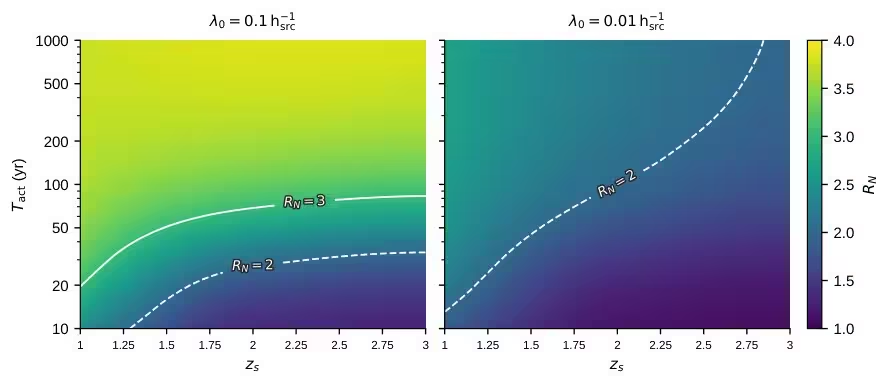
By subtracting the known arrival time delay caused by the cluster, astronomers can measure the precise source-frame separation between two distinct bursts. For a model featuring a galaxy cluster lens like MACS J0717.5+3745 at a lens redshift of 0.54, a five-year monitoring campaign can effectively unlock historical baselines spanning over forty years in the source frame.
Testing Proposed Engine Lifetimes With Statistical Models
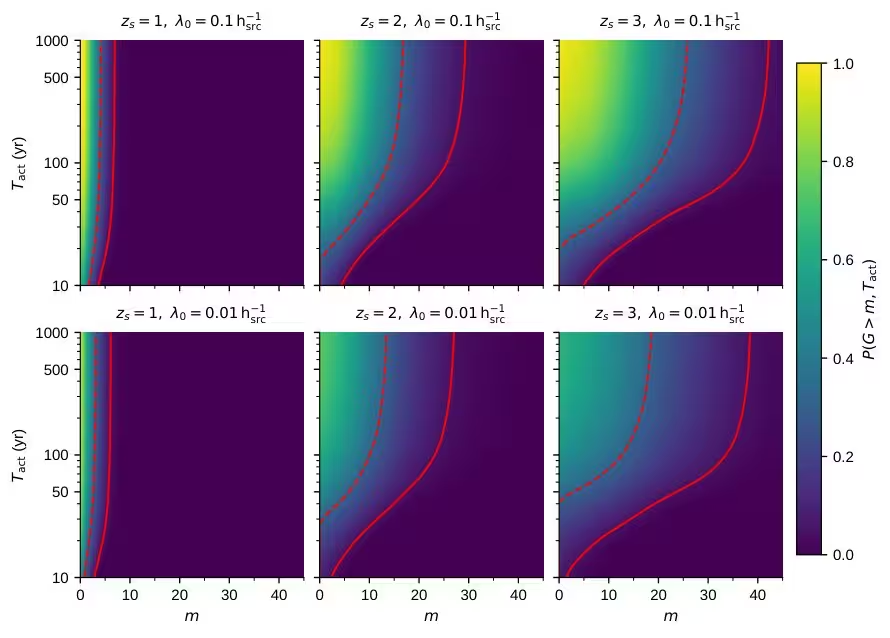
The authors quantified how different activity durations and burst rates influence what instruments can detect. For a source-frame activity episode lasting 100 years at a redshift of 2 and a burst rate of 0.1 per hour, the team found that a five-year observing window yields a 95 percent gain threshold of about 25.6, corresponding to a source-frame span of nearly 42.6 years.
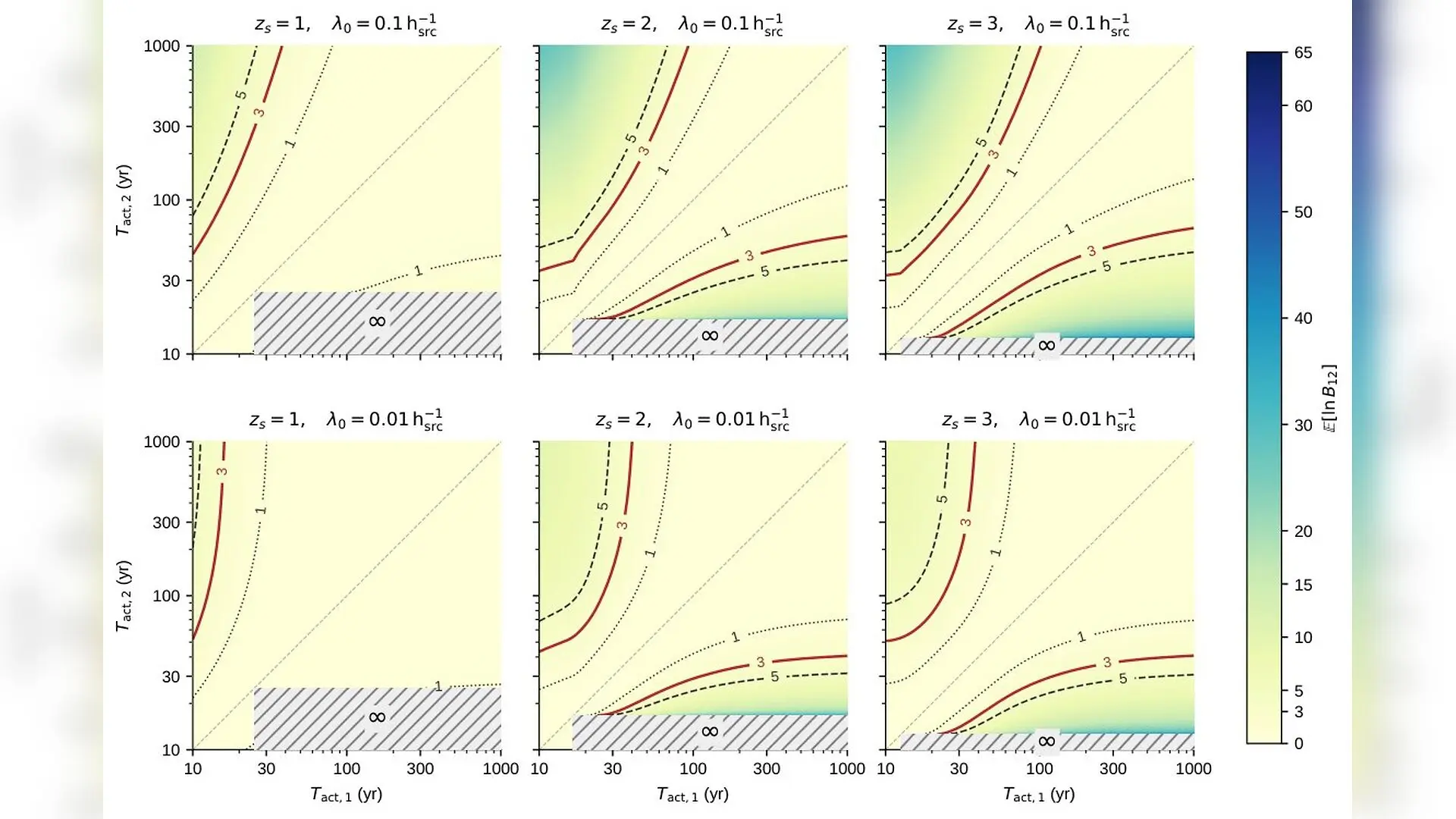
At the population level, the researchers developed a joint likelihood framework combining distinct burst associations with same-burst echoes. This statistical approach allows scientists to test specific activity duration models using a finite catalogue of lens systems. According to their calculations, activity durations differing by an order of magnitude can be distinguished with an expected Bayes factor exceeding 20, providing strong statistical evidence to separate competing theoretical models.
Connecting Burst Activity to Surrounding Plasma Environments
Beyond measuring active lifespans, these lensed epochs offer new ways to study how fast radio burst engines evolve alongside their surrounding environments. Dispersion measures, which track free electrons along the line of sight, and rotation measures, which depend on magnetic fields, can reveal whether a changing propagation environment accompanies burst activity. Because different lensed images sample different paths through the foreground cluster and host galaxy, comparing them helps separate true source evolution from localized plasma effects.
The study also notes that simultaneous observations of persistent radio sources can trace the energy injection and expansion losses of the central engine over decades. Furthermore, predicting the arrival times of later lensed images transforms a serendipitous discovery into a targeted follow-up campaign, opening up multi-wavelength studies of high-energy counterparts.
The authors caution that their models are based on a single cluster lens rather than a complete population, and that two widely separated bursts cannot definitively distinguish continuous activity from intermittent episodes separated by quiescence. Expanding these calculations to other cluster systems will help clarify how fast radio burst engines sustain and eventually terminate their activity.
The study was posted to the arXiv preprint server on November 13, 2026.
This article has been fact checked for accuracy, with information verified against reputable sources. Learn more about us and our editorial process.
Last reviewed on .
Article history
- Latest version
Reference(s)
- Zhou, Huan. “Probing the Activity History of Repeating Fast Radio Bursts with Cluster Lensing.” arXiv.org <http://arxiv.org/abs/2611.17833v1>.
Cite this page:
- Posted by Aisha Ahmed