New Participatory Medicine Framework Aims to Revolutionize Liver Disease Research
By blending citizen science with artificial intelligence, a new collaborative model seeks to bridge the gap between clinical research and the public.
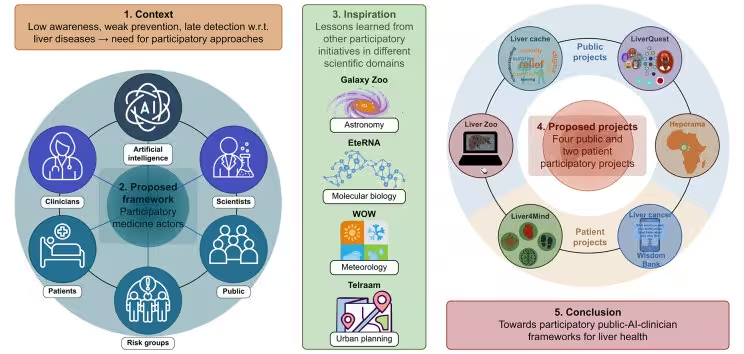
The field of hepatology faces a critical juncture as healthcare costs rise and the burden of liver disease continues to grow. Despite the fact that nine out of ten cases are preventable, public awareness remains alarmingly low, and prevention efforts are consistently underfunded. To address these systemic gaps, a new study published in the JHEP Reports proposes an expanded framework for participatory medicine that leverages the power of citizen science and artificial intelligence to bring the public into the heart of liver health research.
Bridging the Gap with Participatory Science
Citizen science, which involves members of the public in scientific work, has long been a staple in disciplines like astronomy and meteorology. However, its application in medicine has been limited. The authors argue that hepatology is an ideal testing ground for this collaborative approach. By involving not just patients, but also at-risk individuals and the general public, the medical community can gain access to behavioral, environmental, and perceptual insights that are often invisible within the confines of a clinical examination room.
Six Innovative Project Archetypes
The researchers have outlined six conceptual projects that adapt successful citizen science models to the specific needs of liver health:
- Liver Zoo: A staged annotation program for medical imaging that uses public input to help AI identify subtle or unusual patterns that might otherwise be missed by standard diagnostic tools.
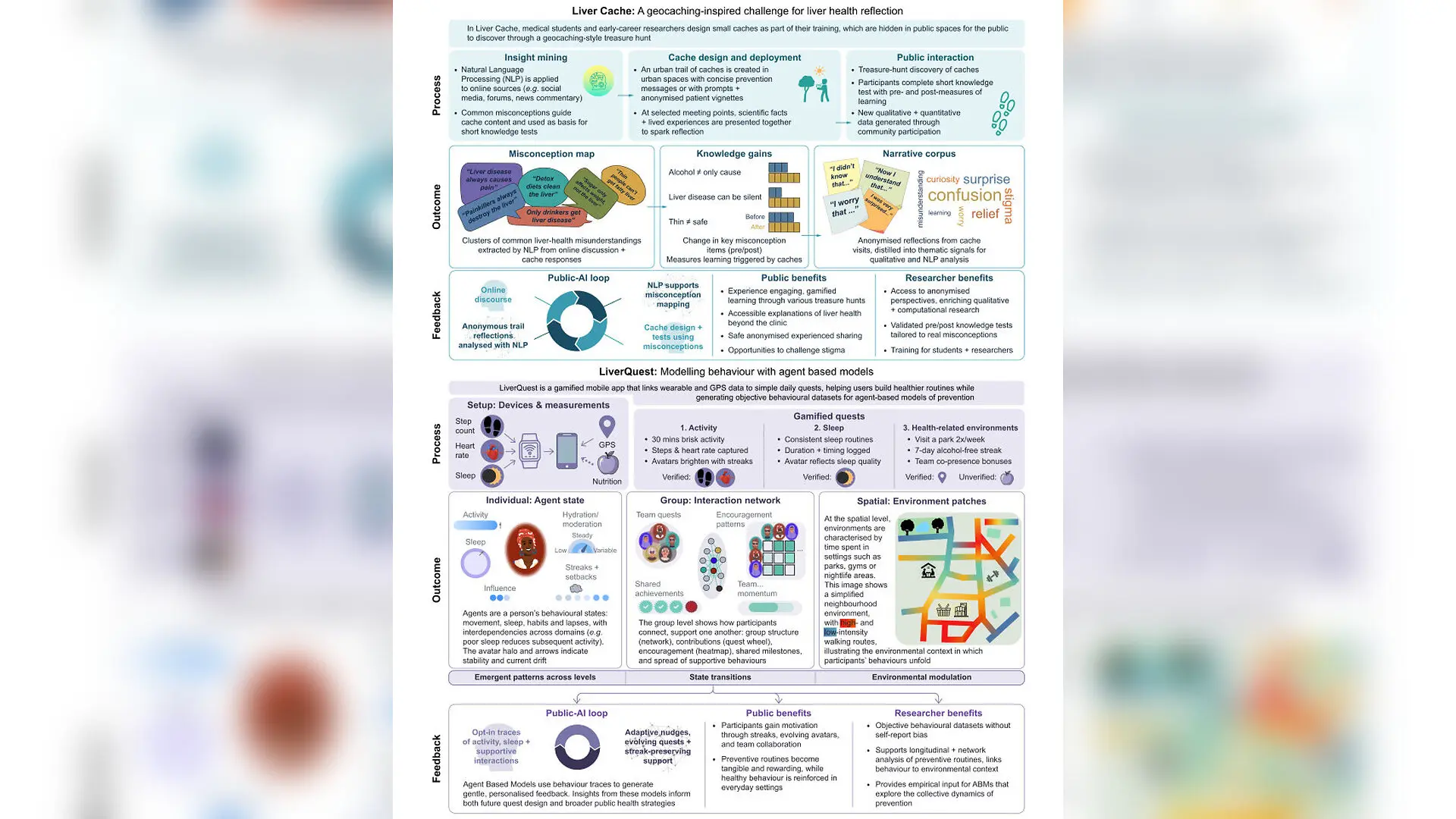
- Liver Cache: A geocaching-inspired initiative that turns urban spaces into discovery sites for liver health information, helping to raise awareness and reduce stigma through community engagement.
- LiverQuest: A gamified mobile app that uses wearable and GPS data to help users build healthier daily routines, while simultaneously generating objective behavioral datasets for research.
- Heporama: A community-based forecasting tool that uses low-cost sensors to monitor aflatoxin exposure in agricultural settings, providing real-time alerts to protect communities from hepatocellular carcinoma.
- Liver Cancer Wisdom Bank: A platform that collects and analyzes patient narratives, linking them to clinical data to provide a deeper understanding of the lived experience of liver cancer.
- Liver4Mind: A patient-led monitoring protocol that combines cognitive testing and wearable data to detect early signs of covert hepatic encephalopathy, a condition often overlooked until it becomes severe.
The Role of the Human-AI Loop
Central to these proposals is the concept of a co-learning loop between humans and artificial intelligence. In these models, AI does not replace human expertise; rather, it acts as a facilitator. For example, in the Liver Zoo project, AI routes simple tasks to volunteers while highlighting unusual cases for expert clinical review. This dynamic interaction allows for the processing of massive datasets while ensuring that human intuition remains at the forefront of discovery.
Overcoming Challenges and Building Trust
The authors acknowledge that implementing these initiatives is not without hurdles. Issues such as data privacy, the risk of stigmatization, and the need for rigorous validation are significant. However, they argue that these challenges are manageable through careful design and a commitment to transparency. By involving the public in the research cycle, these projects aim to counter the perception of prevention as a state-imposed mandate, instead framing it as a collective, community-driven effort.
The ultimate goal of this framework is to move beyond the traditional, top-down model of medical research. By creating a more inclusive and collaborative environment, the hepatology community can bridge the gap between scientific innovation and the people most affected by liver disease. As the authors conclude, patients and the public are not outsiders to liver research, but rather essential partners in building a healthier future.
The research was published in JHEP reports : innovation in hepatology on August 1, 2026.
This article has been fact checked for accuracy, with information verified against reputable sources. Learn more about us and our editorial process.
Last reviewed on .
Article history
- Latest version
Reference(s)
- Laevens, Benjamin P.M.., et al. “The future of hepatology: Preventing liver disease together with the public, scientists and artificial intelligence.” JHEP Reports, vol. 8, no. 8, August 1, 2026, pp. 101846 Elsevier BV, doi: 10.1016/j.jhepr.2026.101846. <https://doi.org/10.1016/j.jhepr.2026.101846>.
Cite this page:
- Posted by Aisha Ahmed