New AI Breakthrough Eliminates Need for Calibration in Super-Resolution Imaging
Astronomy

New AI Breakthrough Eliminates Need for Calibration in Super-Resolution Imaging

By training on diverse simulated data, this new deep-learning model can resolve fine details in everything from cellular structures to distant stars.
By Aisha Ahmed
Published:
Email this Article
New AI Breakthrough Eliminates Need for Calibration in Super-Resolution Imaging
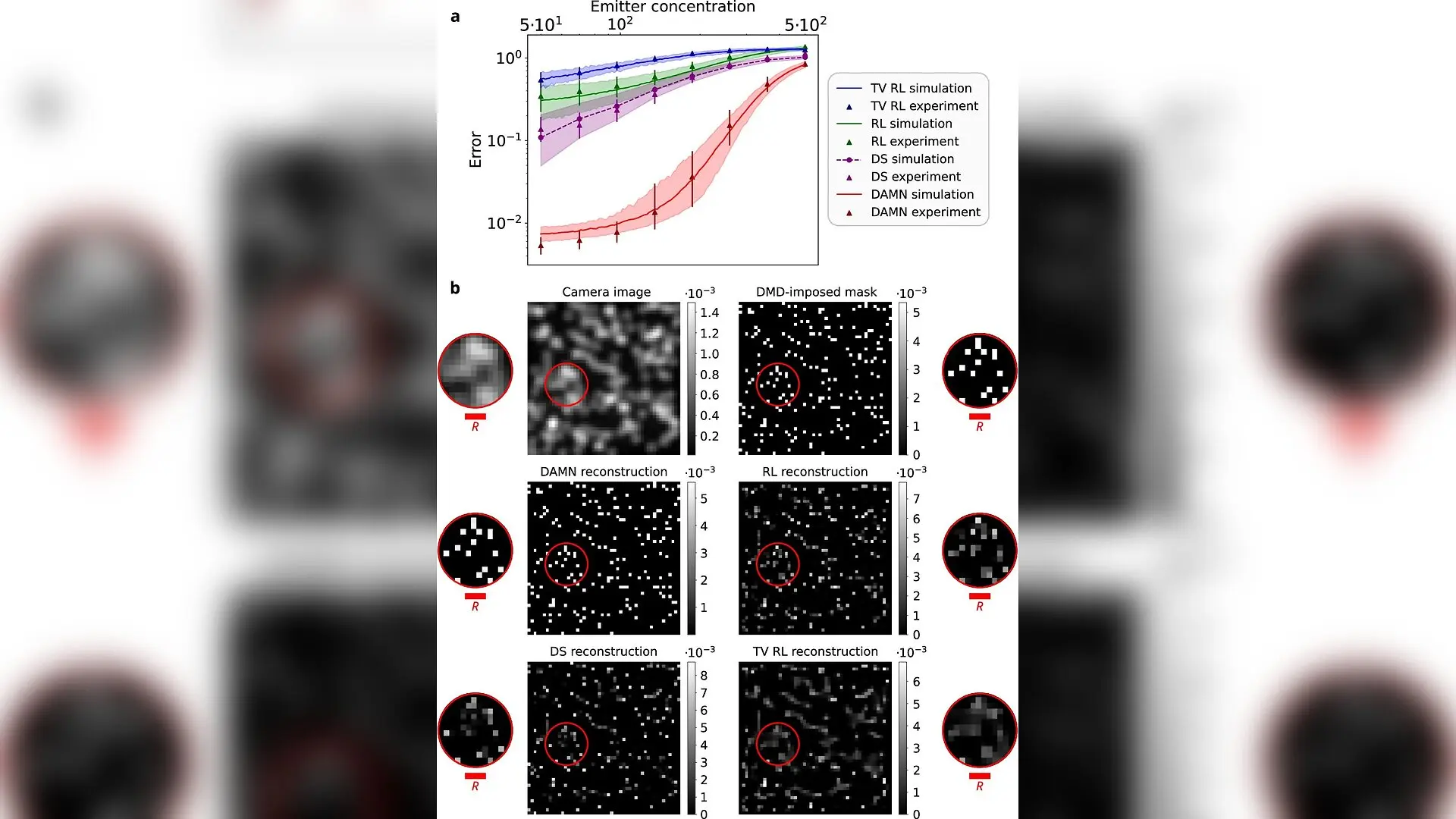
Performance of super-resolution methods on experimental data with the partial control and complete knowledge of ground truth. a The colored dots represent the mean absolute error between the DMD-imposed masks and the super-resolved images reconstructed by each method: Richardson-Lucy (RL, blue), Total variation Richardson-Lucy (TV RL, green), the device-agnostic model (DAMN, red), and individual Deep-STORM models (DS, purple). These errors were evaluated across various emitter concentrations with their 90% confidence intervals. The accompanying continuous lines depict error values derived from simulated data using optical parameters estimated for our imaging system. b A typical camera image containing nearly 200 emitters, alongside its corresponding DMD-imposed mask and reconstructions from each method. The circled areas contain a magnified region for easier visual comparison. It is evident that the DAMN model significantly outperforms the alternative approaches, even in regions where Dominik Vašinka et al. / Nature communications

Super-resolution imaging has become a cornerstone of modern science, allowing researchers to peer into the nanoscale world of cellular biology and capture the distant light of far-off galaxies. However, this transformative power comes with a significant technical hurdle: the requirement for meticulous calibration. To push past the fundamental diffraction limit of light, current methods typically demand detailed, system-specific knowledge of the imaging setup, often necessitating laborious measurements and repeated model retraining whenever conditions change.

A team of researchers has now introduced a solution that could render these bottlenecks a thing of the past. As detailed in a study published in the Nature communications journal, the team has developed a device-agnostic deep-learning framework that eliminates the need for calibration data or explicit knowledge of optical parameters. By shifting the burden of learning from the specific device to a robust, data-driven model, this approach enables rapid, high-quality image reconstruction across a variety of platforms.

Training for Universal Adaptability

The core of this innovation is a device-agnostic modeling network, or DAMN, designed to reconstruct intensity images of point-like emitters. Unlike traditional algorithms that are tightly coupled to a specific point spread function, the DAMN model is trained on an extensive ensemble of numerically simulated data. This training set encompasses a broad spectrum of imaging conditions, including varying emitter power, background noise, and different shapes and widths of the point spread function.
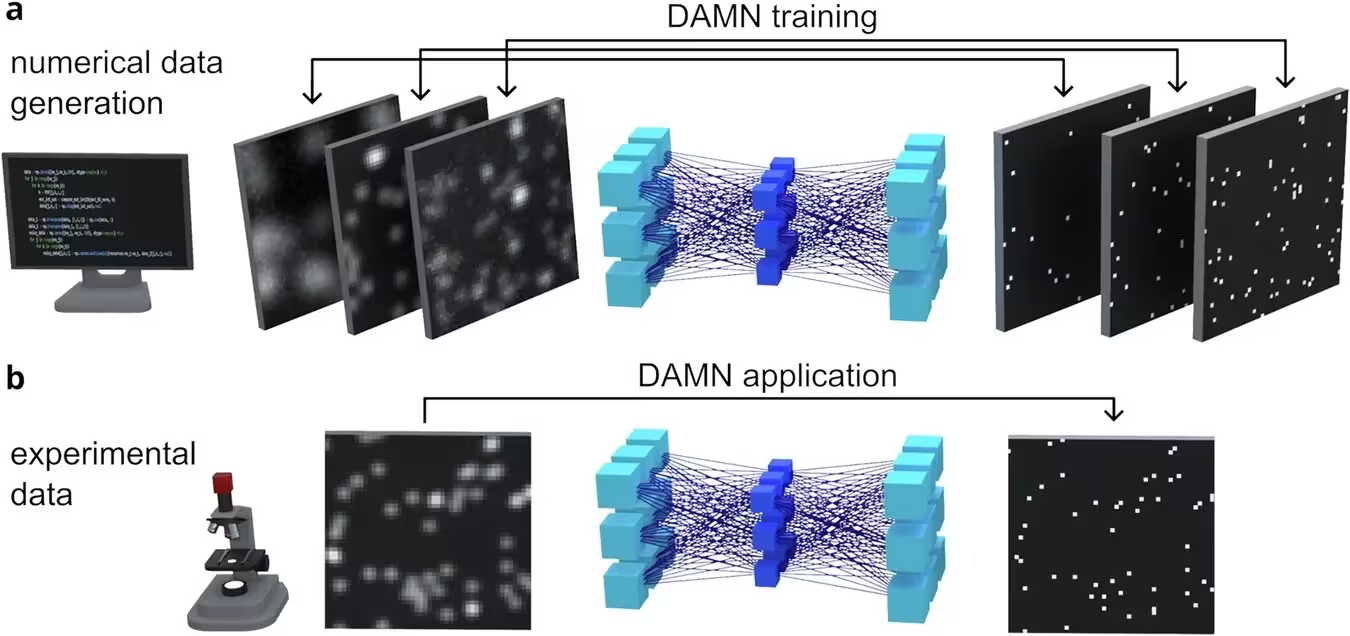
Fig. 1: Schematic representation of the device-agnostic modeling approach and its application to intensity images of point-like emitting sources. a The model is trained using numerically simulated data pairs comprising resolution-limited noisy images alongside their super-resolved counterparts. Each training sample represents a unique combination of underlying optical parameters, such as the width of the point spread function and the signal-to-noise ratio. b Following training, this model is applied to enhance the resolution of experimental images acquired using a real-life imaging system.
Schematic representation of the device-agnostic modeling approach and its application to intensity images of point-like emitting sources. a The model is trained using numerically simulated data pairs comprising resolution-limited noisy images alongside their super-resolved counterparts. Each training sample represents a unique combination of underlying optical parameters, such as the width of the point spread function and the signal-to-noise ratio. b Following training, this model is applied to enhance the resolution of experimental images acquired using a real-life imaging system. Credit: Dominik Vašinka et al. / Nature communications

By exposing the neural network to such a diverse range of synthetic scenarios, the researchers enabled it to generalize across different optical setups. Once the training phase is complete, the model can process a single, resolution-limited camera frame and output a super-resolved image in a single pass. This process requires no additional calibration or prior information about the sample or the optical system, making it inherently more flexible than existing state-of-the-art methods.

Validating Performance Across Scales

To test the versatility of their framework, the researchers conducted a series of rigorous evaluations. In simulated environments, the DAMN model consistently outperformed established techniques, including the Richardson-Lucy deconvolution and the deep-learning-based Deep-STORM, often by up to two orders of magnitude in terms of mean absolute error. Even when faced with optical aberrations that were not explicitly included in the training data, the model demonstrated remarkable robustness.

The team also validated their approach experimentally using a custom-built microscopy setup that allowed for partial control over the spatial distribution of emitters. This experimental data provided a critical bridge between idealized simulations and real-world imaging. In these tests, the DAMN model successfully resolved emitters at distances well below the Rayleigh resolution limit, providing a near-perfect reconstruction of the original patterns without the need for any device-specific tuning.
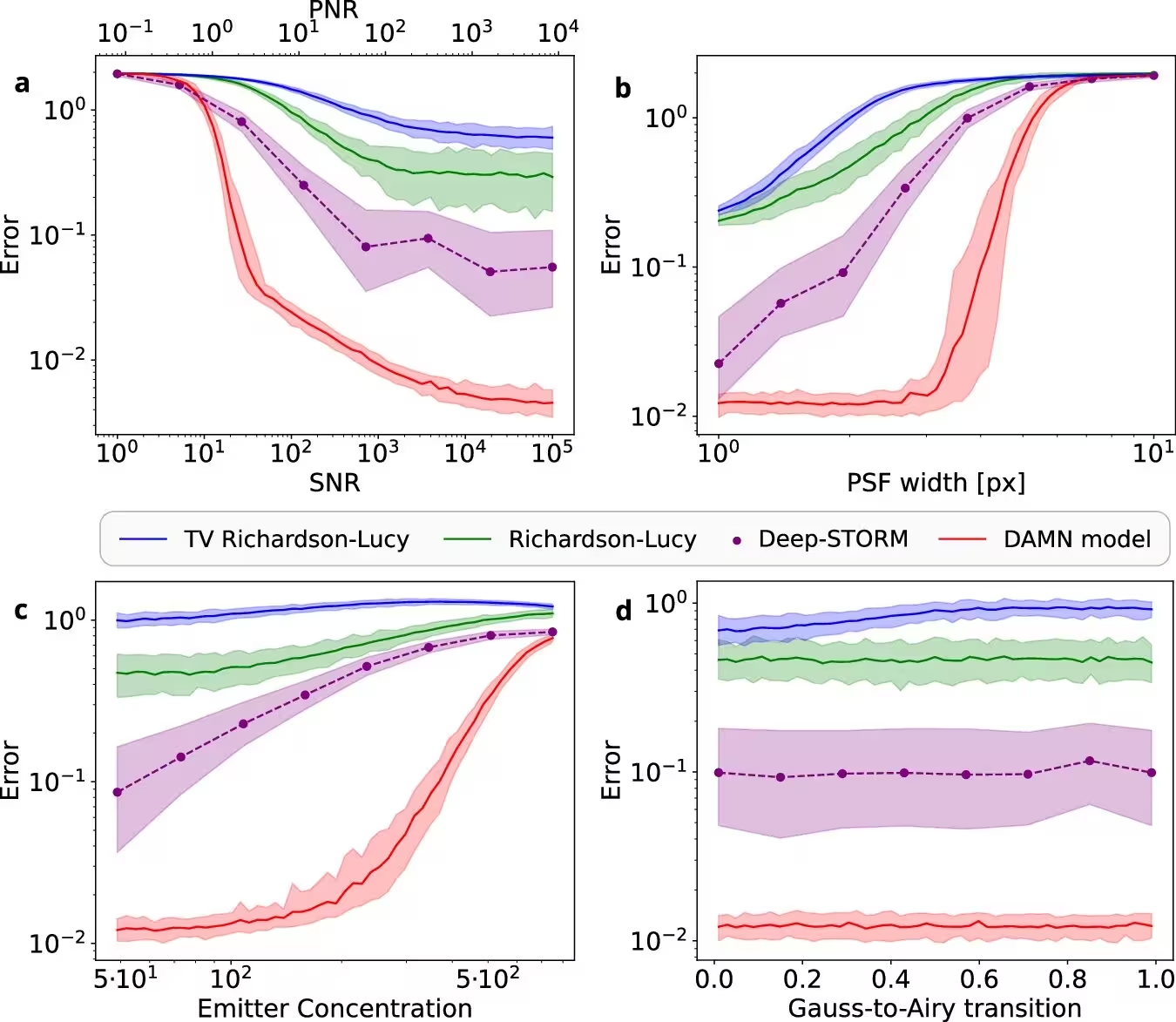
Fig. 2: Performance of super-resolving methods on simulated data. The dependence of the mean absolute error on a the signal-to-noise ratio (SNR), b the width of a Gaussian point spread function (PSF), c the number of emitters in the image (concentration), and d the continuous transition between a Gaussian and an Airy PSF, respectively. The resulting averages of the Richardson-Lucy algorithm (green), its variant with total variation regularization (blue), individual Deep-STORM neural networks (purple), and the DAMN model (red) are accompanied by their 90% confidence intervals over the test set. Panel a is provided with a secondary horizontal axis recalculating the SNR values to the peak-to-noise ratio (PNR). Across all panels, the DAMN model consistently outperforms the alternative approaches by up to two orders of magnitude. The optical parameters not investigated in a given panel have the following values: SNR = 500, the average noise intensity = 10, the concentration = 50, and the Gaussian P
Performance of super-resolving methods on simulated data. The dependence of the mean absolute error on a the signal-to-noise ratio (SNR), b the width of a Gaussian point spread function (PSF), c the number of emitters in the image (concentration), and d the continuous transition between a Gaussian and an Airy PSF, respectively. The resulting averages of the Richardson-Lucy algorithm (green), its variant with total variation regularization (blue), individual Deep-STORM neural networks (purple), and the DAMN model (red) are accompanied by their 90% confidence intervals over the test set. Panel a is provided with a secondary horizontal axis recalculating the SNR values to the peak-to-noise ratio (PNR). Across all panels, the DAMN model consistently outperforms the alternative approaches by up to two orders of magnitude. The optical parameters not investigated in a given panel have the following values: SNR = 500, the average noise intensity = 10, the concentration = 50, and the Gaussian P Credit: Dominik Vašinka et al. / Nature communications

Broadening the Horizon for Imaging

The potential applications for this technology extend far beyond the laboratory bench. The researchers applied their model to real-world datasets, including images of the Andromeda galaxy and high-density tubulin structures from single-molecule localization microscopy. In the case of the Andromeda galaxy, the model was able to resolve a double-star system that was previously blurred into a single point in the original ground-based image. Similarly, in microscopy, the model provided sharper, more accurate reconstructions of cellular structures compared to conventional methods.

By removing the requirement for system-specific calibration, this framework significantly lowers the barrier to entry for high-resolution imaging. It offers a scalable, efficient, and highly adaptable tool that can be applied to any imaging task where generalization is a priority. As the researchers continue to refine their approach, this work lays a solid foundation for a new generation of universal image reconstruction tools that are entirely independent of the underlying hardware, promising to accelerate discovery in fields ranging from material science to deep-space exploration.

The research was published in Nature communications on July 16, 2026.

Fact Checked

This article has been fact checked for accuracy, with information verified against reputable sources. Learn more about us and our editorial process.

Last reviewed on .

Article history

  • Latest version

Reference(s)

  1. Vašinka, Dominik., et al. “From stars to molecules: AI guided device-agnostic super-resolution imaging.” Nature Communications, vol. 17, no. 1, July 16, 2026 Springer Science and Business Media LLC, doi: 10.1038/s41467-026-75584-7. <https://doi.org/10.1038/s41467-026-75584-7>.

Cite this page:

Ahmed, Aisha. “New AI Breakthrough Eliminates Need for Calibration in Super-Resolution Imaging.” BioScience. BioScience ISSN 2521-5760, 10 October 2026. <https://www.bioscience.com.pk/en/subject/astronomy/from-stars-to-molecules-ai-guided-device-agnostic-super-resolution-imaging>. Ahmed, A. (2026, October 10). “New AI Breakthrough Eliminates Need for Calibration in Super-Resolution Imaging.” BioScience. ISSN 2521-5760. Retrieved October 10, 2026 from https://www.bioscience.com.pk/en/subject/astronomy/from-stars-to-molecules-ai-guided-device-agnostic-super-resolution-imaging Ahmed, Aisha. “New AI Breakthrough Eliminates Need for Calibration in Super-Resolution Imaging.” BioScience. ISSN 2521-5760. https://www.bioscience.com.pk/en/subject/astronomy/from-stars-to-molecules-ai-guided-device-agnostic-super-resolution-imaging (accessed October 10, 2026).
End of the article