A Major Part Of The Milky Way May Not Be A Spiral Arm After All
New research suggests the Milky Way’s Norma arm may be a star-forming shock front, challenging our understanding of the galaxy’s complex central bar.
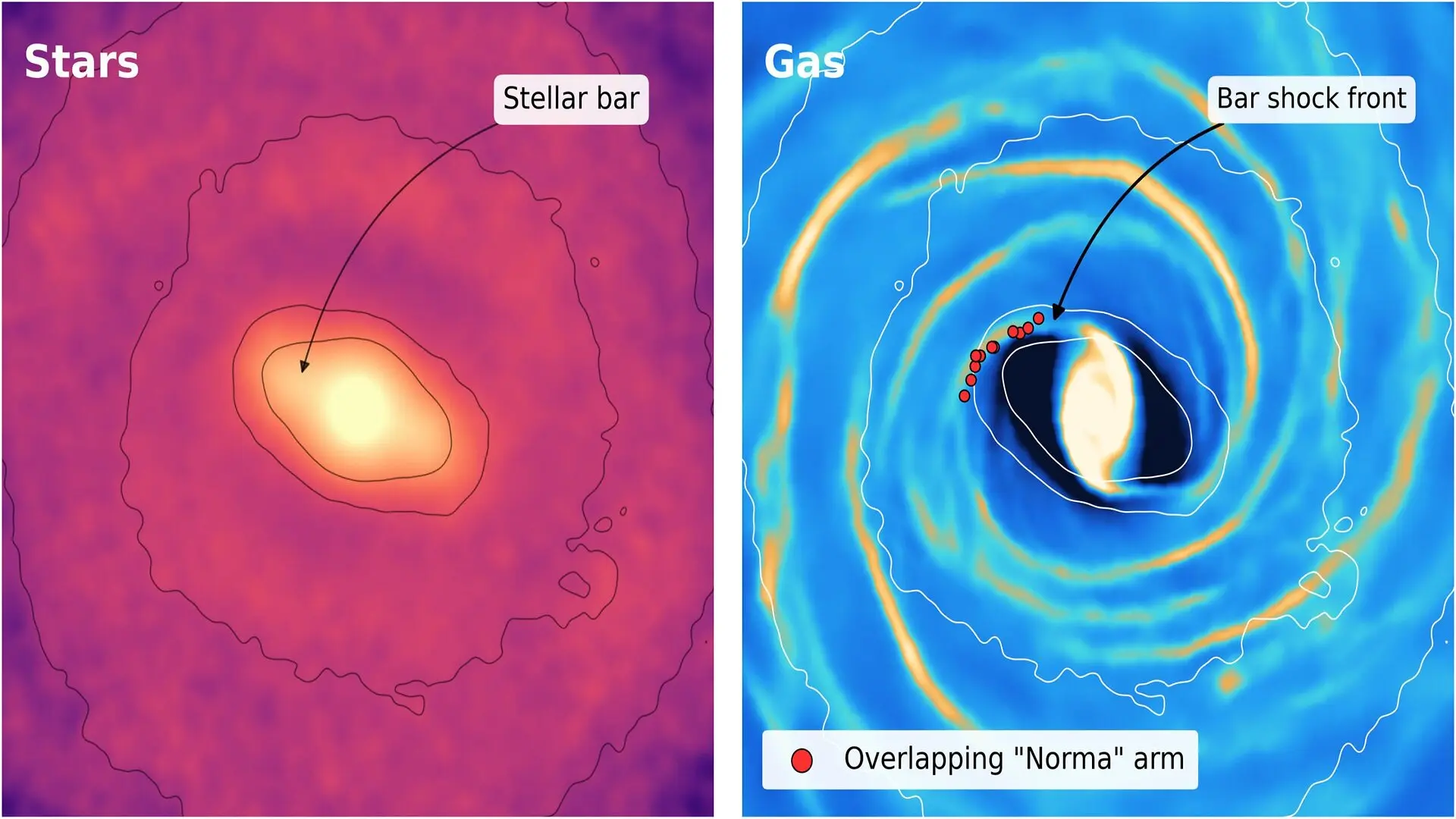
A region of the Milky Way traditionally identified as part of the Norma spiral arm may actually be a high-energy shock front driven by the Galaxy’s massive central bar. New research suggests that stellar nurseries previously attributed to this arm are instead positioned along the leading edge of the bar, where gravitational forces compress gas into new star-forming zones.
The study, led by University of Sydney researcher Hillary Davis and published in Nature Astronomy, utilized complex galaxy simulations to re-evaluate the architecture of our galactic core. By aligning these simulations with microwave data from young stellar regions, the team demonstrated that the observed star formation is consistent with the dynamics of a rotating bar rather than the outward reach of a spiral arm.
Gravity’s Role in Shaping the Galactic Core
The Milky Way’s central bar is not a static structure; it rotates, acting as a gravitational engine that redirects gas flows throughout the inner galaxy. As this gas encounters the bar, it often forms distinct lanes of dense material. While astronomers have long known that such compression can trigger star formation, the process is delicate. In many barred galaxies, the turbulence generated by these shocks often suppresses the birth of new stars rather than fostering it.
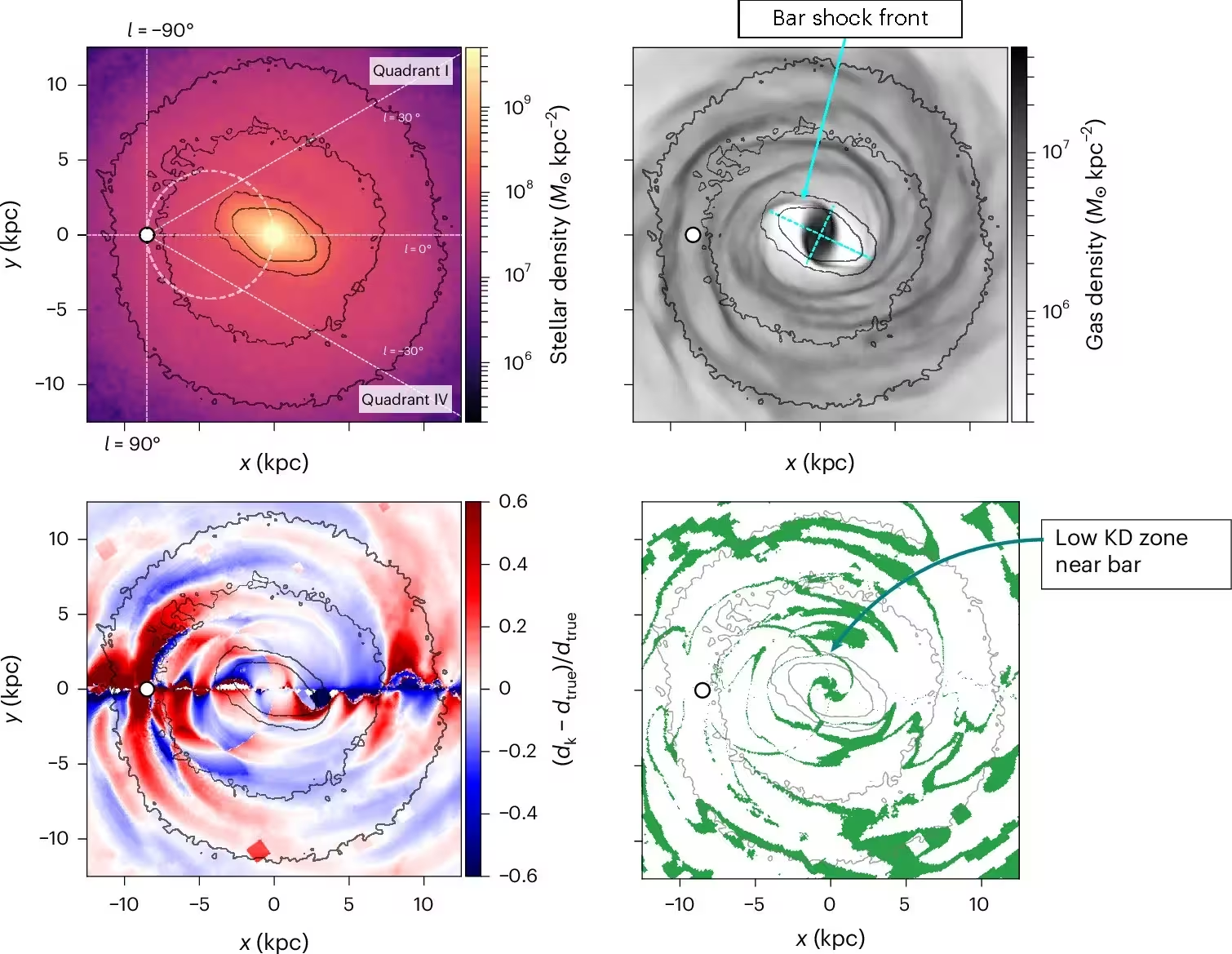
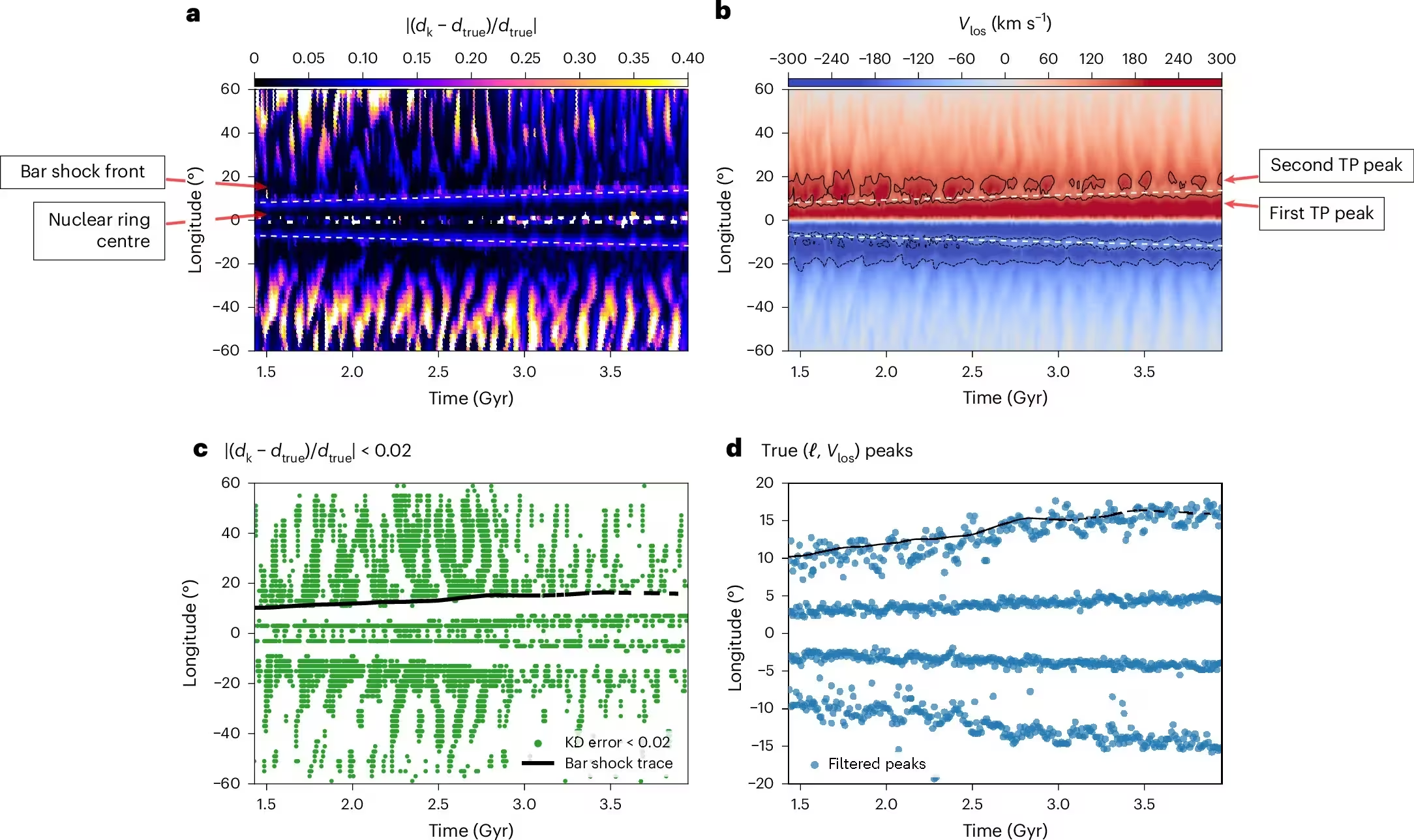
The Milky Way appears to be an outlier. By comparing the locations of young stellar regions—marked by masers, which act as cosmic microwave lasers—with simulated gas patterns, the researchers found that active star formation is occurring exactly where the bar’s shock front is most intense. This suggests that the environment within our galaxy’s bar is uniquely suited to overcome the typical disruptive effects of shock-front turbulence.
Reframing the Galactic Map
Mapping the Milky Way from an internal vantage point is notoriously difficult, as interstellar dust and overlapping structures frequently obscure our view. Previous studies, including those using the BeSSeL Survey and Japan’s VERA project, had associated maser-detected star-forming regions with the Norma arm. This new interpretation suggests that those markers were misidentified because they trace the curvature of the bar’s shock front rather than the trajectory of a spiral structure.
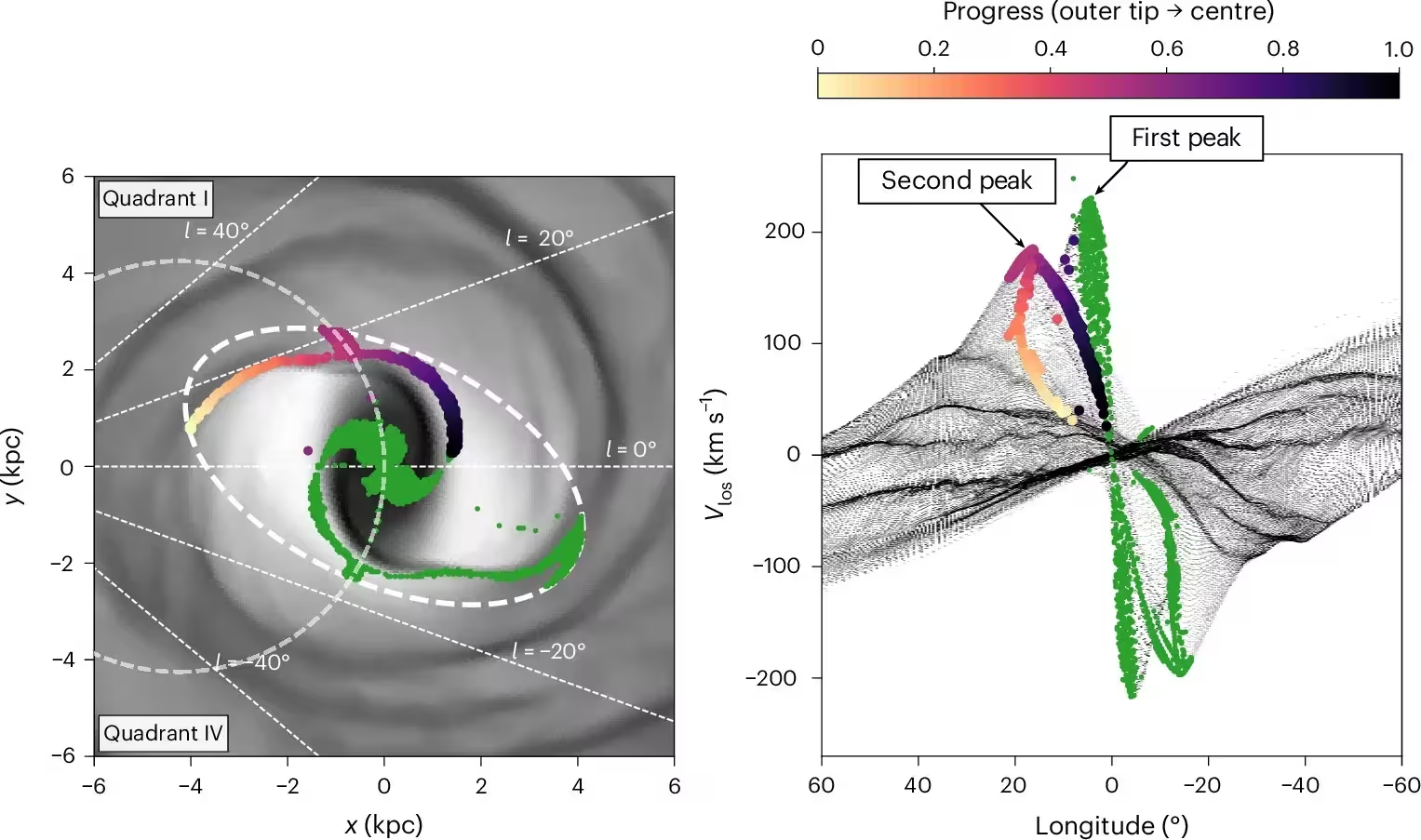
To validate this, the researchers modeled a galaxy over a period of 4.3 billion years, focusing on a snapshot where a well-defined bar had formed. They specifically looked for regions where gas velocity patterns aligned with the predicted shock locations. The model effectively accounted for the observed stellar nurseries, suggesting that the bar exerts a much more profound influence on the inner galaxy’s star-birth cycle than previously recognized.
Understanding the Bar’s Geometry
The findings offer a fresh estimate for the size and behavior of the Milky Way’s central bar. The researchers calculated the bar’s long half-axis to be approximately 14,000 light-years in length, with a shorter axis of about 7,500 light-years. The bar is oriented at an angle of roughly 20 degrees relative to the line connecting the Sun and the Galactic center, rotating at a measured pace of 40 kilometers per second per kiloparsec.
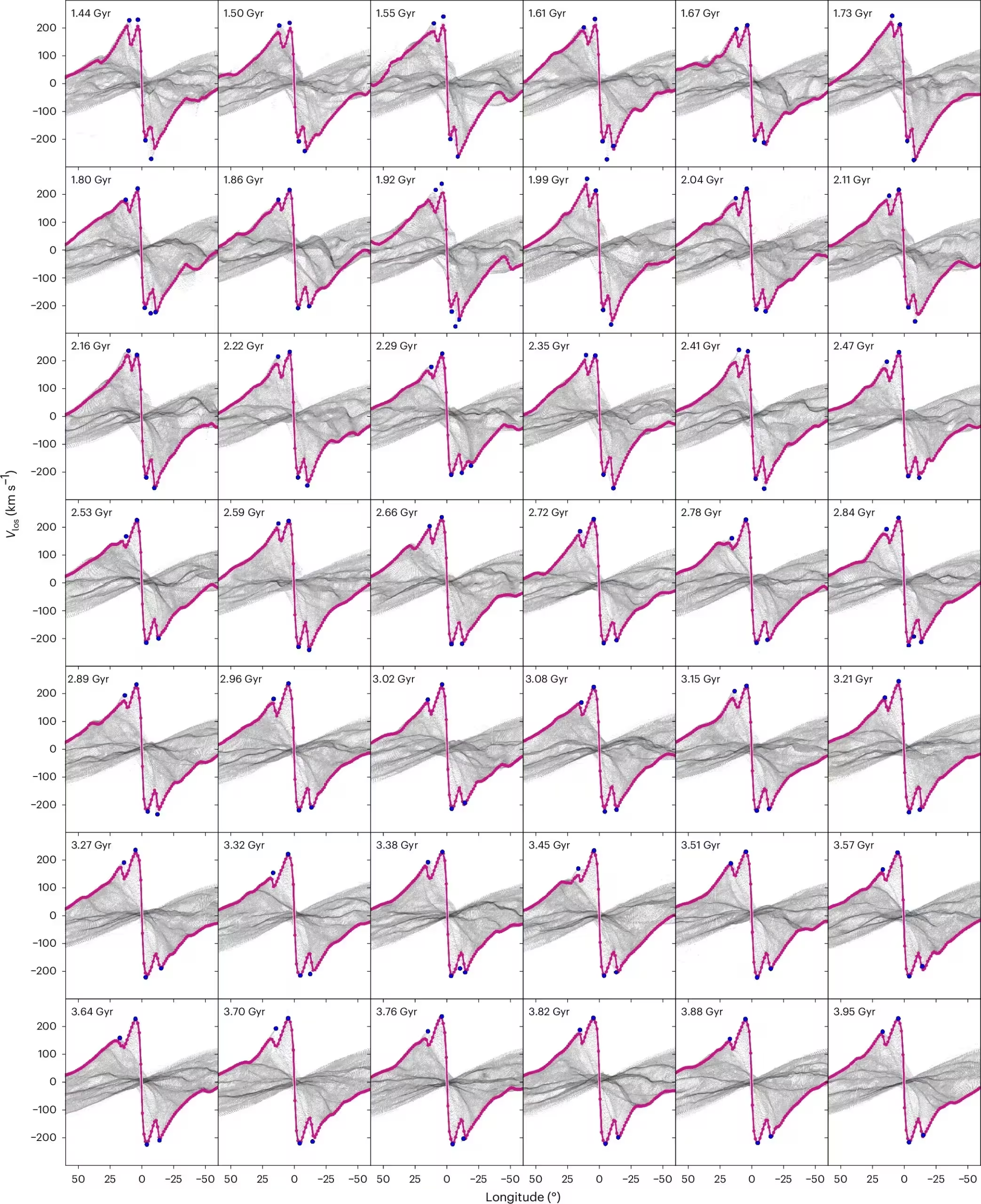
While this model provides a compelling alternative to the spiral arm hypothesis, the team emphasizes that this does not necessarily mean the entire Norma arm is a phantom structure. Instead, the study highlights the complexity of the inner galaxy, where bar-driven shocks and spiral arms may interact in ways that are difficult to distinguish from our position within the disk. Future observations will be required to clarify how these stellar nurseries connect to larger galactic structures and why our bar is so effective at sustaining star formation.
Further Reading on Galactic Evolution
- NGC 1433 (MIRI Image): Webb’s infrared view provides an external comparison for the gas and dust structures surrounding a barred galaxy’s center. (NASA, February 2023)
- NASA’s Webb Reveals Intricate Networks of Gas and Dust in Nearby Galaxies: This official observing report explains how infrared imaging reveals material associated with star formation in nearby galaxies. (NASA, February 2023)
- Trigonometric Parallaxes of High-mass Star-forming Regions: Our View of the Milky Way: Reid and colleagues compile maser distances and motions used to trace Galactic structure, including the Norma region reconsidered here. (The Astrophysical Journal, November 2019)
- The Galaxy in Context: Structural, Kinematic, and Integrated Properties: This review surveys the Milky Way’s major components and the uncertainties involved in measuring their structure and motion. (Annual Review of Astronomy and Astrophysics, September 2016)
- Trigonometric Parallaxes of High Mass Star Forming Regions: The Structure and Kinematics of the Milky Way: An earlier maser survey establishes the distance-measurement approach behind modern maps of the Galaxy’s star-forming regions. (The Astrophysical Journal, March 2014)
This article has been fact checked for accuracy, with information verified against reputable sources. Learn more about us and our editorial process.
Last reviewed on .
Article history
- Latest version
Reference(s)
- Davis, Hillary. “The nature of the Norma arm as a bar-driven star-forming shock front - Nature Astronomy.”, November 20, 2026, pp. 1-12. Nature, doi: 10.1038/s41550-026-03010-5. <https://www.nature.com/articles/s41550-026-03010-5>.
- McCoy, Marty. “NGC 1433 (MIRI Image) - NASA Science.”, February 16, 2023 NASA <https://science.nasa.gov/asset/webb/ngc-1433-miri-image/>.
- McCoy, Marty. “NASA’s Webb Reveals Intricate Networks of Gas and Dust in Nearby Galaxies - NASA Science.”, February 16, 2023 NASA <https://science.nasa.gov/missions/webb/nasas-webb-reveals-intricate-networks-of-gas-and-dust-in-nearby-galaxies/>.
- Reid, M. J.., et al. “Trigonometric Parallaxes of High-mass Star-forming Regions: Our View of the Milky Way.” The Astrophysical Journal, vol. 885, no. 2, November 7, 2019, pp. 131 American Astronomical Society, doi: 10.3847/1538-4357/ab4a11. <https://doi.org/10.3847/1538-4357/ab4a11>.
- Bland-Hawthorn, Joss., et al. “The Galaxy in Context: Structural, Kinematic, and Integrated Properties.” Annual Review of Astronomy and Astrophysics, vol. 54, no. 1, September 19, 2016, pp. 529-596. Annual Reviews, doi: 10.1146/annurev-astro-081915-023441. <https://doi.org/10.1146/annurev-astro-081915-023441>.
- Reid, M. J.., et al. “TRIGONOMETRIC PARALLAXES OF HIGH MASS STAR FORMING REGIONS: THE STRUCTURE AND KINEMATICS OF THE MILKY WAY.” The Astrophysical Journal, vol. 783, no. 2, February 24, 2014, pp. 130 American Astronomical Society, doi: 10.1088/0004-637X/783/2/130. <https://doi.org/10.1088/0004-637X/783/2/130>.
Cite this page:
- Posted by Karan Das