Eighty Four Percent of Massive Stars in Young Clusters Are Surprisingly Pulsing Like Clocks
New space telescope observations reveal universal stellar tremors and challenge how astronomers detect binary star systems in crowded cosmic nurseries.
Nearly every single massive star in four young cosmic nurseries is pulsing like a giant heartbeat, according to an extensive new analysis of space telescope data.
An international team of researchers investigated 82 hot, luminous B-type stars across four young Galactic open clusters, ranging in age from 15 million to 30 million years old. By analyzing high-precision observations from the Transiting Exoplanet Survey Satellite (TESS), the authors report that pulsations are a universal trait among young massive stars rather than a rare anomaly.
How Do Space Telescopes Capture Stellar Tremors in Crowded Clusters?
Open clusters provide ideal natural laboratories because their constituent stars share the same age and chemical composition. However, observing individual stars within these dense stellar groups poses major technical hurdles due to overlapping light and large pixel sizes on spacecraft cameras.
To overcome this, lead researcher Federica Nardini and colleagues at Newcastle University utilized advanced light curve extraction techniques, including simple aperture photometry and point-spread-function fitting that accounts for spacecraft drift and nearby neighbors. Out of the initial sample, the team successfully extracted reliable light curves for 63 stars that suffered from minimal optical contamination.
The study is available on the arXiv preprint server and details how these refined photometric methods allowed astronomers to classify stellar variability with unprecedented precision.
What Types of Pulsations Dominate Young Massive Stars?
Among the analyzed stars with clean data, about 84 percent exhibited clear signs of pulsational variability. The researchers classified these pulsating objects into several distinct categories based on their frequency spectra and spectral types.
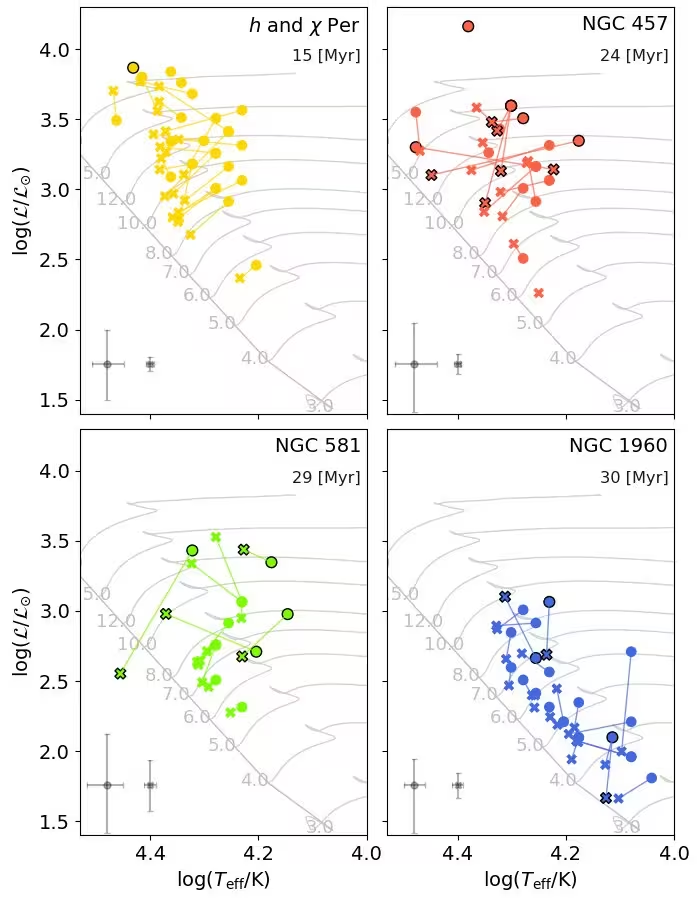
The most common category identified by the team was beta Cephei stars, which are luminous objects showing short-period pressure and gravity modes. A total of 29 stars fell into this group, spanning masses from about five to 25 times the mass of the Sun. Furthermore, all classical Be stars in the sample, which are rapidly rotating objects surrounded by gas disks, displayed distinct pulsation patterns.
Why Do Stellar Tremors Rewrite Binary Star Statistics?
Combining the new space photometry with previous multi-epoch ground-based spectroscopy allowed the team to test whether internal stellar pulsations can mimic the telltale signs of binary star systems. Astronomers traditionally rely on a velocity shift threshold of 20 kilometers per second to flag orbiting companions.
However, the new findings suggest that rapid rotation and non-radial pulsations in Be stars can cause periodic spectral variations that masquerade as binary orbits. By reclassifying two pulsing Be stars as single objects, the authors show that standard velocity thresholds can lead to false positives and may need to be raised for certain fast-rotating stellar populations.
Despite these adjustments, the overall data confirm that the vast majority of massive stars in young clusters live in binary pairs. These findings provide vital constraints for theoretical models of stellar evolution and prepare the ground for future dedicated space missions targeting dense stellar environments.
The study was posted to the arXiv preprint server on November 20, 2026.
This article has been fact checked for accuracy, with information verified against reputable sources. Learn more about us and our editorial process.
Last reviewed on .
Article history
- Latest version
Reference(s)
- Nardini, Federica. “Characterisation of B-type stars in four young Galactic open clusters. II. Photometric variability with TESS and identification of pulsating stars.” arXiv.org <http://arxiv.org/abs/2611.27680v1>.
Cite this page:
- Posted by John Williams