Scientists Have Created a Massive Virtual Simulation of the Early Universe
A massive new simulation of the early universe is providing astronomers with groundbreaking insights into the formation of galaxies and cosmic evolution.
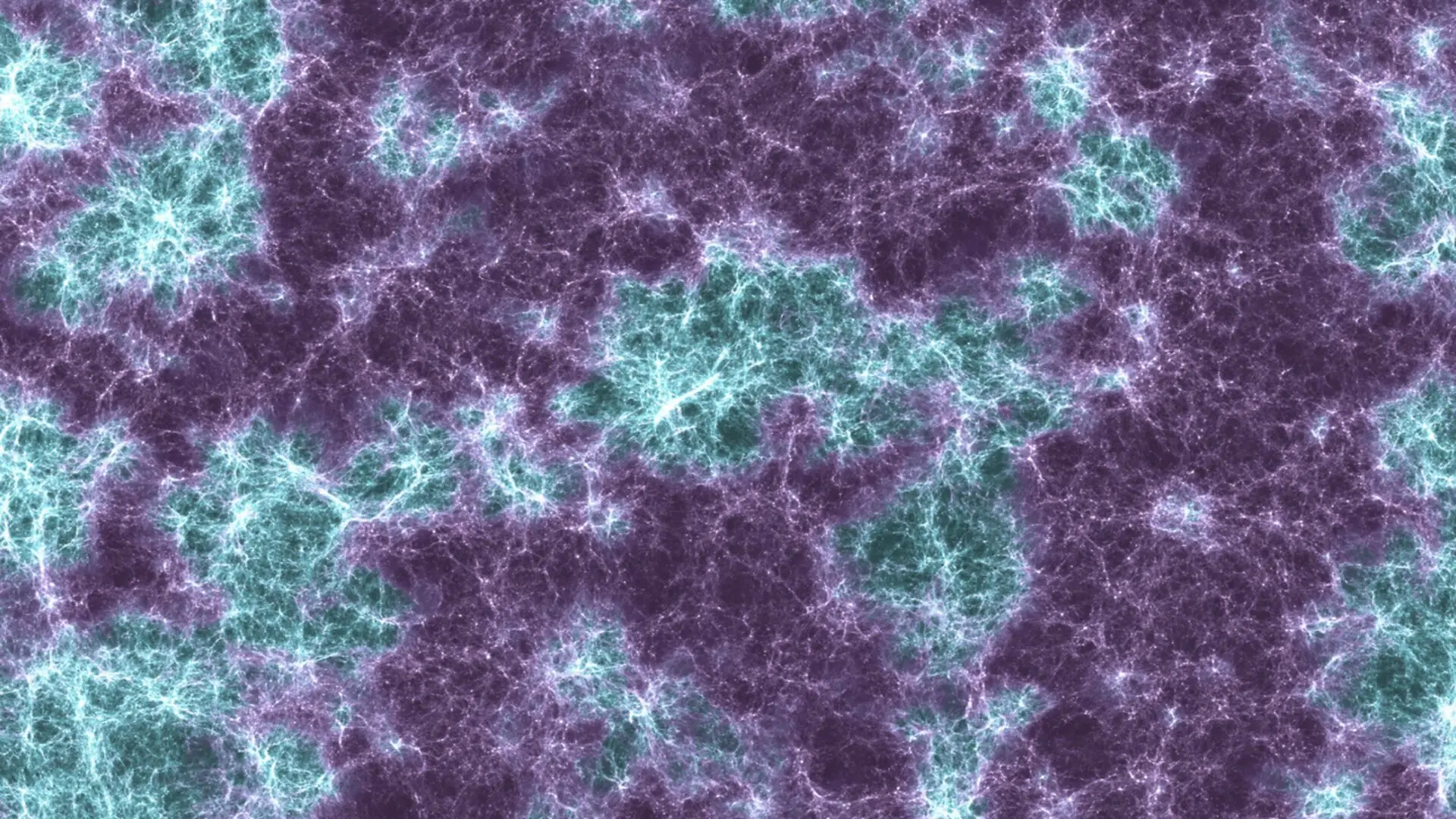
Astrophysicists have unveiled an ambitious new map of the infant universe, successfully reconstructing the first 2 billion years of cosmic history in one of the most comprehensive simulations ever designed. Known as Lumina, the high-resolution model tracks the genesis of early galaxies and the profound chemical transformation of hydrogen and helium across a massive swath of space. The findings, published inMonthly Notices of the Royal Astronomical Society, provide a critical diagnostic tool for researchers seeking to interpret the unprecedented data currently flowing from the James Webb Space Telescope (JWST).
A Massive Digital Window into the Early Universe
Simulating the dawn of the cosmos requires more than just mapping the positions of the first galaxies. Scientists must account for a complex interplay of variables, including the gravitational influence of dark matter, the hydrodynamic behavior of ordinary gas, and the intense, transformative radiation emitted by the first luminous objects. These elements are deeply codependent, creating a dynamic physical system that evolves alongside the expansion of the universe itself.
To capture this complexity, researchers at the Center for Astrophysics | Harvard & Smithsonian developed Lumina as a state-of-the-art cosmological radiation-hydrodynamics model. By simulating a volume measuring 1.5 billion light-years on each side, the team has produced a model more than 100 times larger in volume than previous simulations of comparable detail. This expanded scale is essential, as the early universe was not a collection of isolated galaxies but a sprawling, interconnected cosmic web where radiation from dense stellar clusters traveled vast distances to heat and alter intergalactic gas.
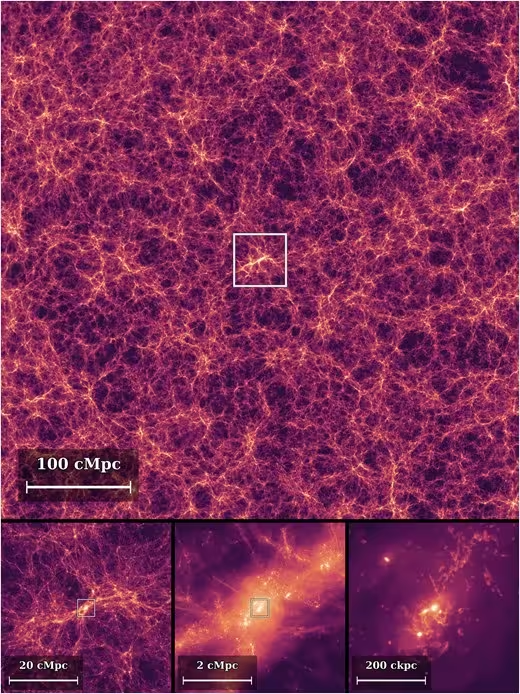
Mapping the Era of Reionization
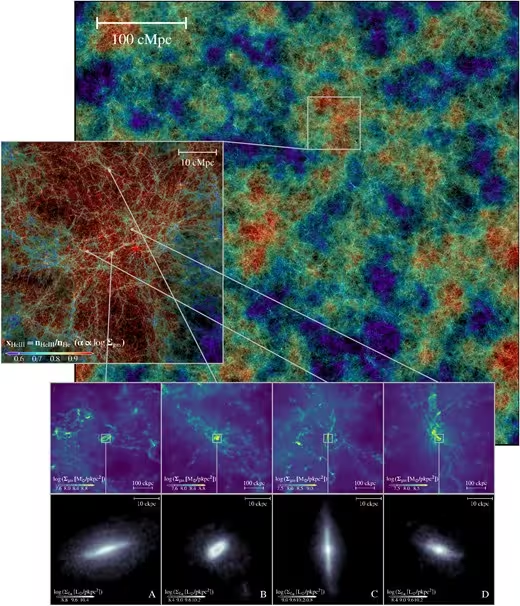
A primary goal of the Lumina project is to chart the period known as cosmic reionization. Following the Big Bang, the universe was filled with neutral hydrogen gas. As the first stars and galaxies ignited, their energetic output stripped electrons from these atoms, effectively ionizing the universe. Lumina captures this transition, along with the distinct, later history of helium ionization, which is closely linked to the intense radiation produced by quasars and supermassive black holes.
By coupling the evolution of these gases with the growth of luminous structures, Lumina allows scientists to see how radiative heating alters the gas supply available for future star formation. This feedback loop is essential for understanding the physical conditions that dictated the lifecycle of early galaxies.
“We feel incredibly fortunate to be building simulations like Lumina,” says co-author Aaron Smith, an assistant professor of physics at the University of Texas at Dallas. “For the first time, we can follow along as both hydrogen and helium changed into their modern form across such an enormous volume of the universe, while still resolving the galaxies and other luminous objects driving that transformation.”
Decoding Observations from the James Webb Space Telescope
The JWST has fundamentally changed astrophysics by peering back to the very first eras of galactic formation. However, interpreting these observations—such as the surprising brightness or density of early galaxies—requires a theoretical baseline. Lumina provides this framework, enabling astronomers to test their models against real-world data.
When the simulated galaxies in Lumina match observations from Webb, it bolsters our understanding of the early universe. When they diverge, it points toward necessary refinements in our theories regarding star formation, gas dynamics, or how radiation escapes from galaxies into the intergalactic medium.
“With JWST, the early universe has become an exciting new frontier in astrophysics,” says lead author Oliver Zier, an ITC fellow at the Center for Astrophysics | Harvard & Smithsonian. “To understand what we are seeing with this telescope, we need to translate our theories into detailed predictions. After several years of work, with plenty of ups and downs, it is incredibly rewarding to see the simulation results and watch our predictions come to life in video.”
This article has been fact checked for accuracy, with information verified against reputable sources. Learn more about us and our editorial process.
Last reviewed on .
Article history
- Latest version
Cite this page:
- Posted by Aisha Ahmed