Astronomers Detect Magnetic Fingerprint of a Gamma‑Ray Burst for the First Time
Astronomers detect first magnetic signature from a gamma-ray burst, revealing the environment around one of the universe’s most powerful explosions.
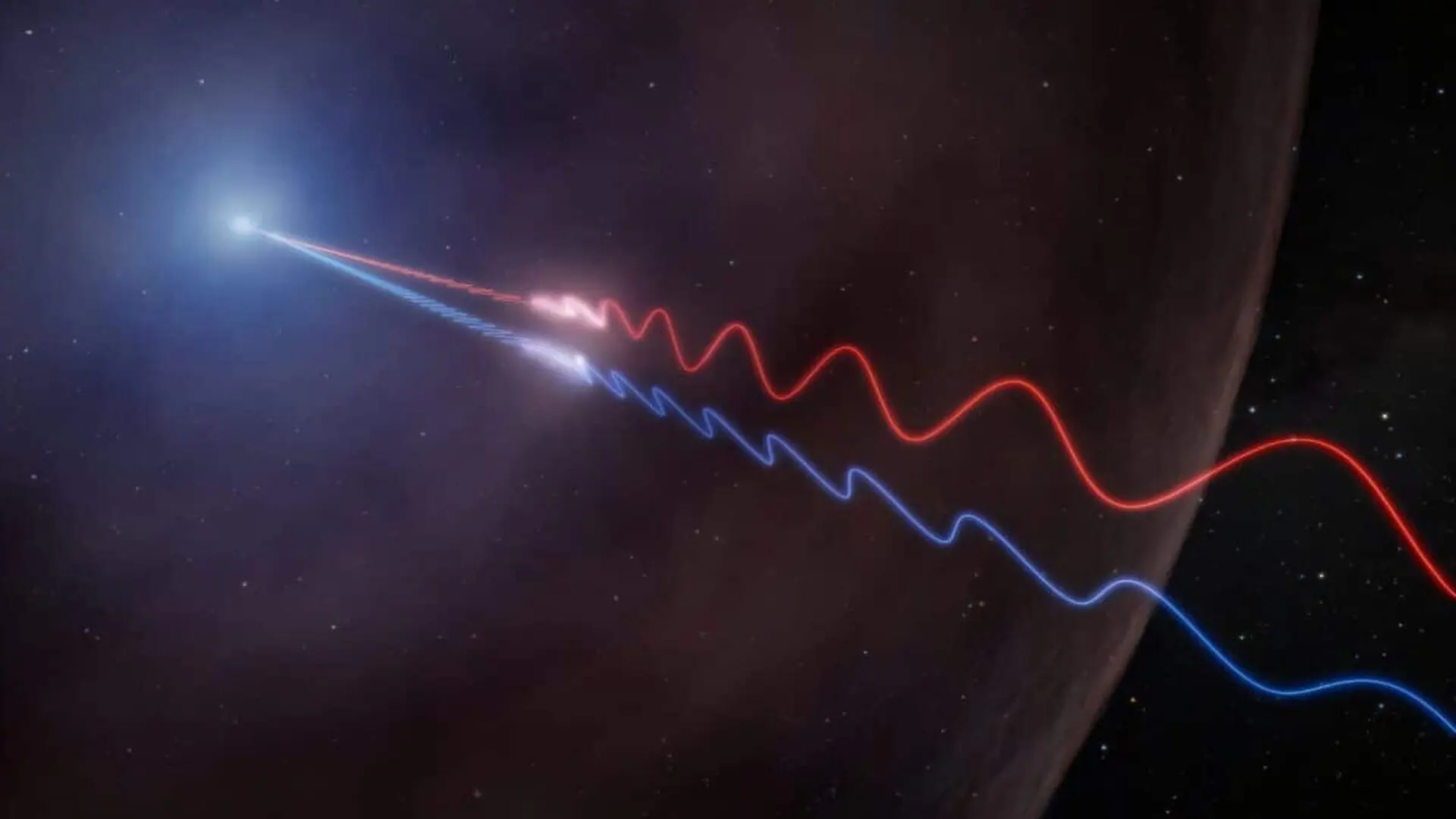
A team of astronomers has captured the magnetic imprint surrounding a gamma‑ray burst afterglow for the first time, unveiling a novel avenue for probing the extreme physics of these cataclysmic events. The finding, posted on arXiv, relied on observations with the National Science Foundation Very Large Array (NSF VLA) and highlights the influence of intense magnetic fields on the surroundings of a dying star’s final blast.
Opening a Fresh Window on the Universe’s Mightiest Flashes
Gamma‑ray bursts (GRBs) rank among the most powerful phenomena known, unleashing in a matter of seconds an energy output comparable to the Sun’s total production over its entire lifespan. These outbursts are tied to tightly collimated jets that travel near light speed, generating afterglows that linger across the electromagnetic spectrum for weeks or months.
For years, researchers have examined GRBs to decipher jet formation and the mechanisms that channel energy outward. Direct measurements of the magnetic fields thought to drive and structure these relativistic streams have remained elusive, as their signatures are typically obscured by the distant radiation emitted during the explosion.
The recent study of GRB 260310A altered this picture. Located relatively nearby in cosmic terms, its radio afterglow shone brighter than any observed in recent decades, permitting a detailed inspection of the emitted radio signal and the identification of a previously unseen characteristic.
Researchers detected a distinct polarization pattern in the radio waves, indicating that the electric field vectors were aligned preferentially. This polarization serves as a direct probe of the magnetic conditions shaping the light as it journeys away from the blast site.
“GRBs are the most powerful explosions in the universe, and magnetic fields are thought to play a central role in powering them, but probing those fields has been extraordinarily difficult,” said Tanmoy Laskar, assistant professor at the University of Utah. “By detecting polarized radio emission, we can now directly measure the magnetic environment of one of the universe’s most violent events. Our new GRB observations allow us to use the universe as our laboratory to test our understanding of how physics operates in such extreme conditions.”
— University of Utah (@UUtah) July 14, 2026
Faraday Rotation Unveils a Hidden Magnetic Landscape
The most striking outcome of the observation was the detection of Faraday rotation, a process whereby magnetic fields twist the polarization angle of light as it traverses magnetized plasma. This effect records the magnetic environment encountered by the radiation between its origin and Earth.
Because the amount of rotation varies with wavelength, measuring the polarization shift across several radio frequencies enables astronomers to infer both the strength and geometry of the intervening magnetic field.
Analysis of the NSF VLA data revealed that the magnetic influence enveloping GRB 260310A far exceeded contributions from the Milky Way or the intergalactic medium. Instead, the signal pointed to a dense, magnetized gas cloud surrounding the progenitor star.
The preprint, posted on arXiv, documents the inaugural direct measurement of Faraday rotation linked to a gamma‑ray burst, offering a fresh diagnostic for probing the environments where massive stars meet their end.
“Previous searches for polarization in GRBs used facilities like the Atacama Large Millimeter/submillimeter Array (ALMA) telescope that measure shorter wavelengths and had to happen early, before the afterglow light faded,” said Collin Christy, a graduate student at the University of Arizona and lead author of the study. “Now, with the NSF VLA, we’ve pushed into the centimeter bands and made the first-ever measurement of Faraday rotation in a GRB. Each new observation reveals another layer of the magnetic story these explosions are telling us.”
Insights into the Birthplaces of Gamma‑Ray Bursts
The magnetic diagnostics also shed light on the locale of GRB 260310A. Evidence suggests the burst erupted within an H II region—a cavity of ionized hydrogen gas forged by the intense radiation and stellar winds of massive young stars.
Such an environment aligns with the prevailing view that many GRBs arise from the catastrophic collapse of exceptionally massive stars, which rapidly exhaust their fuel and launch relativistic jets that pierce the surrounding medium.
Characterizing the surroundings of these explosions helps scientists narrow down the types of progenitor stars capable of producing GRBs and the conditions that foster these extreme outbursts. The new findings bridge the gap between distant radio signatures and the physical properties of the region where the blast originated.
Moreover, the work underscores the unique power of radio observations to uncover information concealed at other wavelengths. While optical and high‑energy data detail the explosion itself, radio polarization reveals the magnetic architecture enveloping the event.
By integrating these complementary perspectives, astronomers can assemble a more comprehensive narrative of massive‑star collapse, jet formation, and the role of magnetic energy in some of the universe’s most violent phenomena.
Prospects for Tracking Cosmic Magnetism with Radio Telescopes
Capturing Faraday rotation in a gamma‑ray burst opens a promising research pathway for investigating relativistic jets and extreme astrophysical settings. Ongoing and future monitoring campaigns could map how magnetic fields evolve as a GRB afterglow expands and dims.
Facilities like the NSF VLA are poised to trace these magnetic structures over time, delivering a dynamic portrait of energy flow in the wake of a cosmic explosion.
“Future monitoring of GRB afterglows with the NSF VLA and other radio telescopes will allow scientists to watch magnetic field structures evolve in real time,” said Dr. Kate Denham Alexander, an assistant professor and Christy’s Ph.D. adviser. “This is a capability that could transform our understanding of how relativistic jets form, how they are powered, and how magnetic energy is released in the most extreme environments the universe has to offer.”
This breakthrough turns magnetic fields from an invisible influence into a measurable quantity, marking a pivotal step forward in GRB research. As next‑generation radio arrays broaden their reach, these distant explosions are set to reveal ever more about the physics governing the universe’s most energetic events.
This article has been fact checked for accuracy, with information verified against reputable sources. Learn more about us and our editorial process.
Last reviewed on .
Article history
- Latest version
Reference(s)
- Christy, Collin. “First Detection of Faraday Rotation in a Gamma-Ray Burst Afterglow: Low Polarization and High Rotation Measure in GRB 260310A Reveal Jet Magnetic Structure and Environment.” arXiv.org <https://arxiv.org/abs/2604.27480>.
Cite this page:
- Posted by Aisha Ahmed