NASA’s Roman Telescope Will Explore Parts of the Milky Way No Planet Hunter Has Studied Before
Astronomers gear up for one of history’s largest planet hunts with NASA’s Roman Telescope launch.
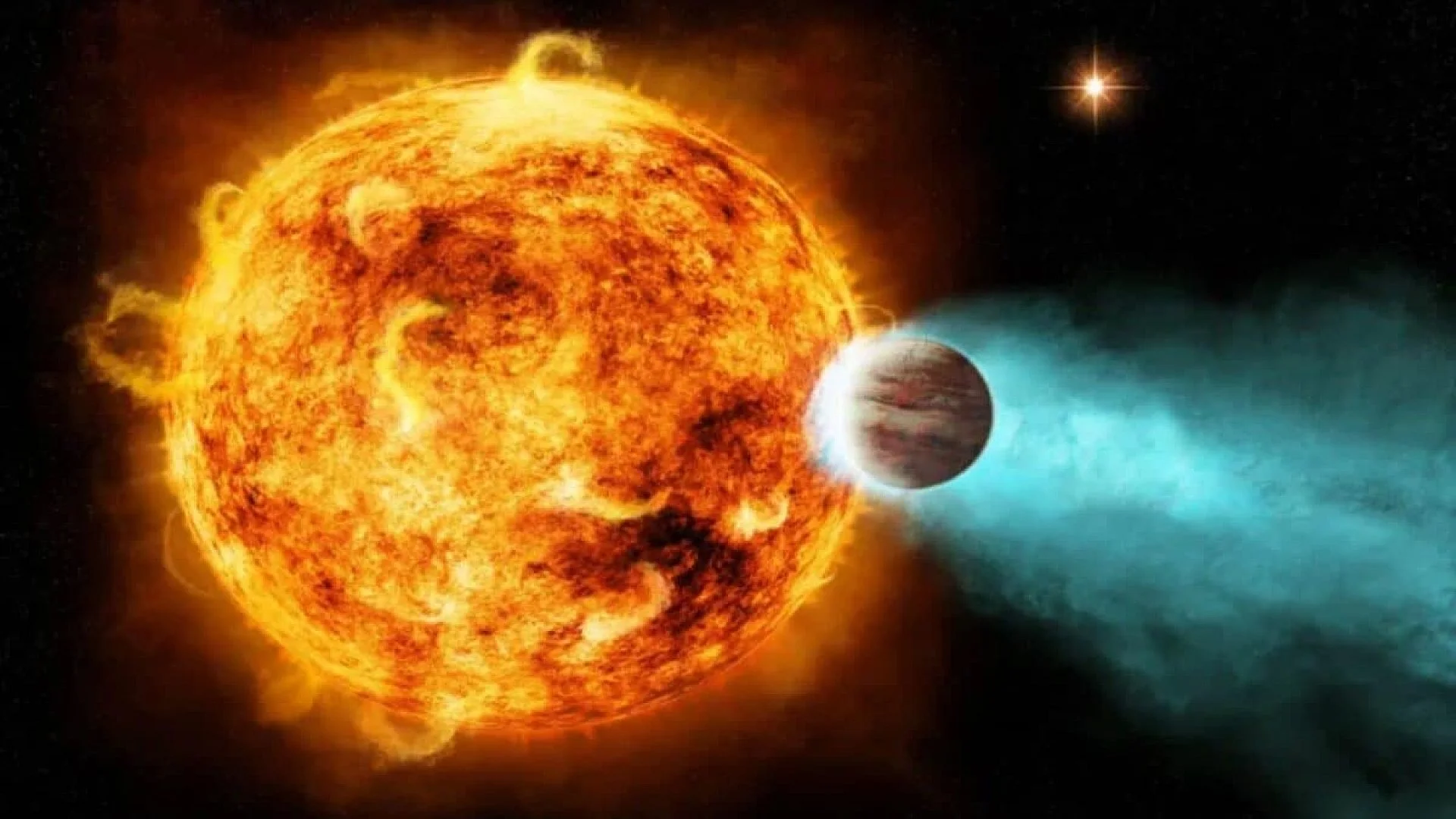
NASA’s Nancy Grace Roman Space Telescope, a next‑generation infrared observatory, is set to widen the search for worlds beyond our own. Engineers estimate the mission could uncover on the order of one hundred thousand previously unknown exoplanets.
Today’s exoplanet inventory lists just over six thousand confirmed planets, most of which orbit stars within a few thousand light‑years of Earth. Roman will push far beyond that familiar neighborhood, probing densely packed stellar fields toward the Milky Way’s core and its far side.
By directing its wide‑field camera at the galactic bulge and the opposite side of the disk, the telescope will explore zones that have received little attention in prior planet‑search programs.
Charting Distant Regions of the Milky Way
“Our galaxy is home to a variety of different environments, but when it comes to hunting for exoplanets, we’ve really only explored one: our own neighborhood,” said Elisa Quintana, an exoplanet researcher at NASA’s Goddard Space Flight Center in Maryland.
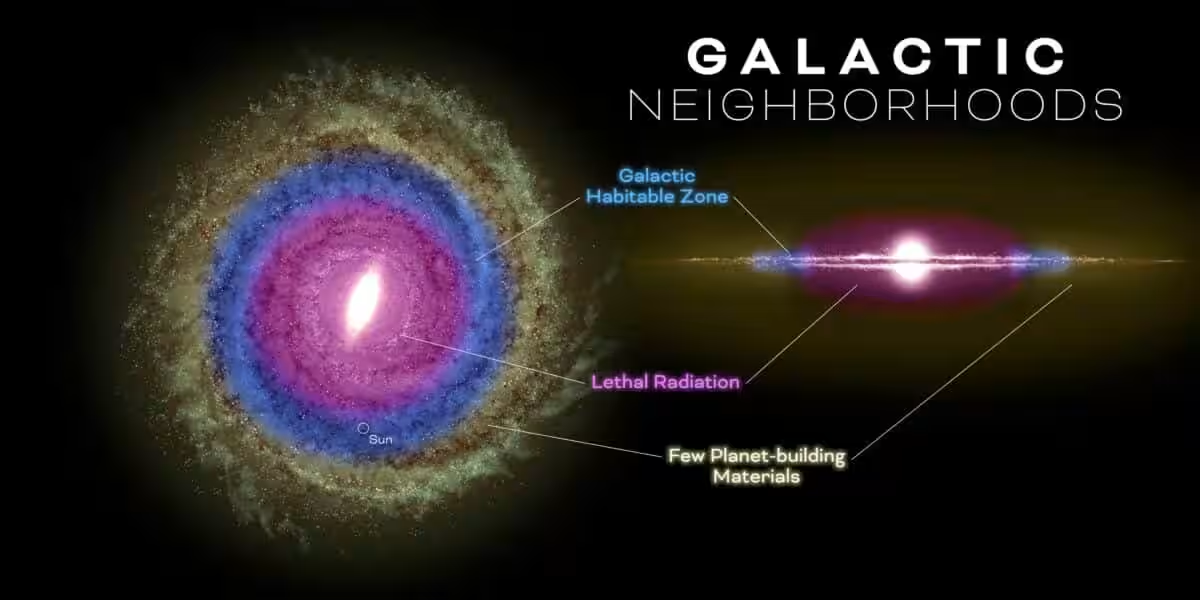
Quintana notes that Roman’s deep‑field observations could reveal how the process of planet formation varies across different parts of the galaxy, potentially identifying stellar environments that preferentially produce certain planet types.
Dual Techniques for Uncovering New Worlds
The telescope will monitor millions of stars continuously, looking for minute fluctuations in brightness. One of its primary tools is the transit method, which catches a planet as it passes in front of its host star, briefly dimming the starlight.
Mission analysts predict that transits alone could account for roughly one hundred thousand exoplanet detections, making Roman one of the most prolific planet‑search instruments ever launched.
In addition, Roman will employ gravitational microlensing, a phenomenon where the gravity of a foreground star magnifies the light of a more distant background star. Any planets orbiting the foreground star imprint characteristic signatures on the amplified light curve.
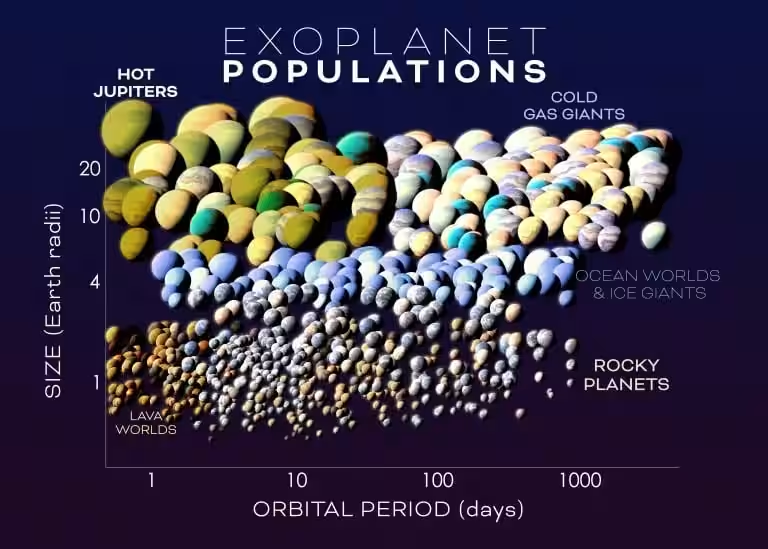
NASA’s projections indicate that microlensing could add more than one thousand additional planets to the census, including bodies comparable in size to Earth and Mars. The technique excels at finding planets that orbit far from their stars, offering a glimpse of planetary architectures similar to our own solar system.
By merging the transit and microlensing approaches, Roman aims to produce the most comprehensive inventory of planetary systems ever compiled for the Milky Way.
Linking Stars, Planets and Atmospheres
Beyond tallying new worlds, the mission will investigate how stellar composition influences planet formation. Prior studies have shown a correlation between a star’s heavy‑element content and the likelihood of hosting planets, especially gas giants.
“Stars with more heavy elements tend to host more planets, especially giant ones,” said Robby Wilson, a postdoctoral fellow at NASA Goddard who led a study examining Roman’s expected exoplanet yield.
Also ReadThis Telescope Spent Five Years Mapping the Cosmos and Captured 47 Million Galaxies in the Process
Roman will also gather atmospheric data for thousands of exoplanets. While the James Webb Space Telescope focuses on detailed characterizations of individual targets, Roman’s wide‑field infrared instruments will compile temperature and climate trends across a much larger sample.
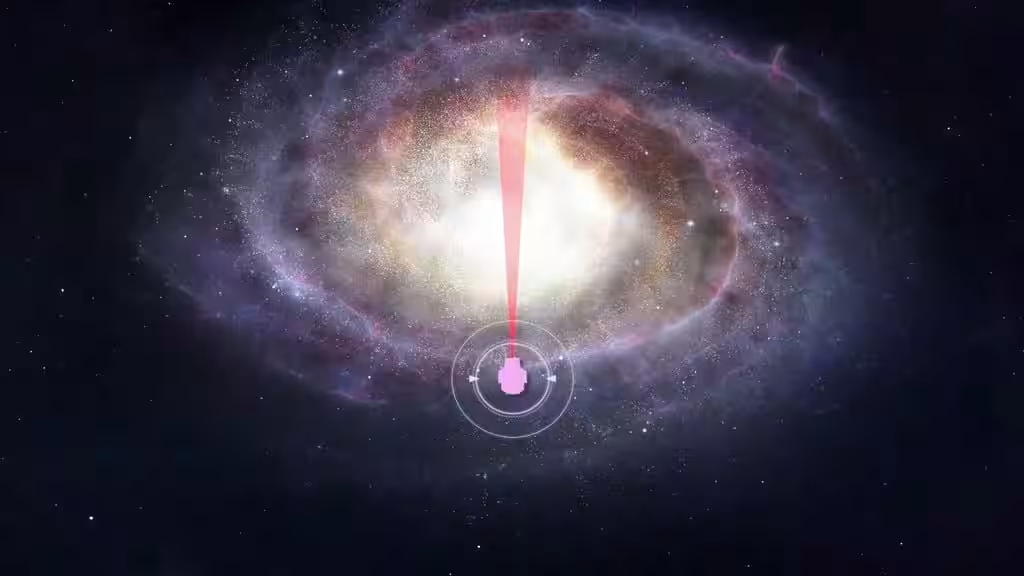
Among the objects Roman will study are hot Jupiters, massive planets that orbit extremely close to their host stars. Infrared measurements of their brightness variations will allow researchers to map temperature contrasts between day‑ and night‑sides, shedding light on atmospheric dynamics.
“Roman’s galactic bulge survey will observe around 100 million stars and probe underexplored areas of our galaxy, which will provide a foundational dataset that will likewise revolutionize what we know about other worlds and our place in the universe.”
This article has been fact checked for accuracy, with information verified against reputable sources. Learn more about us and our editorial process.
Last reviewed on .
Article history
- Latest version
Reference(s)
- Team, NASA. “Elisa Quintana.”, February 7, 2019 NASA Science <https://science.nasa.gov/people/elisa-quintana/>.
- “Robert Forrest Wilson - Sciences and Exploration Directorate.” NASA Goddard Sciences and Exploration Directorate <https://science.gsfc.nasa.gov/sci/bio/robert.f.wilson>.
Cite this page:
- Posted by Aisha Ahmed