AI and Chemistry Probe Dead Sea Scrolls and the Mystery Copper Treasure Map
A five-year study will examine 250 Dead Sea Scroll fragments, but the elusive Copper Scroll and its treasure sites lie outside its scope.
The European Research Council has allocated €2.5 million to Professor Mladen Popović of the University of Groningen to launch the “Tracing Scribes and Scrolls” initiative. Partnering with the Israel Antiquities Authority, the project will unite laboratories and scholars from across Europe to apply chemistry, artificial intelligence, paleography and codicology in order to pinpoint the geographic and cultural origins of the Dead Sea Scrolls.
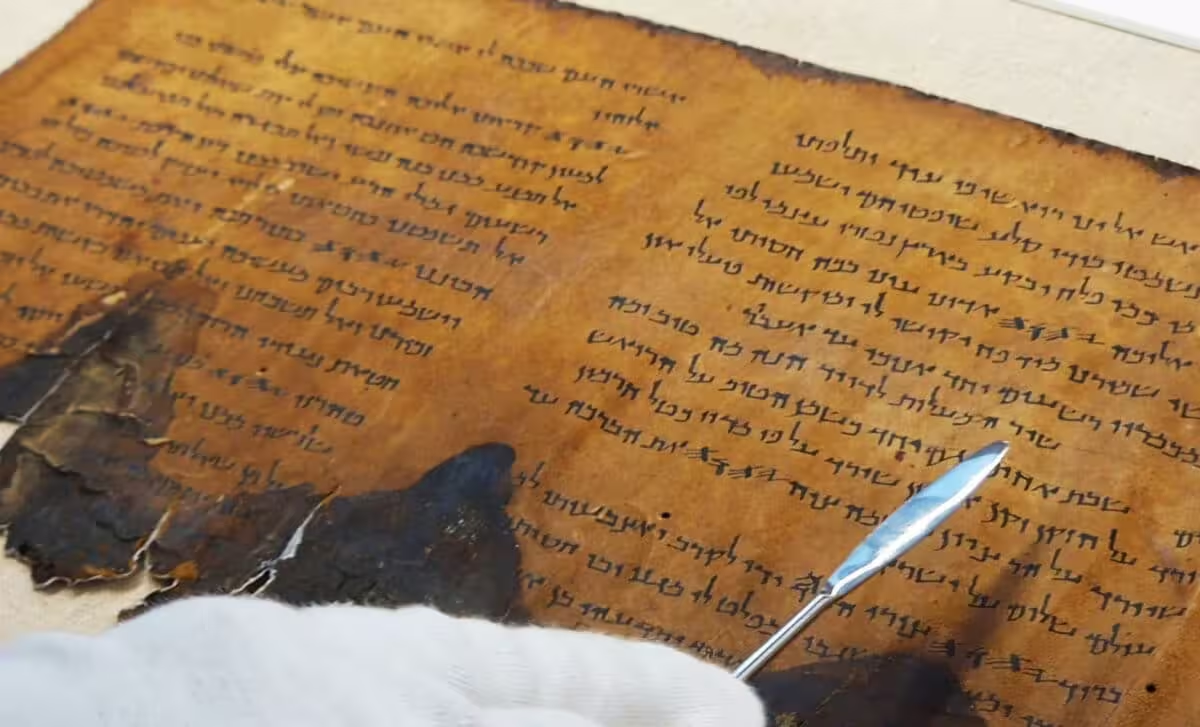
The scroll fragments were unearthed between 1947 and 1956 in a network of eleven caves near Khirbet Qumran on the Dead Sea’s shoreline, after Bedouin shepherds first stumbled upon the manuscripts. The assemblage, comprising thousands of pieces, includes the oldest known copies of many Hebrew‑Bible books together with a wide spectrum of Jewish literary works. Despite decades of scholarship, the precise locations where the materials were produced, prepared or copied remain unresolved.
Creating a Chemical‑Fingerprint Database for the Scrolls
The research will concentrate on 250 individual samples drawn from the larger Dead Sea Scrolls corpus, examining the makeup of parchment, papyrus and ink to trace their provenance. By treating the documents as manufactured objects rather than solely as texts, the team hopes to uncover clues embedded in the material composition.
Ilit Cohen‑Ofri of the Israel Antiquities Authority explained that the effort will generate “an unprecedented database on the chemical composition of samples from the Dead Sea Scrolls.” Recent analyses have demonstrated that material residues can retain information about the conditions under which the fragments were created, surviving for more than two millennia.
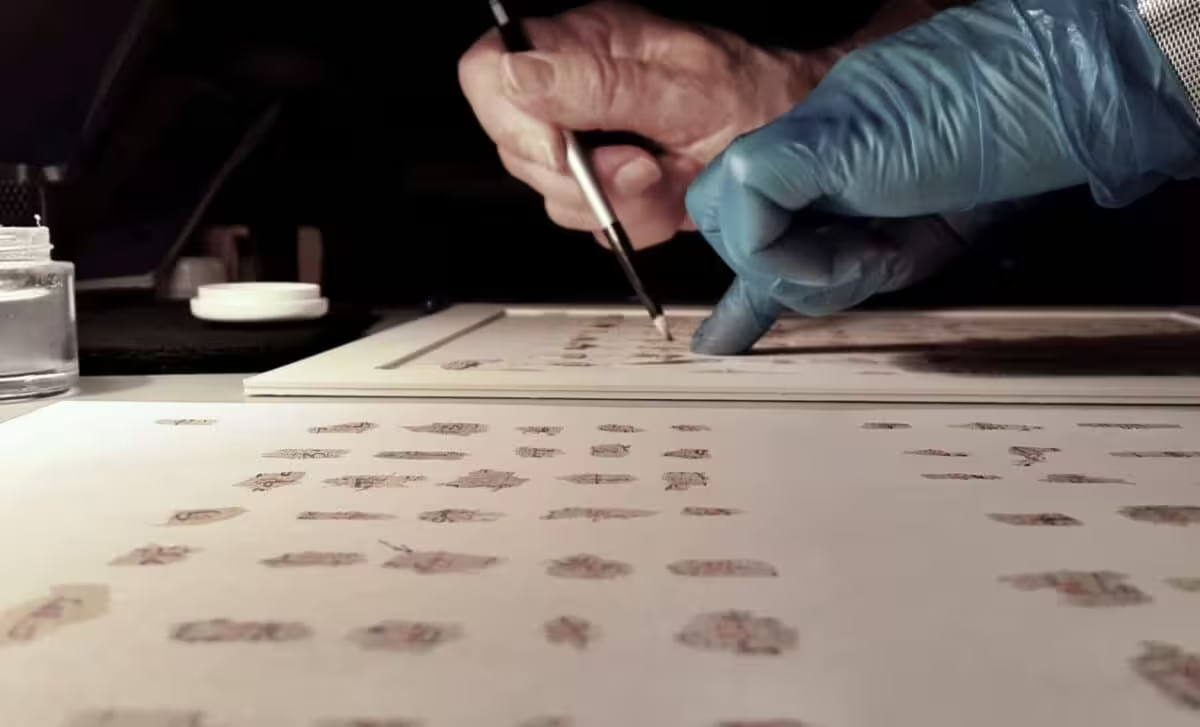
The investigation will blend several analytical approaches. Chemical assays will identify the elemental and molecular signatures of the samples, while AI‑driven pattern recognition, paleographic assessment and codicological study will compare handwriting styles, construction techniques and textual features. Together, these methods aim to reconstruct the production environment of the scrolls.
One outlier, the Copper Scroll, falls outside the primary focus because it was inscribed on metal rather than organic writing supports, placing it beyond the core material categories under study.
The Copper Scroll: A Metallic Record of Supposed Treasure
Archaeologists first encountered the Copper Scroll in 1952 within one of the Qumran caves. It remains the sole copper manuscript in the entire Dead Sea collection. After the scroll’s tight roll caused extreme brittleness, conservators spent five years devising a method to open it, ultimately cutting it into manageable sections.
Opening the scroll revealed a catalogue rather than a biblical text, enumerating locations where valuables were allegedly concealed. An excerpt reads:
“In the fortress which is in the Vale of Achor, forty cubits under the steps entering to the east: a money chest and it [sic] contents, of a weight of seventeen talents.”
The inventory lists gold, silver, coins and vessels, allegedly spread across 61 or 64 sites depending on interpretive choices.
Written in Hebrew, the scroll’s language is cryptic; many terms do not appear in biblical or other known ancient texts. According to the University of Southern California’s Dornsife College of Letters, Arts, and Sciences, the majority of surviving ancient Hebrew manuscripts are religious, whereas the Copper Scroll is secular and its vocabulary remains largely unique.
The obscure terminology hampers translation, and scholars cannot reliably match many of the place names to known locations—some may have vanished entirely. The provenance of the listed riches, their owners, and whether they were ever buried remain matters of speculation.
Temple Wealth Theory Dominates, Yet No Hoard Has Emerged
One leading hypothesis posits that the assets belonged to a temple, hidden shortly before the site’s destruction in 70 CE, possibly linked to the Second Temple. An alternative view associates the treasure with the Qumran sect itself.
Scholars at USC have warned that the identity of the owners and the ultimate fate of the treasure may never be resolved, but the sheer scale of the inventory keeps the temple‑related explanation at the forefront of scholarly debate.
In a 2019 analysis, Joan Taylor of King’s College London argued that the volume described exceeds what an individual or ordinary community could possess, suggesting a state‑level or temple authority as the likely source.
Choosing copper for the record may have been intentional; the metal endures far longer than parchment or papyrus, rendering the scroll resistant to decay and difficult to destroy. The combination of a durable medium and a concealed map implies that the author anticipated both the valuables and their guide being sought after.
Despite persistent interest over the decades, no excavation has recovered the alleged treasure. The scroll might predate the burial, describe a hoard that never existed, or list items still hidden across numerous sites—its text offers no definitive confirmation.
This article has been fact checked for accuracy, with information verified against reputable sources. Learn more about us and our editorial process.
Last reviewed on .
Article history
- Latest version
Reference(s)
- “%D7%9E%D7%94%D7%99%D7%9B%D7%9F %D7%94%D7%92%D7%99%D7%90%D7%95 %D7%9E%D7%92%D7%99%D7%9C%D7%95%D7%AA %D7%9E%D7%93%D7%91%D7%A8 %D7%99%D7%94%D7%95%D7%93%D7%94.” <https://www.iaa.org.il/en/page_news/page/%D7%9E%D7%94%D7%99%D7%9B%D7%9F-%D7%94%D7%92%D7%99%D7%90%D7%95-%D7%9E%D7%92%D7%99%D7%9C%D7%95%D7%AA-%D7%9E%D7%93%D7%91%D7%A8-%D7%99%D7%94%D7%95%D7%93%D7%94>.
- “Copper Scroll - West Semitic Research Project.”, February 2, 2023 West Semitic Research Project <https://dornsife.usc.edu/wsrp/copper-scroll/>.
Cite this page:
- Posted by Vikram Desai