AI Trained on 30 Years of Seismic Data Beats Traditional Methods in Detecting Faint Earthquakes
AI system merges data from many seismic stations to spot faint signals, delivering fast, accurate earthquake detection.

Because a lone seismometer often cannot tell whether a weak tremor originates from a natural earthquake, a clandestine nuclear test, or another source, scientists rely on networks of sensors spread over a limited region and compare their recordings before confirming an event.
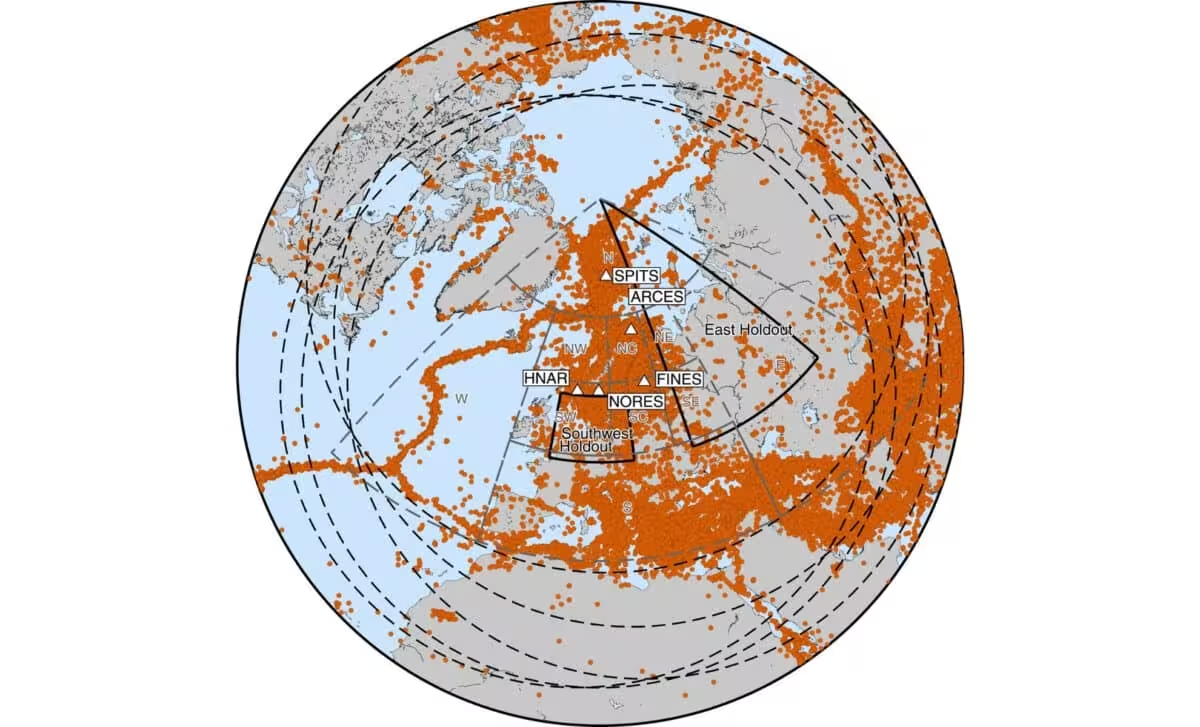
In a recent investigation, Köhler and colleagues explored whether artificial‑intelligence models could interpret those network measurements more efficiently than traditional workflows. The team assembled three decades of data from seismic arrays operated by Norway’s NORSAR research foundation and partner institutions, then trained identical AI architectures using three distinct data‑handling schemes.
Three Strategies for Merging Array Recordings
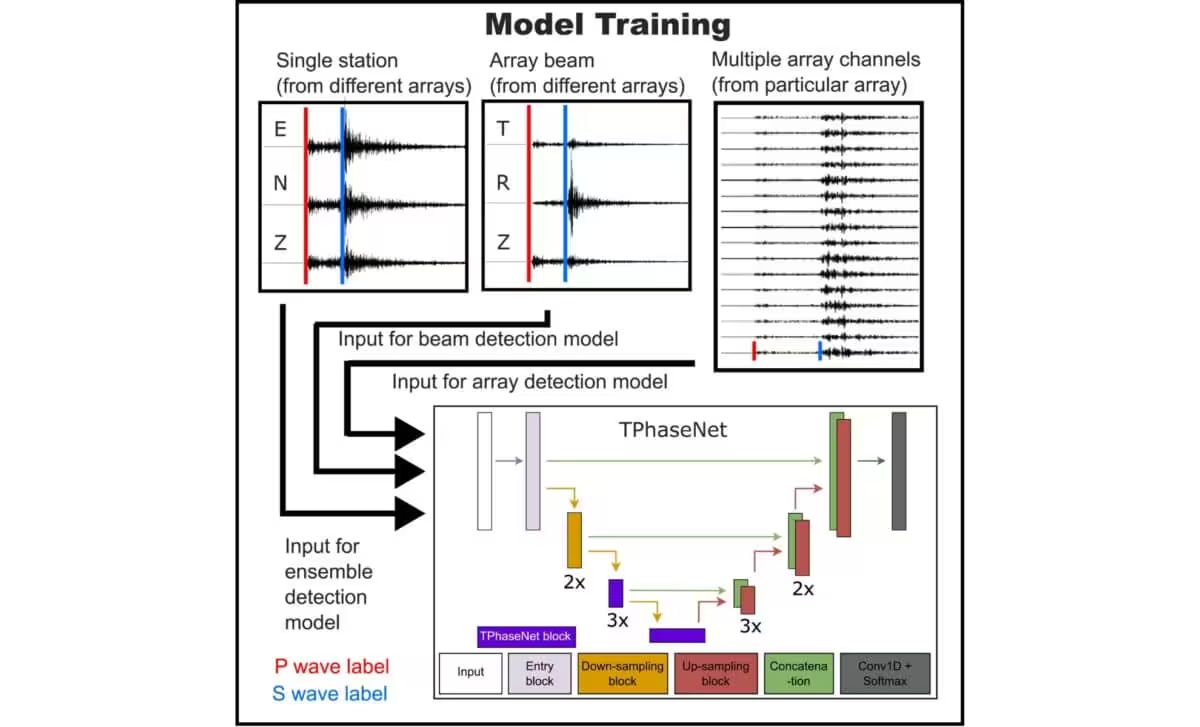
The first scheme treated each station as an independent source. The model learned from the time series of a single sensor, applied its inference separately to every node, and the individual outcomes were merged only after processing.
In the second scheme, the researchers first combined the waveforms from several stations within the same array using a conventional stacking method. The AI system was then fed this aggregated signal rather than the raw, station‑by‑station data.
The third approach gave the network full access to every station’s raw data, allowing the model to learn its own optimal way of integrating the multiple streams without a preset combination rule.
According to the published study, each strategy yielded distinct outcomes in terms of detection precision and computational load, underscoring how preprocessing choices can shape an AI system’s sensitivity to subtle seismic signatures.
Balancing Detection Accuracy and Processing Speed
The pre‑combined method (second scheme) delivered the highest detection rates. By amplifying faint signals before training, the model could more reliably flag low‑amplitude events.
Training each station individually (first scheme) lagged behind both the pre‑combined and the fully integrated approaches in terms of accuracy.
Conversely, the fully integrated method (third scheme) required the least computational resources, offering a middle‑ground performance that sits between the speed of the first approach and the precision of the second.
As reported by ZME Science, the authors suggest deploying the third, computationally light method for real‑time monitoring when rapid turnaround is essential. For offline analyses where speed is less critical, they recommend either pre‑combining the signals or aggregating the model’s outputs after processing individual stations.
The study does not proclaim a universal winner; the optimal technique hinges on whether the priority is swift processing or maximal detection fidelity.
Geographic Generalization Remains a Challenge
When evaluated on data from regions not represented in the training set, the AI system’s performance declined, a limitation the authors attribute to the regional bias of the dataset.
Köhler’s team notes that expanding training to incorporate global seismic records should mitigate this issue, especially for the detection of S‑waves, which showed the most pronounced degradation.
In contrast, P‑wave identification proved more robust across unseen locales, maintaining accuracy without the same loss of sensitivity.
Overall, the findings demonstrate that machine‑learning tools can enhance seismic surveillance by uncovering weak signals from earthquakes, clandestine nuclear tests and other low‑amplitude events that traditional processing might overlook.
This article has been fact checked for accuracy, with information verified against reputable sources. Learn more about us and our editorial process.
Last reviewed on .
Article history
- Latest version
Reference(s)
- Köhler, A.., et al. “Adapting Deep Learning Phase Detectors for Seismic Array Processing.” Journal of Geophysical Research: Machine Learning and Computation, vol. 3, no. 3, June 13, 2026 American Geophysical Union (AGU), doi: 10.1029/2026JH001249. <https://agupubs.onlinelibrary.wiley.com/doi/10.1029/2026JH001249>.
- Sidik, Saima. “A New AI System Can Hear Earthquake Signals Other Methods Miss.”, July 10, 2026 ZME Science <https://www.zmescience.com/science/geology/a-new-ai-system-can-hear-earthquake-signals-other-methods-miss/>.
Cite this page:
- Posted by Vikram Desai