Ancient Slavic Wood Face Uncovered in Polish Lake Reveals 1,000‑Year‑Old Spiritual Secrets
A 1,000‑year‑old wooden carving from Lake Lednica sheds light on early medieval Slavic art and spiritual practices.

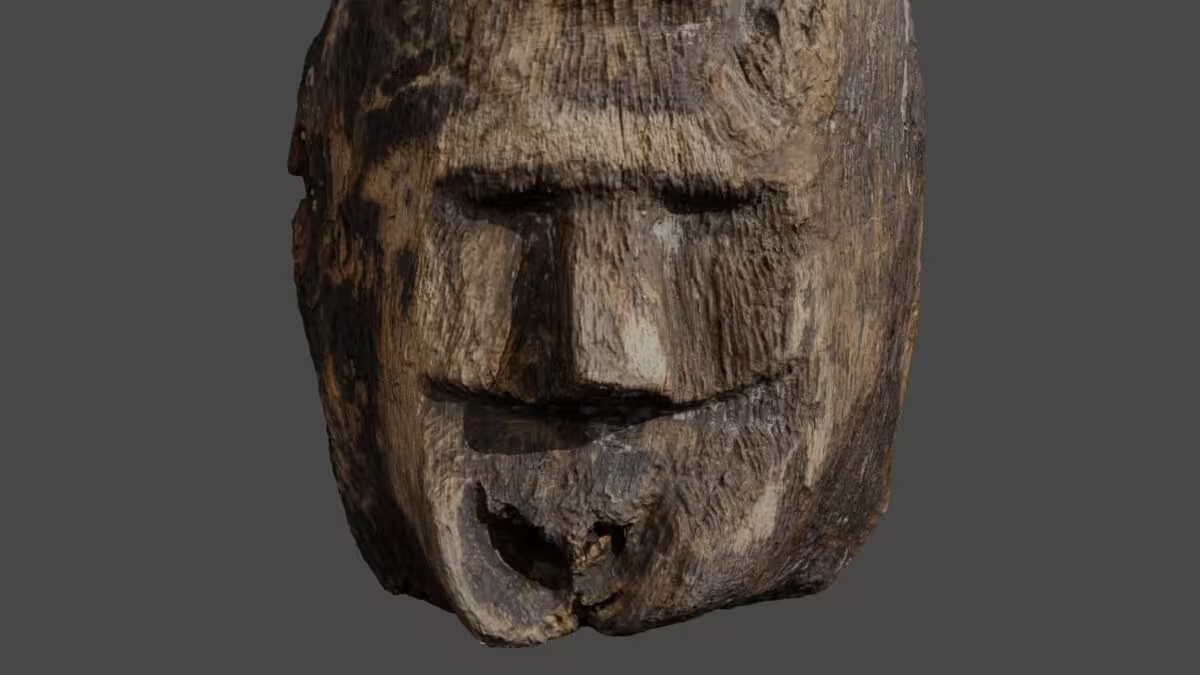
Researchers from Nicolaus Copernicus University have recovered a carved wooden face from the depths of Lake Lednica in western Poland. The artifact, dating to around 967 CE, survived more than a thousand years beneath the lake’s oxygen‑free waters, offering a rare window into early medieval Slavic art and belief systems.
A Wooden Portrait Rescued From a Submerged Fortress
The piece was recovered on a fragment of oak that once formed part of a defensive rampart, specifically a hook beam that had collapsed and sank. Measuring roughly 12 cm in height and 9 cm wide, the carving displays detailed eyes, nose, mouth, cheekbones, eyebrows and a distinctive chin, suggesting intentional placement on the beam’s narrower outer surface for symbolic or protective reasons.
The lake’s anaerobic environment prevented decay, allowing the timber to remain intact despite the passage of centuries. This preservation enables scholars to examine not only the object itself but also the broader cultural context of the Slavic peoples who inhabited the region during the late 10th century.
Contextual Insights From NCU Researchers
According to a study published by NCU scholars, the oak tree used for the beam fell in 967, a year that coincides with the baptism of Mieszko I and Poland’s early Christianization. Comparable wooden faces have emerged from other Slavic sites such as Wolin, Novgorod the Great and Staraya Ladoga, yet the Lednica example appears rooted in a local artistic tradition rather than external Scandinavian or Rus influences.
“This discovery not only evokes admiration for the craftsmanship from over a thousand years ago but also opens a fascinating discussion about the spiritual life of early medieval Slavs,” said Andrzej Pydyn, director of the Centre for Underwater Archaeology at NCU, in a recent press release. The find positions Lake Lednica within a network of ritual and artistic activity that spanned early Slavic territories.
Merging Function and Faith
The hook beam, a structural element of the settlement’s fortifications, may have served a dual role. Archaeologists propose that the carved face could represent a deity, an ancestral hero or a protective spirit mediating between the living community and the unseen realm. While its precise purpose—whether to guard the settlement, signal authority or act as a ritual conduit—remains uncertain, the artifact exemplifies the intertwining of practical construction and symbolic expression characteristic of the period.
A statement from the Museum of the First Piasts in Lednica describes the wooden portrait as “a priceless monument and a rare example of an item combining utility and symbolic functions.” The museum notes that animal remains, including horse jaws, were also uncovered near the ramparts, suggesting that ritual offerings may have accompanied defensive building projects.
Recognition and Ongoing Research
The carved face quickly became one of Poland’s most celebrated archaeological discoveries of 2025, earning the title “Unique Artefact of 2025” in the Archaeological Sensations 2025 poll conducted by Archeologia Żywa. Photographer Mateusz Popek’s images of the find were praised for their quality and contribution to public interest in archaeology.
As analysis continues, the Lednica portrait promises to deepen scholarly understanding of Slavic ritual practices, artistic techniques and everyday life more than a millennium ago.
This article has been fact checked for accuracy, with information verified against reputable sources. Learn more about us and our editorial process.
Last reviewed on .
Article history
- Latest version
Reference(s)
- “Face from the lake.”, October 1, 2019 <https://portal.umk.pl/en/article/face-from-the-lake>.
Cite this page:
- Posted by Vikram Desai