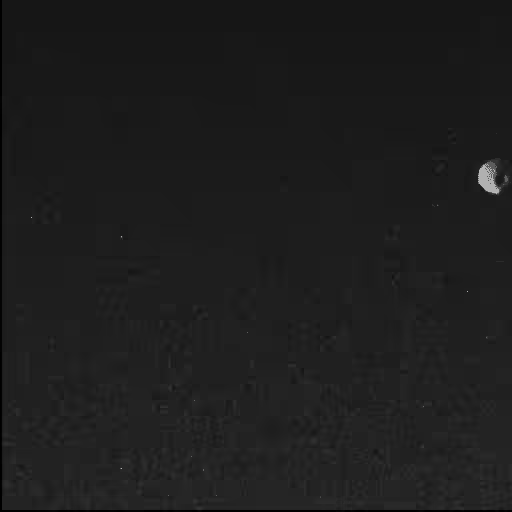
NASA’s Juno Mission Unveils Stunning New Image of Jupiter’s Moon Thebe
NASA’s Curiosity Rover encountered an unforeseen complication when a rock adhered to its drill mechanism. However, through a series of creative problem-solving strategies, the team managed to dislodge the obstruction, providing fresh perspectives on the geological composition of Mars.

NASA’s Juno Spacecraft Unveils Hidden Secrets of Jupiter’s Ring System
Unlocking the Mysteries of Thebe: A Crucial Player in Jupiter’s Celestial Dance
In a groundbreaking discovery, NASA’s Juno spacecraft has captured an extraordinary image of Thebe, Jupiter’s second-largest inner moon, providing a new perspective on the planet’s enigmatic ring system. The close flyby, which took place on May 1, 2026, marked a significant milestone in understanding the celestial dynamics surrounding Jupiter, revealing not only the moon itself but also its pivotal role in the formation of the gas giant’s elusive “gossamer” ring.
Thebe: A Key Component in Jupiter’s Ring Dynamics
Located at the outer edge of Jupiter’s faint ring system, Thebe plays a critical role in the planet’s ring dynamics. Scientists believe that Thebe’s gravitational influence, combined with dust from its surface, significantly contributes to the formation of Jupiter’s delicate “gossamer” ring. This faint ring, invisible to the naked eye, is primarily composed of small particles that are thought to have originated from Thebe itself or other nearby moons.
Juno’s Stellar Reference Unit: A Game-Changer in Space Exploration
NASA’s Juno spacecraft, during its May 1 pass, approached Thebe from a mere 3,100 miles (5,000 kilometers), capturing an image with remarkable resolution, around 1.9 miles (3 kilometers) per pixel. This unprecedented level of detail offers scientists an unparalleled look at the moon’s surface and the surrounding space environment, helping to unravel the mysteries of Jupiter’s complex ring system.
The SRU: A Dual-Purpose Instrument for Navigation and Science
The Stellar Reference Unit (SRU), primarily used for navigation, has proven invaluable in scientific exploration. Its exceptional sensitivity in low-light conditions has turned it into a powerful secondary instrument for studying Jupiter and its moons. Beyond this, it has been instrumental in past discoveries, such as the detection of “shallow lightning” in Jupiter’s atmosphere and providing high-resolution images of Jupiter’s iconic ring system.
Juno’s Journey: A Testament to Innovative Engineering
The Juno mission, managed by NASA’s Jet Propulsion Laboratory (JPL) in Pasadena, California, is a prime example of innovative engineering. The dual-purpose approach of the SRU allows the spacecraft to gather unprecedented data that was once beyond the reach of previous space missions.
The Significance of Thebe’s Discovery
Thebe, often overshadowed by larger moons like Ganymede and Io, is now emerging as a key object of interest in planetary science. By closely studying Thebe’s role in shaping Jupiter’s faint ring system, scientists can learn more about the forces at play in the creation and maintenance of planetary rings. The enhanced imaging capabilities of Juno’s SRU allow for more precise measurements of the moon’s surface composition, which could have wider implications for understanding other ring systems in the solar system.
The Future of Jupiter Research: Unlocking the Secrets of Thebe and Beyond
Juno’s recent flyby of Thebe may open the door to more detailed studies of Jupiter’s smaller moons and their contributions to the planet’s overall ring system, possibly even hinting at other, unknown factors in the evolution of Jupiter’s enigmatic environment.
This article has been fact checked for accuracy, with information verified against reputable sources. Learn more about us and our editorial process.
Last reviewed on .
Article history
- Latest version
Cite this page:
- Posted by Vikram Desai