Backyard “Decoration” Revealed as 2,000-Year-Old Roman Tombstone
A stone found in a Louisiana garden turned out to be a missing Roman grave marker lost during World War II, showing how ancient history can resurface in the most unexpected places.
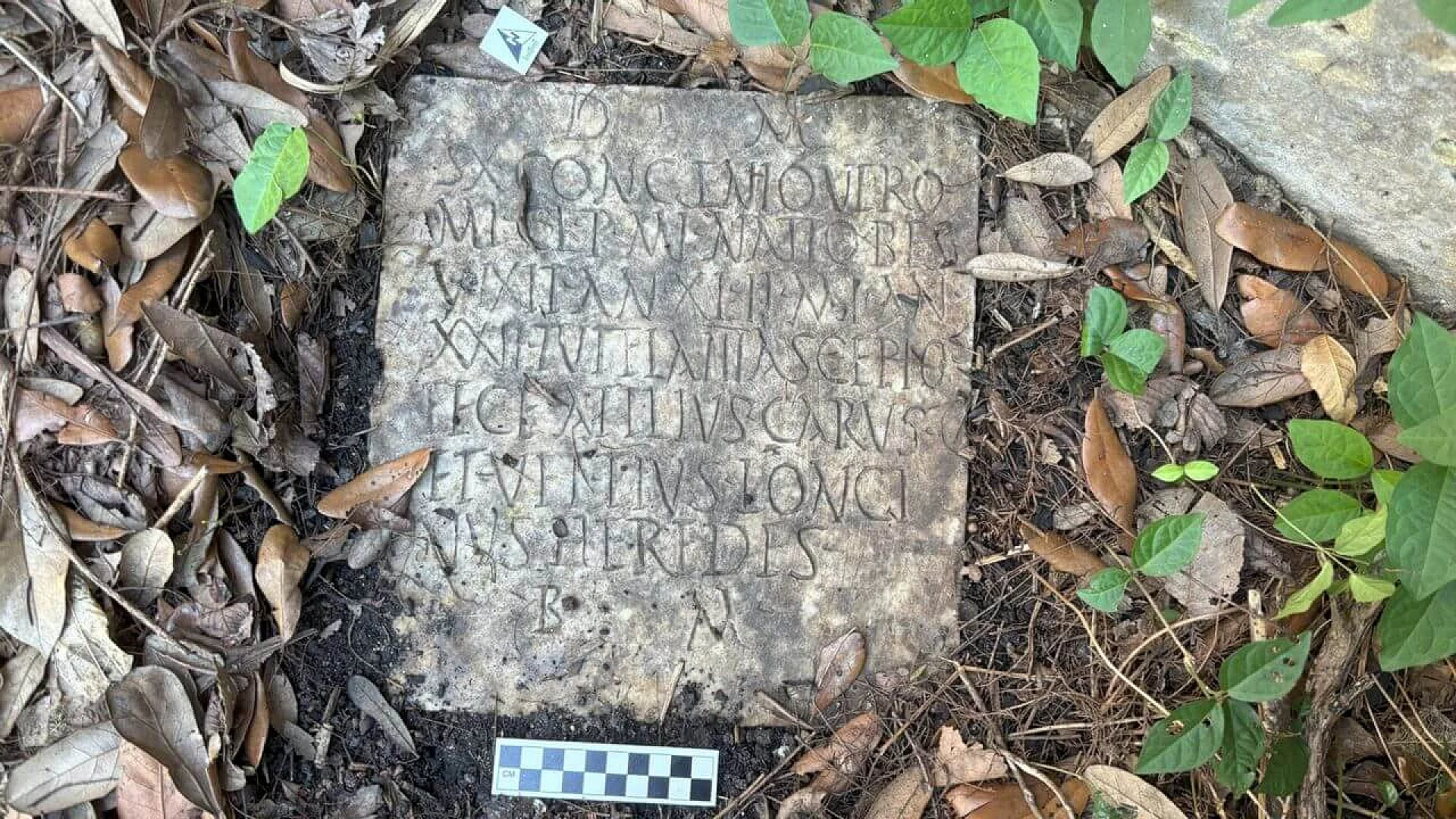
Sometimes history does not arrive with drums or headlines. Sometimes it shows up quietly, half buried in the soil while someone is trying to tidy their yard.
That is exactly what happened at a home in New Orleans, where a marble slab sat unnoticed among plants and garden features. At first glance, it looked decorative, the kind of object people buy to give their backyard a classical feel. You see these things all the time in landscaping catalogs, faux-antique pieces meant to look old but actually mass-produced.
But this one felt different.
The surface carried a Latin inscription. Not random lettering. Not a stylized imitation. Real words, carefully carved. And that small detail was enough to make the homeowners pause and ask a simple question that changed everything: What if this is not a decoration at all?
That moment of curiosity set off a chain of events that would connect modern America to the Roman Empire, and also to the unfinished business of World War II.
The Language That Gave It Away
Experts quickly focused on the opening phrase carved into the stone: Dis Manibus. In ancient Rome, this was a standard dedication meaning “to the spirits of the dead.”
If you walked through a Roman cemetery two thousand years ago, you would have seen those words again and again. They were part religious expression, part cultural tradition, and part personal tribute. Families used them to honor loved ones and to signal respect for ancestors.
Because this formula was so widely used, archaeologists today can recognize it almost instantly. It is like seeing a familiar heading on a document and knowing what kind of record you are reading before you even finish the first line.
Once specialists saw that phrase, they knew the stone was genuine.
A Soldier’s Story, Preserved in Stone
As scholars translated the rest of the inscription, a life began to emerge from the carved letters.
The monument commemorated a man named Sextus Congenius Verus. He was originally from Thrace, a region far from Rome, yet he served in the Roman military for more than two decades. According to the inscription, he died at age 42 after 22 years of service, and the gravestone was commissioned by his heirs.
That kind of detail is priceless to historians. Roman funerary inscriptions were not only memorials. They were identity records. They told you where someone came from, how they lived, and how they wanted to be remembered.
For many soldiers like Verus, military service was a pathway into Roman society. The army was one of the empire’s most powerful engines of integration, bringing together people from different regions, languages, and cultures under a shared system.
So this stone was not just about death. It was about belonging.
Scholars Begin Connecting the Dots
To understand where the artifact came from, researchers from Tulane University and University of New Orleans began comparing the object with historical records.
Measurements, wording, and layout all seemed oddly familiar.
Eventually, they found a match in archival documentation from the National Archaeological Museum of Civitavecchia in Italy. The stone had once been cataloged there as part of the museum’s collection, associated with a cemetery in the ancient port town.
But then the trail went cold.
The artifact had been listed as missing for decades.
The War That Scattered History
To understand how a Roman gravestone could travel across the Atlantic, you have to go back to the 1940s.
During World War II, bombing campaigns caused widespread destruction across Europe. Museums were not spared. Buildings collapsed, collections were damaged, and countless artifacts disappeared amid chaos, looting, and emergency evacuations.
The museum in Civitavecchia was heavily damaged during Allied bombing in 1943 and 1944. Many items were lost or displaced, including this very stone.
This was not an isolated case. Across the continent, cultural heritage was scattered in ways historians are still trying to untangle today.
An Unexpected American Journey
At some point during the war, the gravestone appears to have come into the possession of an American soldier stationed in Italy. After returning home, he kept it among personal belongings, where it was treated more like an unusual keepsake than an archaeological treasure.
Years passed. Then decades.
Family members inherited the object without knowing its origin. Eventually, during a household move in the early 2000s, it was placed outdoors as part of a garden landscape. It stayed there quietly, exposed to weather, blending into everyday life.
It is strange to think about. For years, people walked past a monument carved when the Roman Empire still ruled the Mediterranean, never realizing what they were seeing.
How Archaeology Often Begins With a Gut Feeling
Many people imagine archaeology as dramatic excavations in distant deserts. But discoveries often start much smaller. A question. A suspicion. A sense that something is out of place.
In this case, it was not a shovel that uncovered history. It was recognition.
That moment, when someone noticed the Latin inscription and decided to investigate instead of ignoring it, made all the difference.
The Science of Tracing an Artifact’s Past
Confirming the stone’s identity required careful provenance research. Scholars compared old museum inventories, archival photographs, and recorded dimensions to verify that the Louisiana slab matched the one documented in Italy decades earlier.
This kind of work is like detective science. It combines historical scholarship, material analysis, and archival investigation. Every detail must align before experts can say with confidence that an object has been found again after being lost.
And when they do, it is not just a rediscovery. It is a restoration of context.
Returning the Stone to Its Original Home
Once the identification was confirmed, steps began to send the artifact back to Italy. The process is being coordinated by the Federal Bureau of Investigation Art Crime Team, which specializes in recovering and returning cultural property.
Repatriation is about more than logistics. Objects like this carry historical meaning tied to place. Returning them allows scholars to reconnect them with local history, archaeological records, and cultural memory.
It is, in a way, finishing a story that war interrupted.
Why This Discovery Matters Today
Artifacts move. They are carried by war, migration, inheritance, and sometimes simple misunderstanding. The past is not fixed. It travels.
Even eighty years later, historians continue to recover objects displaced during the conflict. Each rediscovery helps rebuild the cultural record that war fractured.
You do not need a massive excavation to change historical understanding. Sometimes, one inscription is enough to reconnect an entire narrative.
A Stone That Crossed Two Thousand Years
Think about the timeline for a moment.
A Roman soldier dies nearly two millennia ago. His family commissions a gravestone. Centuries pass. Empires rise and fall. The stone survives long enough to enter a museum. Then war strikes, and it vanishes into uncertainty. Decades later, it reappears in a quiet American neighborhood, mistaken for yard art.
And now, finally, it is heading back to the region where it began.
That journey, stretching across centuries and continents, reminds us that history is not only something we study. Sometimes it is something we accidentally inherit, rediscover, and then carefully return.
This article has been fact checked for accuracy, with information verified against reputable sources. Learn more about us and our editorial process.
Last reviewed on .
Article history
- Latest version
Cite this page:
- Posted by Zara Tariq