40,000-Year-Old Symbols Suggest Humans Created a Communication System Long Before Writing
New research reveals that Ice Age hunter-gatherers used a sophisticated system of geometric signs to store and share information across generations, potentially laying the groundwork for future written languages.
Humans possess a unique capacity to store and share information using surfaces beyond the human brain. This ability allows for the distribution of knowledge necessary for survival and helps coordinate large groups of people. Modern reflections of this capacity include written language, mathematical symbols, and even the digital code underlying artificial computing systems. Without the ability to encode information outside of the here and now of spoken words, the modern information age would not be possible.
Archaeologists have long recognized that this cognitive trait has deep roots. Evidence of information encoding has been found in excavation layers dating back hundreds of thousands of years. Early ancestors, including Neanderthals, used mobile artifacts and cave walls as carriers for visual signs. However, there is a notable increase in the number and complexity of these markings around 45,000 years ago. This period marks the arrival of the first modern humans in Eastern and Central Europe during the Upper Paleolithic.
The Swabian Jura Discovery
A recent study published in Proceedings of the National Academy of Sciences focused on a collection of artifacts from the Swabian Jura in southwestern Germany. This region contains a cluster of cave sites inhabited by people of the Aurignacian culture between 43,000 and 34,000 years ago. These early Europeans were skilled craftspeople who produced a specialized range of tools for working animal hides, cutting meat, and creating clothing.
The researchers analyzed more than 200 mobile objects from these caves. The collection included tools made of bone and antler, as well as figurines laboriously carved from mammoth ivory. These figurines often depict the natural environment of the Ice Age, featuring woolly mammoths, wild horses, steppe bison, and cave lions. Notably, these inhabitants also created the first known musical instruments, such as flutes made of bone and ivory.
Thousands of Intentional Signs
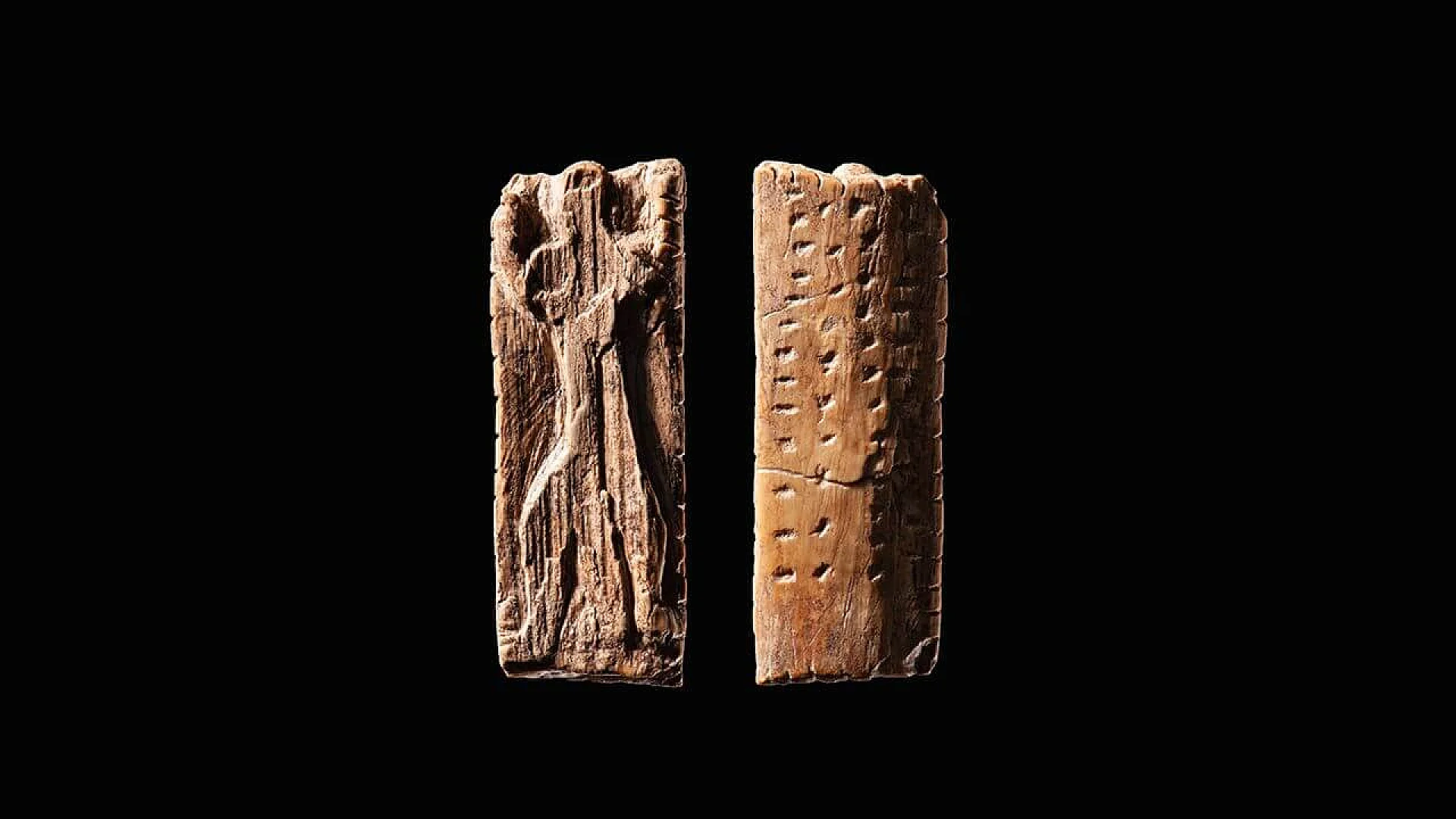
The surfaces of these 40,000-year-old objects are adorned with several thousand geometric signs. These markings are not the accidental by-products of butchering or craftsmanship, such as cut marks or holes for ropes. Instead, they are intentional and nonutilitarian modifications of the surface. The inventory of signs includes simple shapes like lines, points, and crosses. It also features more complex patterns, such as stars, grid patterns, and zigzag lines.
While theories regarding the meaning of these signs are numerous, the researchers sought to understand their basic, measurable properties. To do this, they applied classification algorithms and statistical models derived from quantitative linguistics. This allowed them to capture the quantitative signatures of the sign sequences and compare them to known communication systems.
Not Quite Writing, But Not Random
The study’s analysis illustrated that these ancient sign sequences are clearly distinguishable from modern-day writing. Modern scripts typically exhibit higher levels of entropy, a measure of how much information is packed into a sequence based on the predictability of the symbols. Modern languages also tend to have longer sequences of characters compared to the Paleolithic markings.
However, the statistical properties of the Aurignacian signs were found to be comparable to the earliest protocuneiform tablets from ancient Mesopotamia. Protocuneiform, which dates to approximately 3500–3000 BC, represents the very beginning of writing and record-keeping. The 40,000-year-old European signs share similar levels of unigram entropy and repetition rates with these early Mesopotamian records. This suggests that while they did not encode full spoken language, they were used in a systematic and conventional manner several ten thousand years before the advent of genuine writing.
High Information Density on Sacred Objects
One of the most significant findings of the study was that these signs were not applied randomly across all objects. The researchers used multiple regression models to predict the information density of a sequence based on the type of artifact it was carved upon. They found that ivory figurines, both of animals and humans, tended to carry sequences with roughly 15% higher information density than simple tools.
Personal ornaments and musical instruments, such as bone flutes, generally had lower information density than tools. This selective application suggests that early humans were choosing specific objects to carry more complex or concentrated information. The higher density on figurines might reflect their importance in a spiritual world or their role in storing vital cultural knowledge.
Stable Communication Over Millennia
The study also examined whether these sign systems changed over the 10,000-year period they were in use. Surprisingly, the estimated age of an object was not a significant predictor of its information density. This indicates that the sign sequences remained relatively stable in their complexity from roughly 40,000 to 30,000 years ago.
This stability suggests a long-lasting cultural tradition. These early hunter-gatherers were likely teaching these sign systems to subsequent generations, maintaining a conventional method of communication across millennia. Such a system would have been essential for survival in the harsh Ice Age environment, allowing groups to record seasonal data, track resources, or manage social relationships.
The Role of Decoration
The researchers also addressed the common question of whether these markings are simply decoration. While some markings may be aesthetically pleasing, the study argues that decoration and information value are not mutually exclusive. Historically, sign systems have often been used as decorative elements in calligraphy, tattoos, and pottery without losing their underlying meaning.
In the context of the Swabian Jura, some signs appear to have moved beyond simple representation. For example, dots found on an ivory plaque depicting a hybrid human-lion creature (the “Adorant”) are organized into linear rows of similar lengths. These markings seem abstracted from any realistic depiction of animal fur and may represent numerical information. This shift toward symbolic and linear organization is a hallmark of developing communication systems.
A Foundation for Human Progress
The findings challenge the idea that complex information storage systems only emerged with the rise of agriculture and permanent settlements. Instead, they prove that the first hunter-gatherers arriving in Europe had already developed a system of intentional and conventional signs on mobile artifacts. This capacity for external memory likely provided a significant evolutionary advantage, allowing modern humans to thrive in new and challenging environments.
By quantifying these ancient marks, scientists are beginning to bridge the gap between prehistoric art and the history of writing. This emerging field, known as Evolutionary Semiotics, seeks to understand how the statistical properties of human communication evolved over hundreds of thousands of years. The thousands of lines and dots carved into mammoth ivory 40,000 years ago are not just doodles, they are the early footprints of the human information age.
The research was published in Proceedings of the National Academy of Sciences on February 23, 2026.
This content has been reviewed by subject-matter experts to ensure scientific accuracy. Learn more about us and our editorial process.
Last reviewed on .
Article history
- Latest version
Reference(s)
- Bentz, Christian., et al. “Humans 40,000 y ago developed a system of conventional signs.” Proceedings of the National Academy of Sciences, vol. 123, no. 9, 23 February 2026, doi: 10.1073/pnas.2520385123. <https://doi.org/10.1073/pnas.2520385123>.
Cite this page:
- Posted by Zara Tariq