Mars Is Secretly Shaping Earth’s Climate Over Millions Of Years, Scientists Reveal
A recent investigation indicates that Mars exerts a gradual influence on Earth’s orbital path and the cyclical patterns of deep ocean currents over extended geological periods.
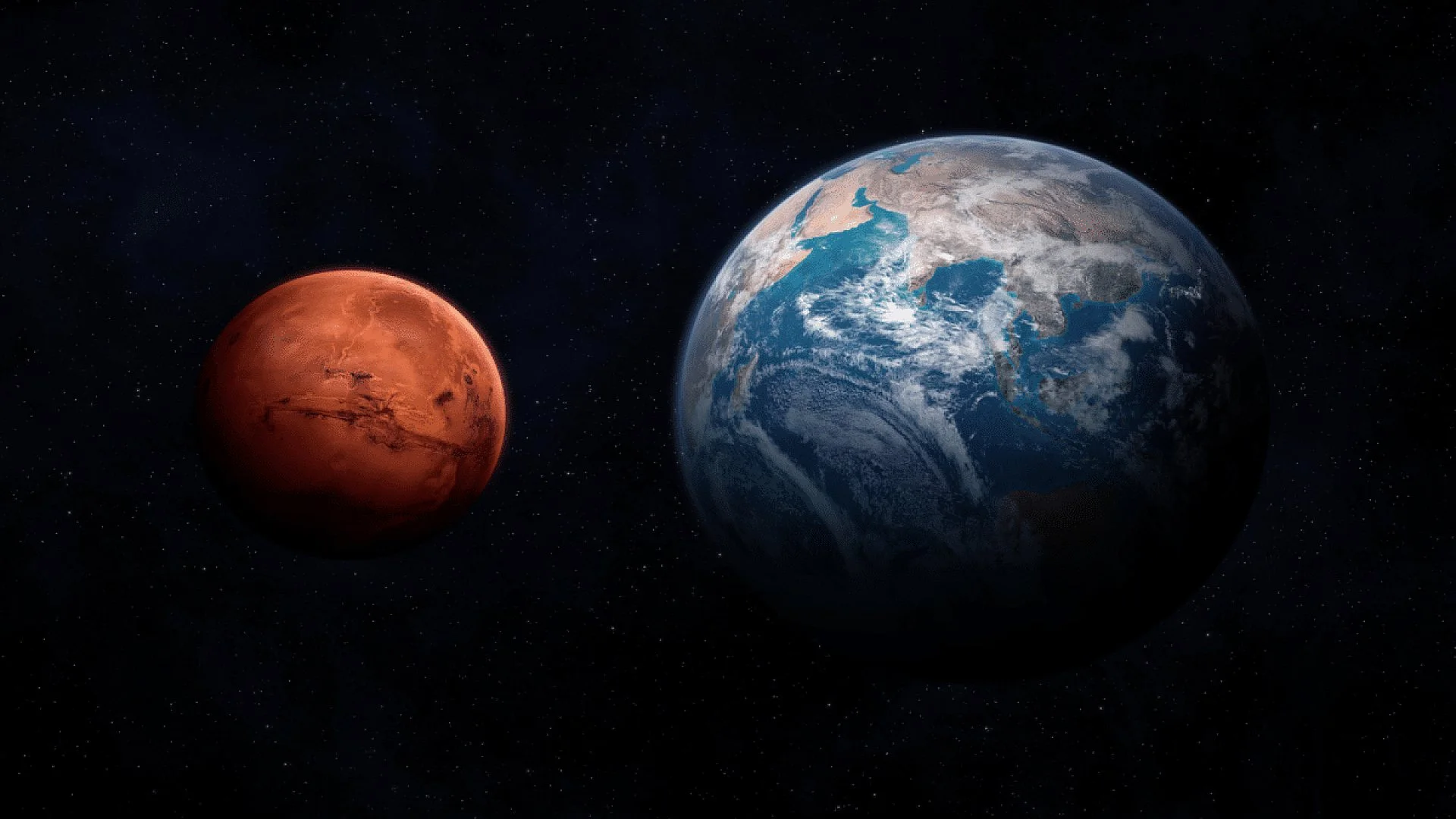
A groundbreaking study published in Nature Communications uncovers the profound impact of Mars on Earth’s orbit, revealing a subtle yet significant influence on long-term climate shifts and deep ocean circulation patterns over millions of years. This pioneering discovery bridges the gap between planetary motion and geological processes, fundamentally transforming our understanding of Earth’s climate rhythm.
The Cosmic Connection: Mars’ Gravitational Pull
The notion that planets interact with each other is well-established, yet the scale of impact revealed in this study is nothing short of remarkable. Earth and Mars, separated by vast distances, engage in a perpetual gravitational dance, with Mars exerting a gentle yet persistent influence on Earth’s orbital path. Every 26 months, during planetary opposition, Mars subtly alters Earth’s orbit, shifting its eccentricity and affecting the amount of solar energy it receives. This repeated nudge, though imperceptible in the short term, has a profound impact on Earth’s climate over vast timescales.
Researchers have long studied orbital cycles, but this study highlights a distinct and slower rhythm driven by planetary resonance. “The gravity fields of the planets in our solar system interact with each other, and this resonance changes planetary eccentricity, a measure of how close to circular their orbits are,” explained study co-author Dietmar Müller, a geophysics professor at the University of Sydney. This gravitational dialogue between planets reveals a hidden layer of climate influence that unfolds far beyond human timescales.
Unveiling the Secrets of the Ocean Floor
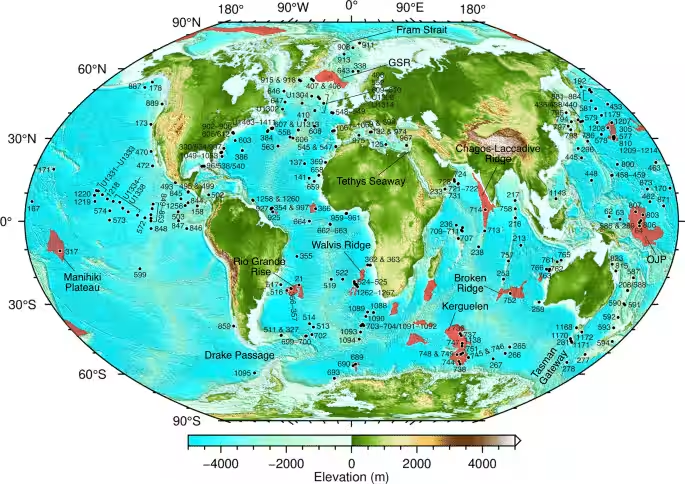
The study’s findings rely on extensive geological records preserved deep beneath the ocean’s surface. Using satellite data and sediment mapping, researchers traced patterns of accumulation across the seafloor spanning over 65 million years. These records reveal periodic gaps where sediment deposition was disrupted, pointing to stronger deep-sea currents at specific intervals. The team identified a recurring cycle occurring roughly every 2.4 million years, described as an astronomical grand cycle. During these phases, intensified currents and powerful abyssal eddies disturb the ocean floor, eroding previously stable sediment layers.
The study, published in Nature Communications, connects these oceanic shifts directly to orbital variations influenced by Mars. “Our deep-sea data spanning 65 million years suggests that warmer oceans have more vigorous deep circulation,” explained Adriana Dutkiewicz, the study’s lead author and a sedimentologist at the University of Sydney. This relationship between orbital mechanics and ocean dynamics provides a rare glimpse into how cosmic forces leave physical imprints on Earth’s geology.
Credit: Nature Communications
The Dynamic Deep Ocean
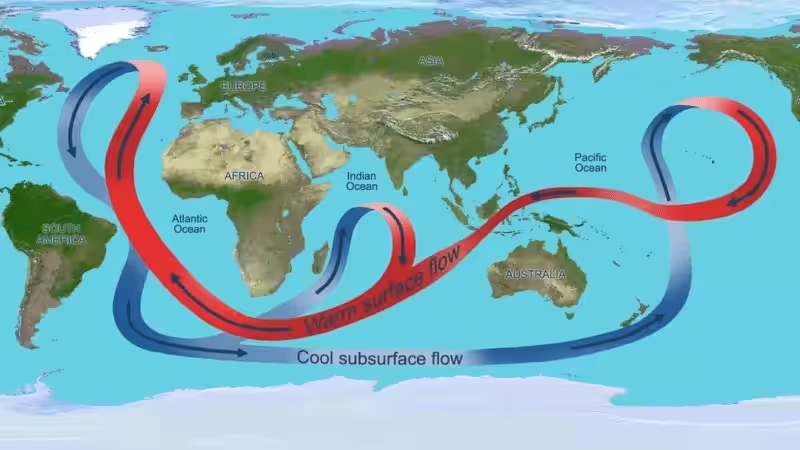
The deep ocean is often perceived as slow and static, but this research challenges that notion. Beneath the surface, a complex system of currents constantly moves heat, oxygen, and nutrients across the globe. These movements are influenced not only by surface conditions but also by long-term planetary cycles. The study highlights how variations in orbital eccentricity can intensify deep-water circulation, creating stronger mixing and more dynamic flow patterns.
This includes the formation of eddies capable of reaching extreme depths, reshaping the ocean floor in the process. “We know there are at least two separate mechanisms that contribute to the vigor of deep-water mixing in the oceans,” Müller noted. These mechanisms operate across different scales, from global circulation systems to localized turbulence. The findings suggest that even if major systems weaken, smaller processes may continue sustaining deep ocean movement, maintaining a level of balance within the system.
Implications for Today’s Climate Debate
While the discovery reveals a powerful long-term climate driver, researchers draw a clear distinction between these ancient cycles and current global warming. The 2.4-million-year rhythm operates on a timescale vastly different from modern climate change, which is unfolding over decades. The study emphasizes that present warming trends are linked to human-driven greenhouse gas emissions rather than planetary interactions.
At the same time, understanding these deep-time cycles helps scientists build more accurate climate models and better interpret geological records. It also sheds light on the resilience of ocean systems, especially in the face of potential disruptions like a slowdown in the Atlantic Meridional Overturning Circulation (AMOC). “This will potentially keep the ocean from becoming stagnant even if Atlantic meridional overturning circulation slows or stops altogether,” Dutkiewicz concluded. The research offers both perspective and context, showing that while Earth’s climate is influenced by cosmic forces, the changes unfolding today are driven by entirely different mechanisms.
This article has been fact checked for accuracy, with information verified against reputable sources. Learn more about us and our editorial process.
Last reviewed on .
Article history
- Latest version
Reference(s)
- Dutkiewicz, Adriana. “Deep-sea hiatus record reveals orbital pacing by 2.4 Myr eccentricity grand cycles - Nature Communications.”, vol. 15, no. 1, March 12, 2024, pp. 1998 Nature, doi: 10.1038/s41467-024-46171-5. <https://www.nature.com/articles/s41467-024-46171-5>.
- “3335.” <https://www.earth.columbia.edu/articles/view/3335>.
Cite this page:
- Posted by Vikram Desai