Nutrient Limitations Trigger Turing Instabilities in Microbial Communities
Physical diffusion rates of shared metabolites drive microbes to self-organize into structured spatial aggregates.
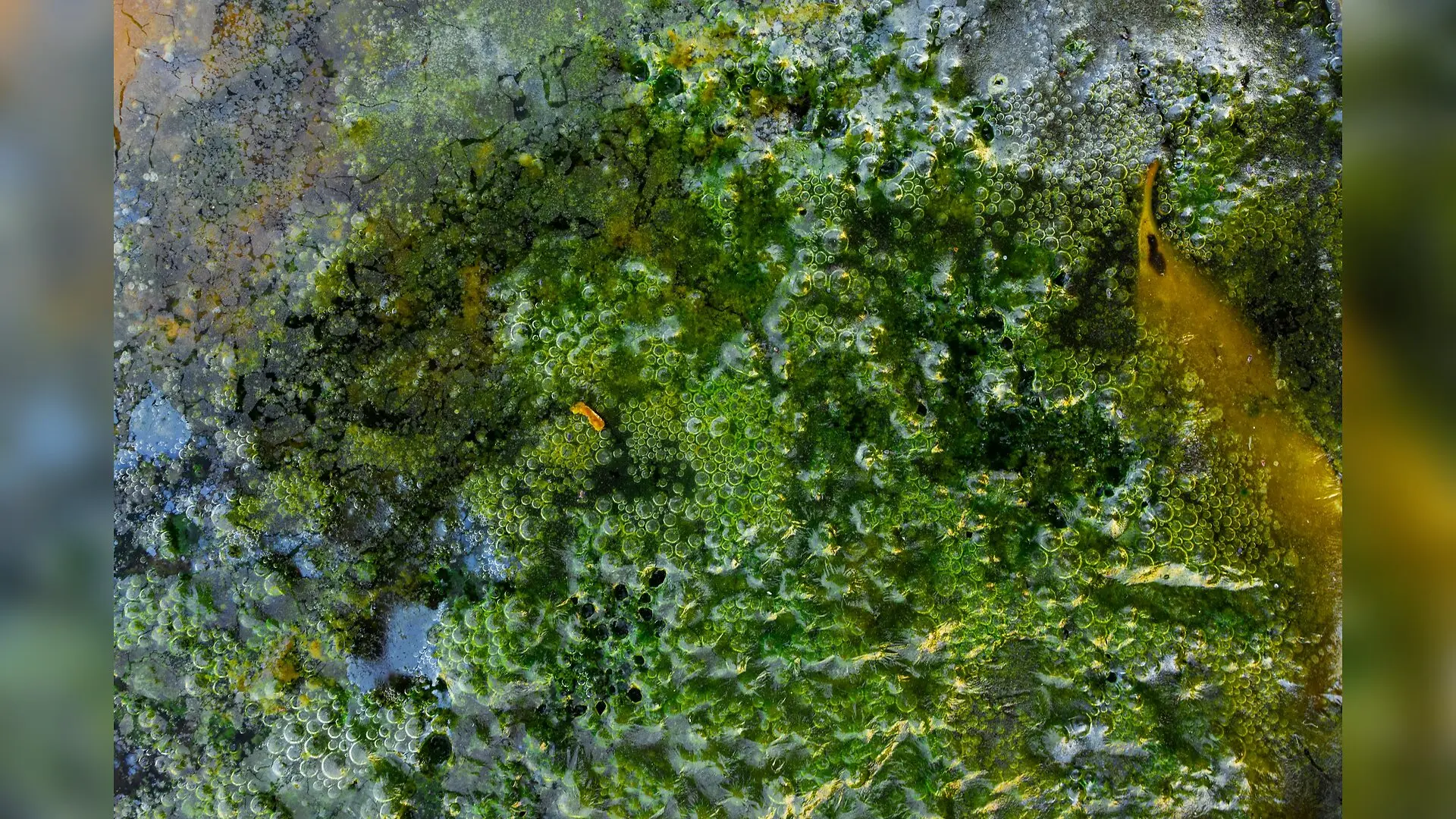
Microbial communities spontaneously organize into complex spatial patterns when nutrient supplies run low, driven entirely by the way microscopic cells exchange metabolic byproducts. Researchers at University College London discovered that the diffusion of these shared molecules creates a classic chemical instability across simulated populations of bacteria and archaea. The study reveals how basic physical constraints reshape ecosystems without needing external environmental gradients.
How Do Metabolic Exchanges Spark Instabilities in Living Populations?
Microbes survive by consuming environmental resources and secreting metabolic byproducts that other strains can eat, a process known as cross-feeding. When these communities inhabit resource-poor environments, a delicate feedback loop emerges between local metabolite availability and cell growth. Jan Kocka and their colleagues at University College London evaluated these dynamics using a consumer-resource model with 20 distinct microbial strains and 20 individual metabolites. The findings are available on the arXiv preprint server.
The mathematical analysis demonstrates that micron-sized microbes and nanometre-scale metabolites diffuse at vastly different rates. This disparity triggers a Turing instability, a mathematical phenomenon first proposed by Alan Turing to explain biological pattern formation. Local activation occurs when slow-moving metabolites accumulate and give nearby cells a growth advantage, while long-range inhibition stems from intense competition for the primary environmental resource.
What Controls the Transition Into Patterned States?
To understand what drives the emergence of these spatial patterns, the team built a simplified coarse-grained model tracking total community biomass. The analysis shows that system stability depends on four key dimensionless parameters, including metabolic leakage and the ratio of diffusion coefficients between metabolites and environmental resources. When energy supplies are scarce and leakage exceeds a specific critical threshold, uniform populations break down into structured formations.
The calculations indicate that spatial instabilities only appear when environmental resources are severely limited. If energy becomes too abundant, populations rely less on cross-feeding, which suppresses the local growth advantage. Similarly, if cross-fed metabolites diffuse much faster than environmental resources, the local accumulation disappears, preventing any pattern from forming.
What Happens to Communities Beyond the Onset of Instability?
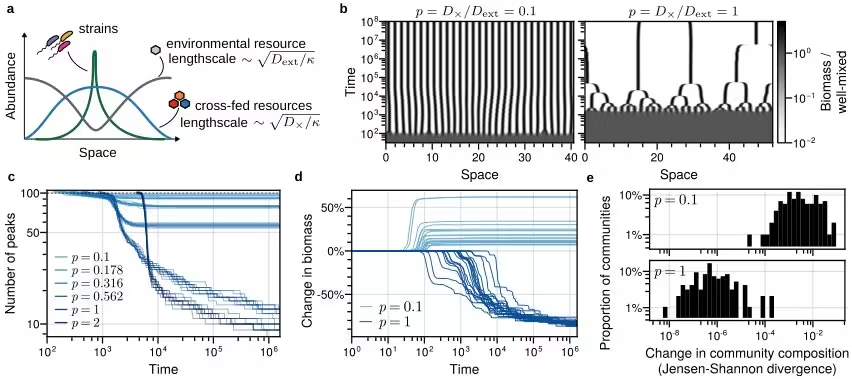
Simulating the long-term fate of these unstable communities reveals that total biomass coalesces into compact aggregates with dense cores. The spacing between these clusters matches the fastest-growing mode predicted by linear stability theory. When metabolites diffuse slower than external resources, neighbouring aggregates interact primarily by competing for the supplied nutrient, which stabilizes the resulting pattern.
However, when diffusion rates are nearly equal, cross-feeding draws neighbouring clusters together until only a few large aggregates remain. This structural shift also alters community composition. The relative abundance of low-strain populations increases significantly within the spatially structured state compared to initial well-mixed conditions, showing how physical diffusion rates directly influence biodiversity.
Can These Patterns Be Observed in Laboratory Experiments?
The authors suggest that these Turing instabilities should be readily testable in laboratory settings using wild soil isolates or synthetic, genetically engineered microbial consortia. Researchers could grow these communities on agar plates with varying concentrations of key resources such as glucose, then map the spatial distribution of strains using multiplexed imaging techniques. Future studies will need to incorporate additional physical forces like cellular crowding and extracellular matrix secretion to fully understand complex microbial ecosystems.
The study was posted to the arXiv preprint server on November 20, 2026.
This article has been fact checked for accuracy, with information verified against reputable sources. Learn more about us and our editorial process.
Last reviewed on .
Article history
- Latest version
Reference(s)
- Kocka, Jan. “Nutrient limitation drives Turing instabilities in cross-feeding microbial communities.” arXiv.org <http://arxiv.org/abs/2611.27534v1>.
Cite this page:
- Posted by Hassan Raza