Why Early Denoising Steps in Generative AI Break Down Under Chip Approximations
New research reveals that diffusion models tolerate rough math approximations in later steps while demanding high precision at the start.
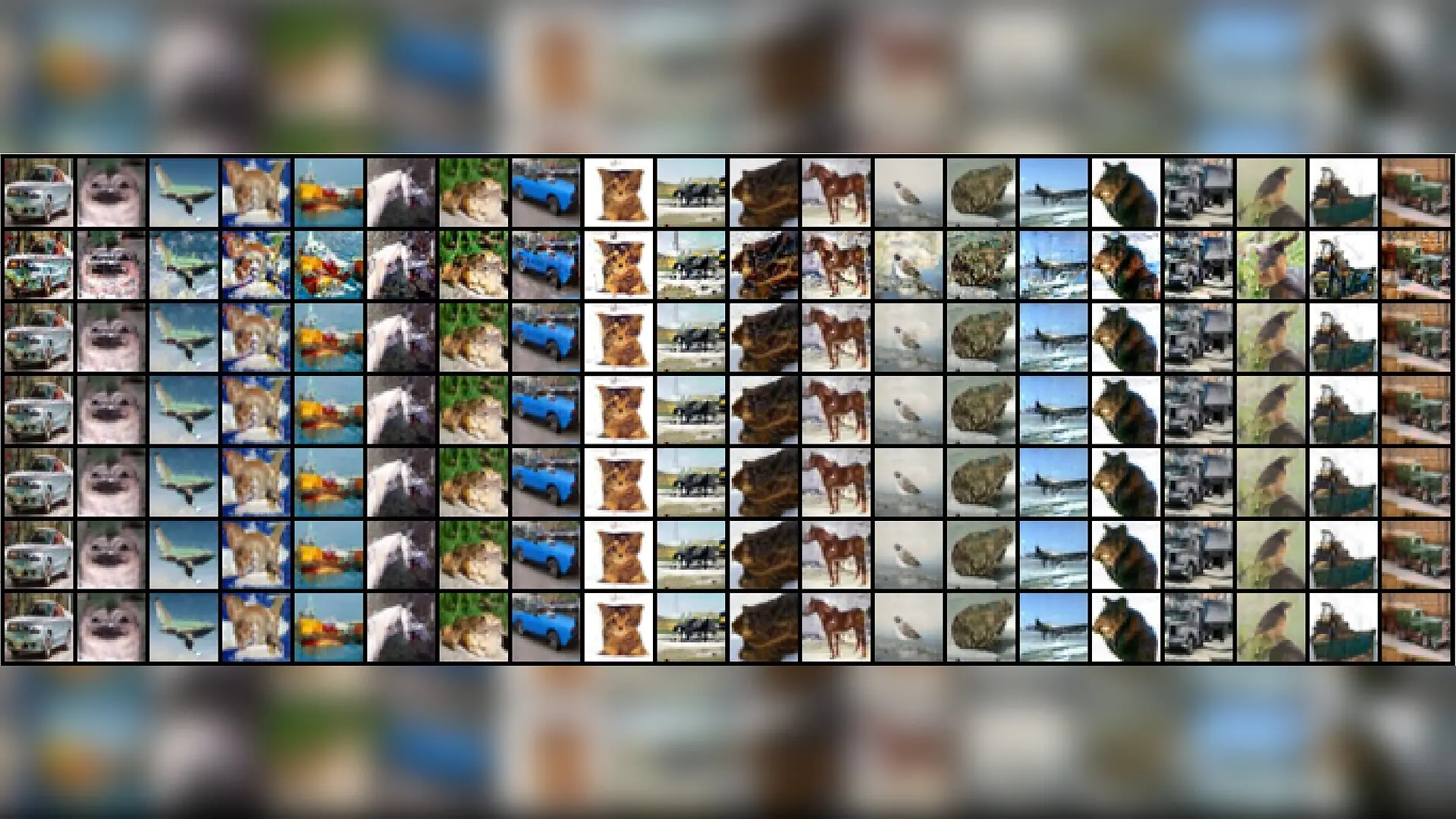
New research shows that the way generative artificial intelligence systems create images contains a hidden vulnerability, where early mathematical steps are hyper-sensitive to errors while later stages shrug off rough approximations. Generative artificial intelligence tools rely on a sequence of steps that clean up random noise to form a picture, requiring immense computer power and energy. By studying how hardware errors affect different moments in this image-creation pipeline, researchers discovered a clear split in how computer chips can handle the workload. The study is available on the arXiv preprint server, outlining a method to build faster and more energy-efficient computer hardware.
How Does Approximate Computing Save Energy in Modern Microchips?
Deep neural networks, which are computer systems inspired by the human brain, can tolerate a small amount of numerical noise without breaking down. This tolerance lets engineers use a strategy called approximate computing, which swaps out traditional, power-hungry math circuits for simpler alternatives that use less electricity and take up less physical space on a silicon chip. Specifically, standard computer processors rely on heavy circuitry known as multiply-accumulate units to handle the intense matrix math behind deep learning. Replacing these heavy math blocks with lighter designs can dramatically cut down electricity demands and reduce the physical footprint of processors on edge devices like smartphones.
Diffusion models create images by gradually turning static noise into a clear picture across a sequence of dozens of individual denoising steps. Each step uses a neural network to predict and remove a tiny bit of noise from the intermediate image, creating a sequential chain of calculations. Because each step builds directly on the previous one, any error introduced early in the sequence has the potential to snowball and ruin the final output. Researchers wanted to know exactly how much error each step in the chain could tolerate before the resulting images degraded into messy static.
What Happens When Engineers Swap Out Standard Math Units at Different Steps?
To test this behavior, Ori Schweitzer from the Technion along with colleagues Uri Weiser and Freddy Gabbay evaluated an 8-bit quantized version of a popular diffusion model running on a standard benchmark image dataset known as CIFAR-10. The team measured image degradation using the Fréchet Inception Distance, a standard metric that compares the statistical realism of generated images against real photographs. Instead of modifying the entire software pipeline at once, the authors used a sliding window of twenty consecutive iterations where they replaced standard math operations with a hardware approximation technique called shift-and-accumulate, while keeping all other steps fully accurate.
The shift-and-accumulate microarchitecture, built on prior designs from the research group, decomposes standard multiplication into a set of leading-one bit shifts and additions. This specific hardware substitution typically slashes chip area and power consumption by over thirty percent across various neural network architectures with minimal loss in accuracy. When applied to diffusion models, however, the team found that the sensitivity of the process was remarkably uneven across the timeline of image generation.

Why Are the First Thirty Denoising Steps So Fragile?
The experiments revealed a strongly non-uniform resilience profile across the one hundred total sampling steps. The first twenty steps of the denoising process proved to be exceptionally fragile, with approximations introduced during this window causing severe visual noise and significantly worse image quality scores. Starting from iteration thirty onward, however, the impact of approximate arithmetic dropped off sharply, showing negligible effect on final image quality metrics.
When the authors expanded the approximation window to cover fifty or more of the later steps, the model still managed to produce reasonable images despite a noticeable rise in visual distortion. To preserve fine details and sharp edges, keeping just the final ten iterations at full mathematical precision proved sufficient to maintain high image fidelity. This discovery demonstrates that diffusion models possess a structured temporal robustness that hardware designers can directly exploit.
How Can Chip Makers Build Smarter Accelerators for Artificial Intelligence?
These findings point toward a new design principle for artificial intelligence hardware, suggesting that microchips do not need to treat every calculation in a generative model with equal weight. By building processors that pipeline precise, high-accuracy math units for the fragile early steps, and switch to efficient approximate units for the robust later steps, hardware engineers can capture major efficiency gains. This approach enables substantial reductions in power consumption and chip area without sacrificing the visual quality of the output, opening the door for faster and more efficient artificial intelligence tools on everyday hardware.
The study was posted to the arXiv preprint server on November 20, 2026.
This article has been fact checked for accuracy, with information verified against reputable sources. Learn more about us and our editorial process.
Last reviewed on .
Article history
- Latest version
Reference(s)
- Schweitzer, Ori. “Iteration-Dependent Temporal Resilience in Diffusion Models for Approximate Computing.” arXiv.org <http://arxiv.org/abs/2611.27745v1>.
Cite this page:
- Posted by Asif Iqbal