How Human Learners Figure Out What Not To Say By Tracking Conversational Silence
A new mathematical framework reveals how children use contextual diversity and positive conversational feedback to learn the strict boundaries of language.

When children hear someone say “we can make a cake later,” they instantly grasp that the structure is grammatical, yet they also figure out when a missing phrase means something is strictly forbidden. How human learners map out the invisible boundaries of language by noticing what people do not say has long puzzled cognitive scientists. A study published in arXiv by Yanzhe Zhao from Tianjin University reveals how learners combine structural clues, conversational opportunities, and speaker choices into a single mathematical framework.
How Do Shared Predictive Environments Unlock Unseen Word Combinations?
To understand how children generalize language without direct correction, the author examined thirty randomized artificial grammars. The computational model, known as a Shared-Context Bridging estimator, demonstrated that shared distributional contexts allow learners to identify category-compatible word pairings even when those specific words have never appeared together. Across the artificial language tests, this mechanism achieved an impressive mean area under the curve score of 0.945 after processing only one hundred and twenty sentences. Direct adjacency memory, by contrast, remained no better than random guessing at 0.500.
When the researchers scrambled the contextual predictions while preserving overall word frequencies, the generalization effect vanished entirely. This finding suggests that human brains rely heavily on predictable surrounding linguistic environments to bootstrap structural permission for unfamiliar combinations. However, knowing that a sentence structure is theoretically allowed is only half the battle. A learner must still figure out how often a phrase should actually be chosen in conversation and why its absence should be treated as evidence of a rule violation.
Why Does the Organization of Conversational Contexts Change the Weight of Silence?
The new research shows that an expression going unsaid carries entirely different weights depending on how conversational settings are organized. If a learner encounters repeated omissions in a single persistent setting, they can easily attribute the silence to a low local rate or an unusual conversational topic. Distributing those same sixteen omissions across sixteen independent communicative contexts, however, strips away that easy excuse and transforms the absence into strong negative evidence against the combination.
To capture these dynamics, the study derives a joint evidence law governed by context diversity and within-context repetition. The mathematics reveal that encountering new communicative settings multiplies the effective evidence scale, whereas repeating omissions within the exact same context yields diminishing marginal information. This theoretical insight explains why children need a diverse conversational diet rather than repetitive drills to reliably prune incorrect grammatical overgeneralizations.
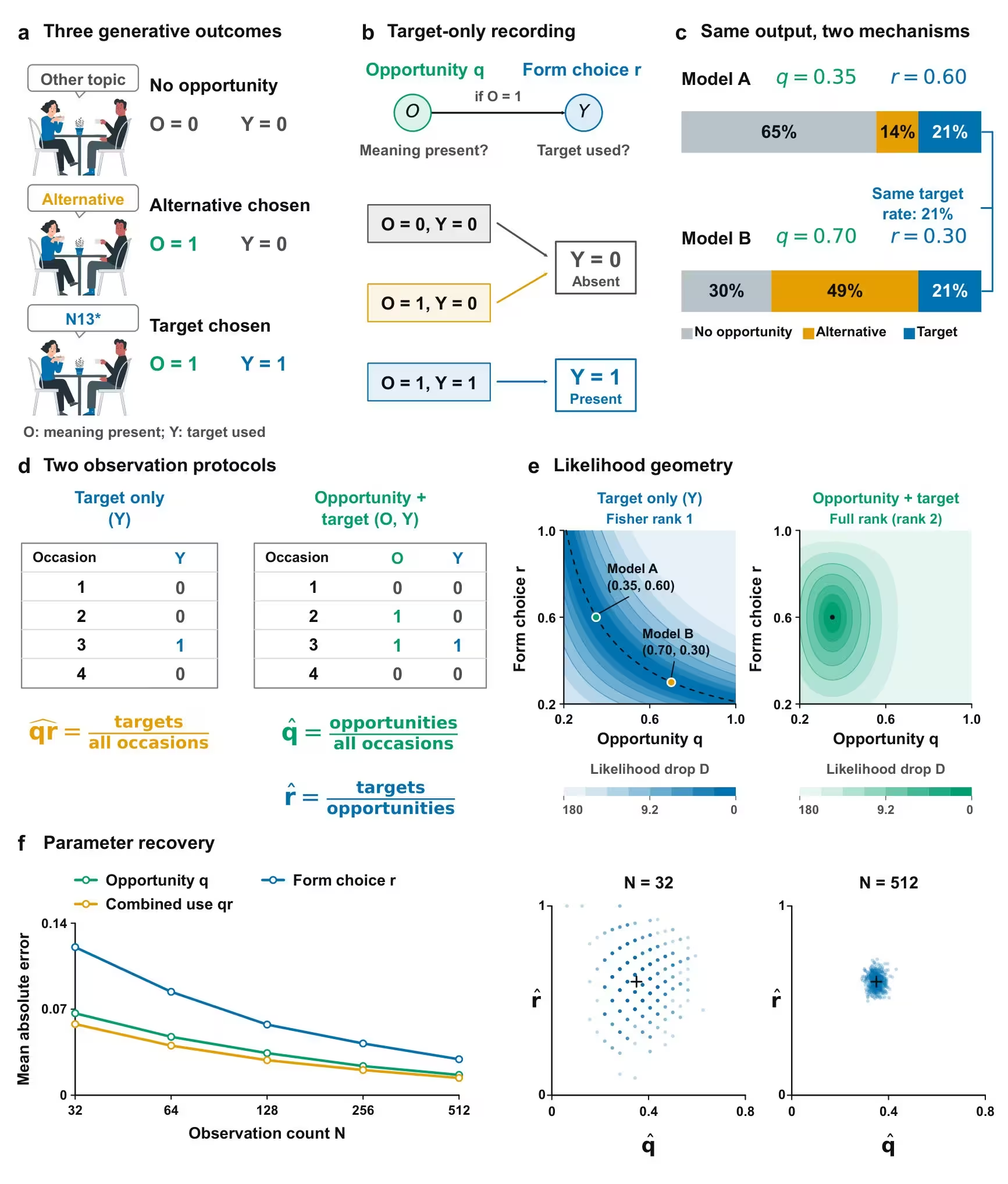
Can Positive Experience Make Subsequent Omissions More Damaging?
One of the most counterintuitive discoveries in the work is that positive encounters with related expressions actively calibrate how strongly target omissions restrict permission. When learners observe frequent use of related permitted forms, their expected usage rate shifts upward. Consequently, subsequent omissions of the target phrase become far more surprising, driving down the posterior probability of permission much faster than they would in a sparse linguistic environment.
The author also uncovered a phenomenon called structural support reversal. A candidate phrase that starts out with higher initial structural plausibility and higher expected usage can ultimately end up more heavily penalized by sustained absence than a weaker competitor. When a structurally favored candidate is also expected to be used frequently, accumulating omissions create a tipping point that eventually overturns its initial advantage.
What Do Reanalyses of Human Experiments and Natural Speech Reveal?
To ground these theoretical models in human behavior, the author reanalyzed data from five artificial language experiments involving four hundred and forty adult and child participants. The reanalysis confirmed that meaning-matched competition substantially increases learners’ preference for attested structures over unattested restricted combinations. Furthermore, linking acceptability judgments to active production choices across three hundred and ninety-nine participants demonstrated that item-specific restriction ratings significantly improve out-of-sample predictions of actual speech choices.
Looking at naturalistic input, an analysis of eleven families across six Universal Dependencies CHILDES corpora revealed pervasive source-level clustering in article usage. Natural speech contains significantly more conversational cells with complete article absence than expected under homogeneous usage models. This excess dispersion across real-world transcripts underscores why cognitive models must account for persistent contextual uncertainty when explaining how learners master the subtle limits of human language.
The study was posted to the arXiv preprint server on November 20, 2026.
This article has been fact checked for accuracy, with information verified against reputable sources. Learn more about us and our editorial process.
Last reviewed on .
Article history
- Latest version
Cite this page:
- Posted by Zubair Ali