New AI Model Generates Six Months of Hourly Climate Forecasts Without Error Breakdown
An adjustable noise parameter lets researchers smoothly balance temporal coherence and ensemble spread in regional weather simulations.

A new artificial intelligence model can generate six months of continuous, hourly regional climate forecasts without breaking down or losing small-scale detail, solving a major hurdle in climate simulation. Global climate models often run at coarse resolutions of roughly one hundred kilometers, missing local weather extremes like sudden flash floods or intense localized storms. While regional climate models bridge this scale gap by zooming in to twelve-kilometer resolution, they demand massive computing power that restricts scientists from testing multiple warming scenarios or large ensemble runs.
To overcome this computational bottleneck, researchers have increasingly turned to generative artificial intelligence models based on diffusion techniques. However, previous versions typically evaluated weather fields one timestep at a time, treating each hourly map as an isolated snapshot rather than part of a flowing sequence. This fragmentation meant simulated storms could randomly jump, appear, or vanish between consecutive hours, failing to accumulate rainfall realistically over multi-day periods.
In a study published on the arXiv preprint server, lead author Luca Glawion of the Karlsruhe Institute of Technology and colleagues investigated whether autoregressive conditioning, where each generated hour feeds back into the model to shape the next, could deliver temporally coherent weather rollouts without suffering from error accumulation. The team introduced a noise-conditioned teacher-forcing training scheme that exposes the artificial intelligence network to previous regional climate states corrupted by varying levels of random noise.
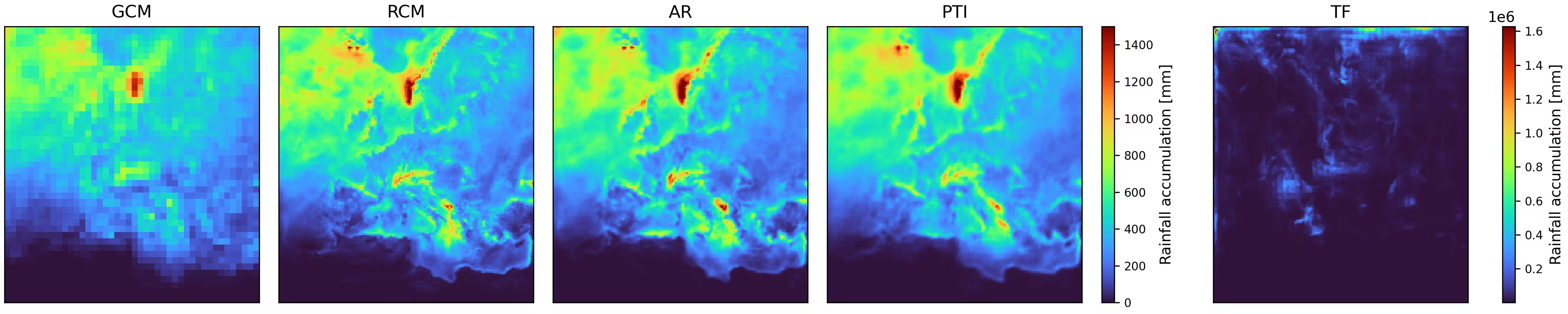
How Does Adjustable Noise Control Weather Consistency?
During training, the diffusion model learns to weigh the previous hour against concurrent global climate model data by adjusting to the information content left in the noisy input. At inference time, a single scalar parameter controls the noise level, allowing scientists to dial in the exact degree of temporal coupling they need. Setting the noise parameter to maximum treats each timestep independently, which provides an easy way to initialize long rollouts without needing prior high-resolution observations. Lowering the noise parameter activates full autoregressive feedback, forcing the model to anchor its predictions in its own recent past.
When tested on a six-month historical European simulation covering July through December 2021, the autoregressive setup successfully tracked reference regional climate model autocorrelation functions across hourly to weekly timescales. The authors report that the model showed no progressive degradation or runaway error accumulation over the entire half-year rollout. The only notable change was a slight contraction of ensemble spread during the first twenty-four hours before stabilizing at a constant level.
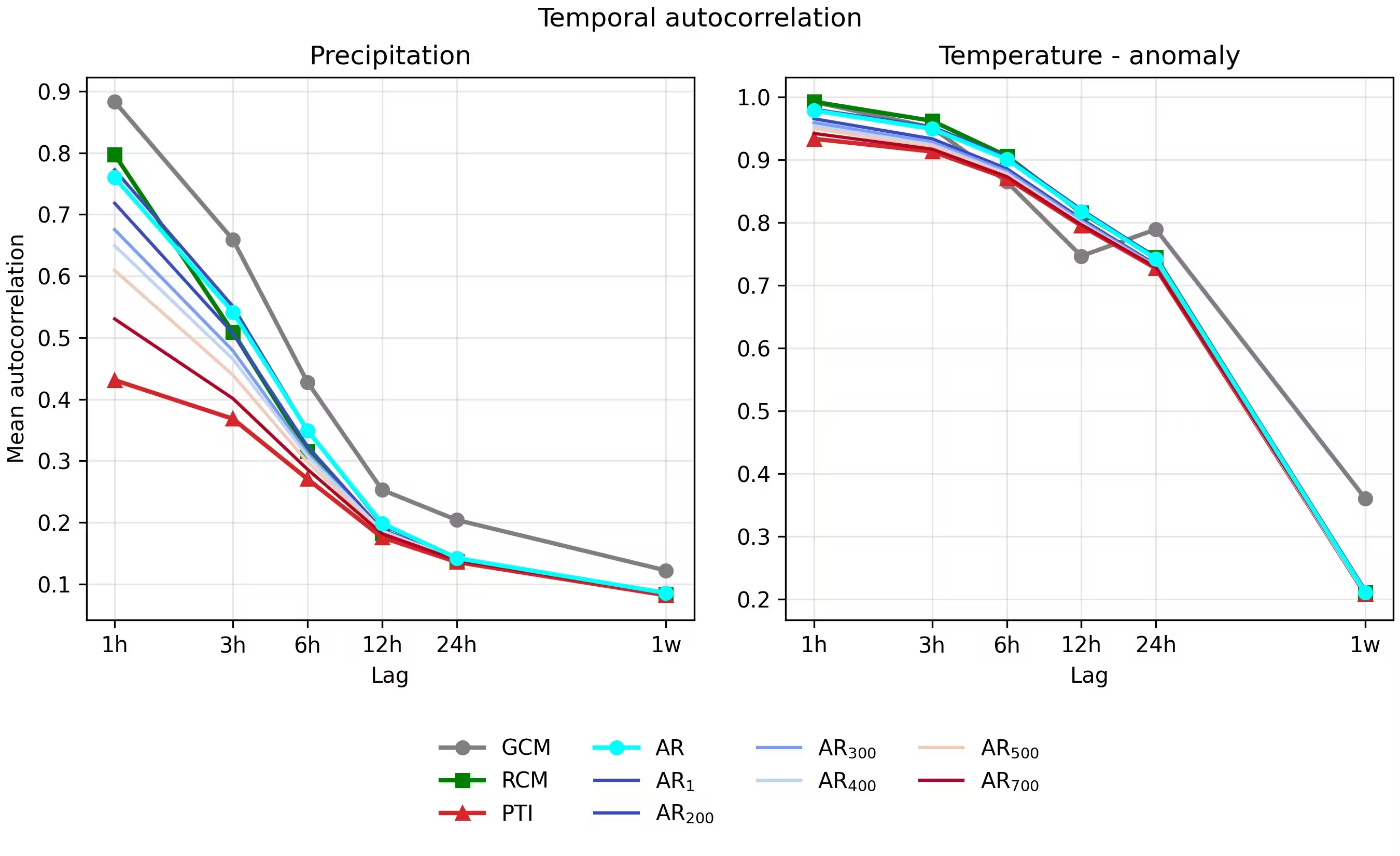
Why Do Accumulated Extremes Matter for Hydrology?
While hourly precipitation maps looked plausible under both independent and autoregressive modes, the differences grew stark when researchers aggregated rainfall over twenty-four hours or longer. Independent hourly generation underestimated extreme daily precipitation totals by up to a factor of two, because inconsistent storm positions failed to stack together correctly over time. In contrast, the autoregressive mode maintained smooth, physically coherent storm trajectories that captured extreme precipitation quantiles much more closely.
For two-meter temperature fields, the distinctions between independent and autoregressive modes proved much smaller, as temperature cycles remain heavily constrained by global climate inputs regardless of temporal feedback. The researchers note that while autoregressive feedback introduces a mild underdispersion at the native one-hour resolution, it successfully preserves the multi-hour accumulation structures vital for hydrological forecasting, soil saturation tracking, and flood risk assessment.
The study was posted to the arXiv preprint server on November 20, 2026.
This article has been fact checked for accuracy, with information verified against reputable sources. Learn more about us and our editorial process.
Last reviewed on .
Article history
- Latest version
Reference(s)
- Glawion, Luca. “Beyond Resolution: Inference-Time Parameterized Temporal Consistency in Generative Regional Climate Downscaling.” arXiv.org <http://arxiv.org/abs/2611.27641v1>.
Cite this page:
- Posted by Divya Iyer