Why 35,000 Hidden Pulsars Still Can’t Dismiss Dark Matter in Milky Way’s Gamma Ray Mystery
A faint glow at the Milky Way’s center pushes astronomers to revisit a long‑debated space mystery—can new analysis finally solve it?
A diffuse burst of high‑energy photons emanating from the Milky Way’s nucleus continues to puzzle astronomers. Recent analysis does not eliminate the prospect that the signal, termed the Galactic Center Excess, could arise from dark matter particles that annihilate themselves.
Why the Galactic Core Is a Tough Spot for Researchers
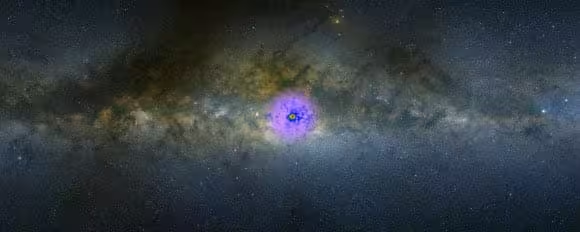
The central region of the Milky Way is crowded with luminous sources and dense clouds of gas, making it one of the brightest gamma‑ray locales in the sky. This complexity hampers efforts to isolate any single contributor to the observed glow.
In a recent paper, Florian List of the University of Vienna highlights the difficulty, noting that the region’s intense brightness and source congestion pose a major challenge for interpretation.
“Interpreting the signal is particularly difficult because the Galactic Center is an exceptionally bright and crowded region of the gamma-ray sky.”
Competing Explanations: Pulsars Versus Dark Matter
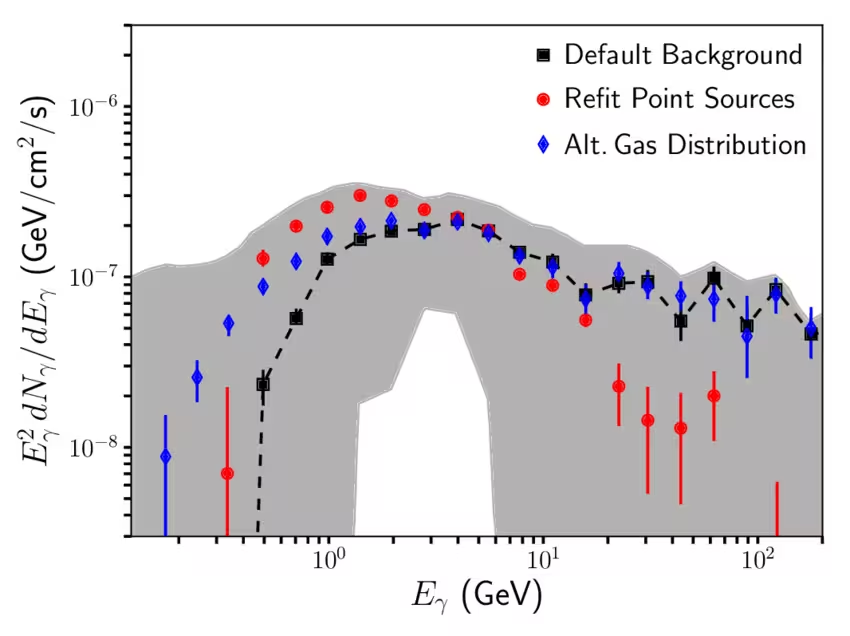
Two main hypotheses dominate the debate. One attributes the excess to clusters of rapidly rotating neutron stars—pulsars—that can generate gamma radiation. The alternative posits a class of dark‑matter particles that are their own antiparticles; when such particles collide, they would annihilate and emit gamma rays.
The latter scenario is grounded in the notion that certain dark‑matter candidates could self‑annihilate, a process analogous to electron‑positron annihilation, but it would only become significant where dark matter is densely concentrated.
Machine‑Learning Survey Redefines the Pulsar Scenario
To weigh these alternatives, List and his team trained a machine‑learning algorithm on over a million synthetic gamma‑ray maps. Earlier work had suggested that a modest population of unresolved point sources could account for the excess. The new model, however, indicates that such sources would need to be exceedingly dim, rendering them practically indistinguishable from a dark‑matter signal.
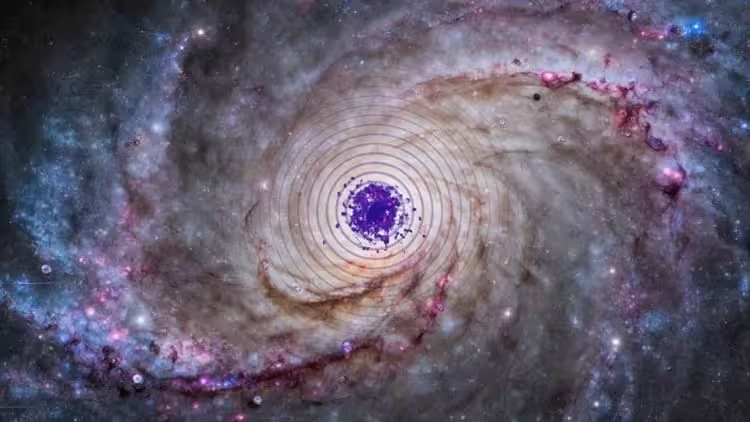
Quantitatively, the analysis raises the required number of pulsars from a few hundred—previous estimates—to more than 35,000 concentrated near the Galactic Center.
Nick Rodd, a researcher at Lawrence Berkeley National Laboratory, commented that the faintness required for the point‑source explanation makes it almost indistinguishable from the signature expected of self‑annihilating dark matter.
“Our new analysis shows that the sources would have to be so faint that they would be almost indistinguishable from the emission expected from annihilating dark matter.”
Implications and Outlook
The findings, published in Physical Review Letters, do not settle the debate but caution against dismissing the dark‑matter hypothesis outright. List emphasizes that while the study does not prove dark matter as the source, it demonstrates that excluding it would be premature.
As observations improve and computational techniques evolve, the astrophysics community will continue to probe whether the mysterious gamma‑ray glow is the signature of exotic particles or the collective output of countless, faint pulsars.
This article has been fact checked for accuracy, with information verified against reputable sources. Learn more about us and our editorial process.
Last reviewed on .
Article history
- Latest version
Reference(s)
- “Florian List.” <https://scholar.google.com/citations?user=XXD-JPMAAAAJ&hl=en>.
- “Nick Rodd | LBNL Theory.” <https://www-theory.lbl.gov/?page_id=12106>.
- List, Florian., et al. “Energy Distribution of the Galactic Center Excess’s Sources.” Physical Review Letters, vol. 136, no. 23, June 12, 2026 American Physical Society (APS), doi: 10.1103/dkcq-6y4f. <https://journals.aps.org/prl/abstract/10.1103/dkcq-6y4f>.
Cite this page:
- Posted by Asif Iqbal