SpaceX IPO makes Musk trillionaire and turns 4,400 workers into millionaires overnight
Revolucionó Wall Street con fortuna récord en la salida a bolsa de SpaceX, cambiando destinos más allá de Musk
On Friday, June 12, 2026, SpaceX president and chief operating officer Gwynne Shotwell gathered with colleagues at the Nasdaq MarketSite in New York as the company marked its first day of trading as a public entity. Within hours, the debut transformed the high‑profile private firm into a market powerhouse valued at roughly $2.1 trillion.
Shares began trading around midday at $150, climbed to about $168, and closed the session just under $161, according to the Associated Press. That closing price placed SpaceX as the sixth‑largest public corporation in the United States, surpassing Tesla in market capitalization.
The flotation also converted years of employee equity into headline‑making wealth. More than 4,400 current and former staff members were projected to become millionaires, while roughly 400 were set to exceed the $100 million threshold, as reported by the New York Times.
SpaceX’s Debut Propels It Into Billion‑Dollar Club
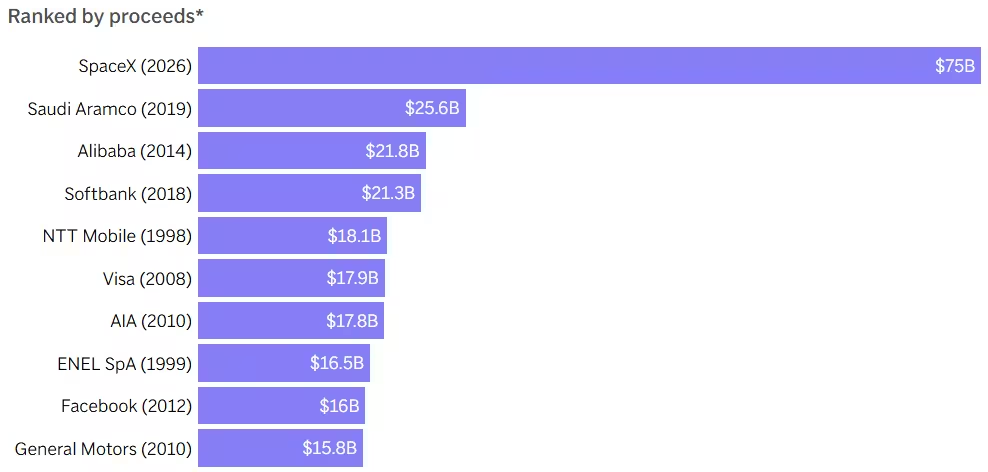
Investors poured $75 billion into the offering at $135 per share before the market opened, establishing the largest U.S. initial public offering on record and eclipsing the 2019 Saudi Aramco benchmark.
Robust demand reflected confidence in SpaceX’s long‑term prospects despite a reported $8.7 billion loss spanning from the start of 2025 through March 31, 2026. Buyers cited the company’s launch services, Starlink broadband constellation, plans for orbital data centers, and artificial‑intelligence initiatives as primary attractions.
Founded in 2002, SpaceX now operates a portfolio that includes launch vehicles, spacecraft, and thousands of Starlink satellites. CEO Elon Musk linked the public offering to broader ambitions such as expanding satellite services, establishing space‑based data centers, and ultimately building a human settlement on Mars.
Musk joined the Nasdaq opening ceremony from the company’s South Texas launch site at Starbase rather than from New York, reiterating his vision of a “multiplanetary” future and tying the IPO to those long‑range goals.
Elon Musk’s Net Worth Crosses the Trillion‑Dollar Threshold
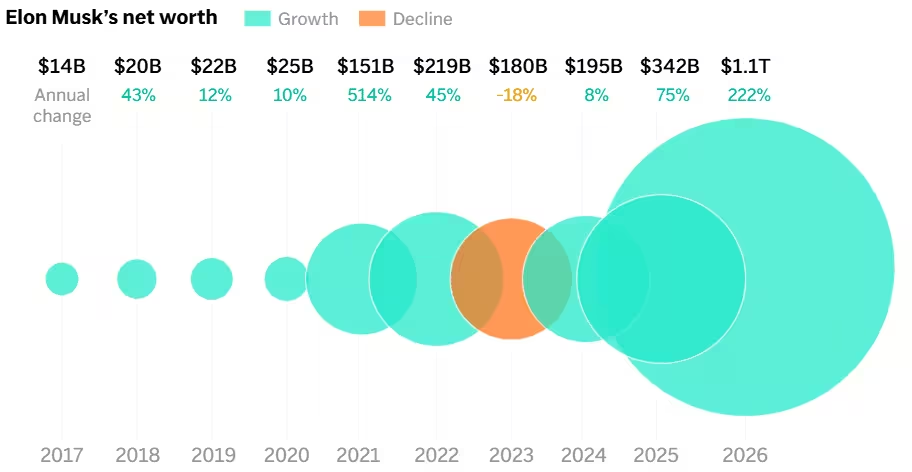
The listing propelled Musk into trillion‑dollar territory on paper. Combining his stakes in SpaceX and Tesla, Forbes estimated his wealth at $1.1 trillion after the first day of trading, a figure highlighted by ABC News as a potential first for a private individual.
Most of that fortune is tied up in equity, not cash. Musk retains roughly four out of every ten SpaceX shares post‑offering, and regulatory filings indicate he cannot dispose of those holdings for a full year.
With the debut, SpaceX’s market value exceeded that of Tesla, even though many of its future initiatives rely on technologies that have yet to be proven at scale.
Employee Equity Turns Into Paper Fortunes
The financial windfall extended well beyond the founder and senior executives. Stock awards had long been part of the compensation package for staff who joined SpaceX while it was still a private, high‑risk venture.
Around 400 workers and former employees were projected to become “centimillionaires,” a status typically reserved for founders or early‑stage investors. Andrew Benson, head of Hill.com, described the scenario as exceptionally rare for an IPO to generate that many individuals with at least $100 million in paper wealth.
These gains remain theoretical until employees sell their shares under the post‑IPO lock‑up rules. A public market price provides a valuation benchmark, but it also subjects the equity to daily fluctuations that could erode the paper wealth if investor sentiment shifts.
Long‑Term Staff Share Their Success Stories
Trevor Hise, a former launch engineer who joined SpaceX in 2011 after graduation, exemplifies how early equity can pay off. Holding more than 100,000 shares, his stake would be worth at least $13.5 million at the $135 price point, allowing him to retire at 37 and consider establishing a philanthropic foundation with his wife.
Gavin Petit made a comparable gamble when he accepted a $80,000 salary in 2012 and chose to accumulate stock instead of taking cash bonuses. At the time of the IPO, his holdings were valued at roughly $13.80 per share.
Both narratives underscore the uncertainty employees faced when SpaceX endured failed rocket tests and looming bankruptcy fears. Those who retained their shares through turbulent periods bet that the company would ultimately survive long enough for equity to matter.
Some Former Staff Missed the Timing
The IPO also highlighted a tougher outcome for workers who liquidated their positions before the public debut, often due to burnout or skepticism about a public listing. Unverified anecdotes suggested that a few early employees exchanged shares for restaurant gift cards, though no concrete financial records confirm those claims.
Others, like former global supply‑chain manager Helvin Bacareza, left the firm after two years in 2020 with a sizable stock portfolio and chose to hold the shares beyond the lock‑up period, positioning themselves to benefit from the market debut.
At the close of Friday’s session, SpaceX’s share price settled just under $161, assigning the company a market capitalization of approximately $2.1 trillion.
This article has been fact checked for accuracy, with information verified against reputable sources. Learn more about us and our editorial process.
Last reviewed on .
Article history
- Latest version
Reference(s)
- Condon, Bernard. “SpaceX soars in debut and makes Musk the first trillionaire.”, June 12, 2026 AP News <https://apnews.com/article/musk-spacex-tesla-ipo-trillionaire-billionaire-worth-rockets-7723f82b6063a9a17c194e25982cd66d>.
- <https://www.nytimes.com/2026/06/10/technology/spacex-ipo-employee-millionaires.html>.
- <https://abcnews.com/Business/spacex-ipo-make-elon-musk-trillionaire/story>.
Cite this page:
- Posted by Asif Iqbal