ESA Spacecraft Gets Massive Gravity Boost During Rare Earth Flyby To Reach Jupiter
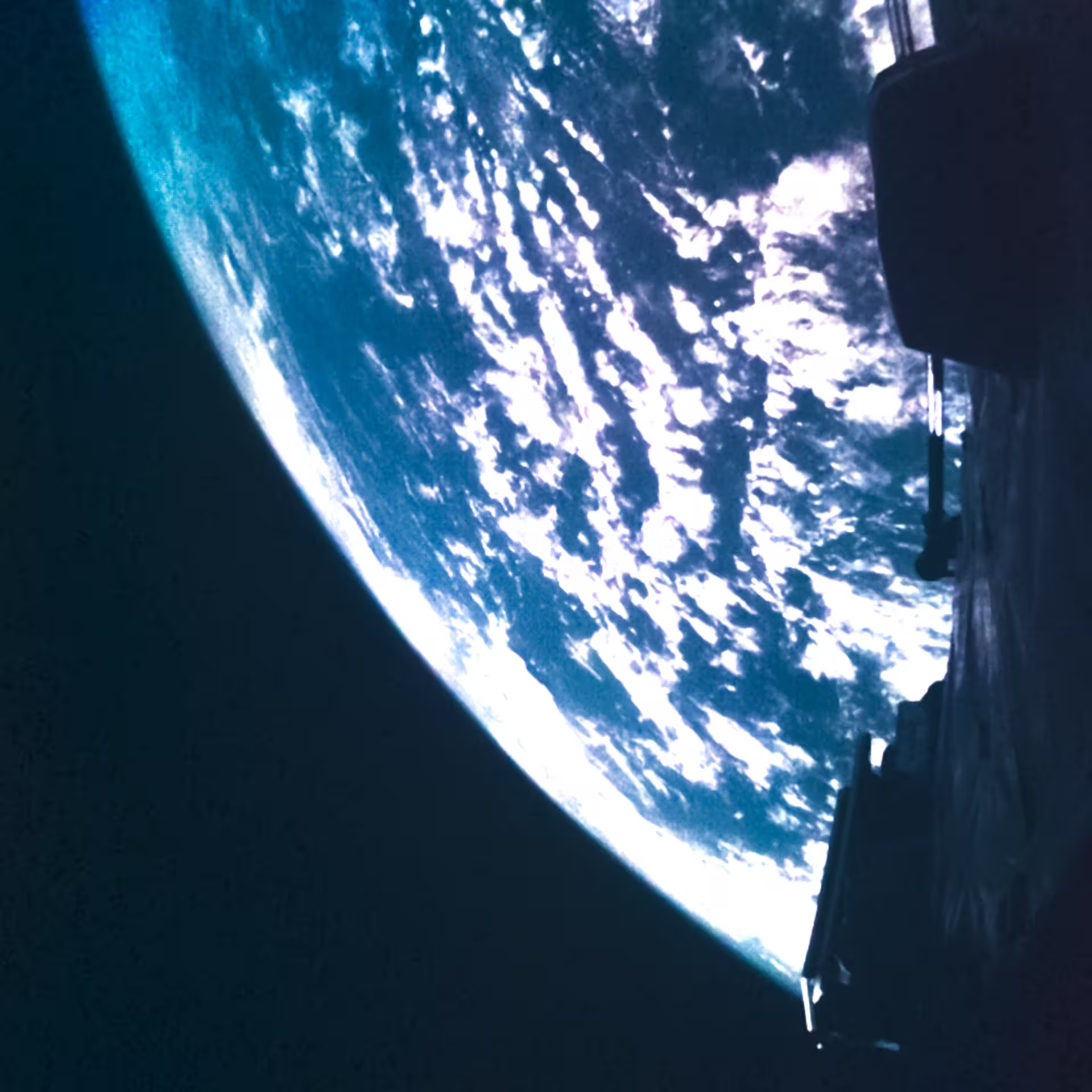
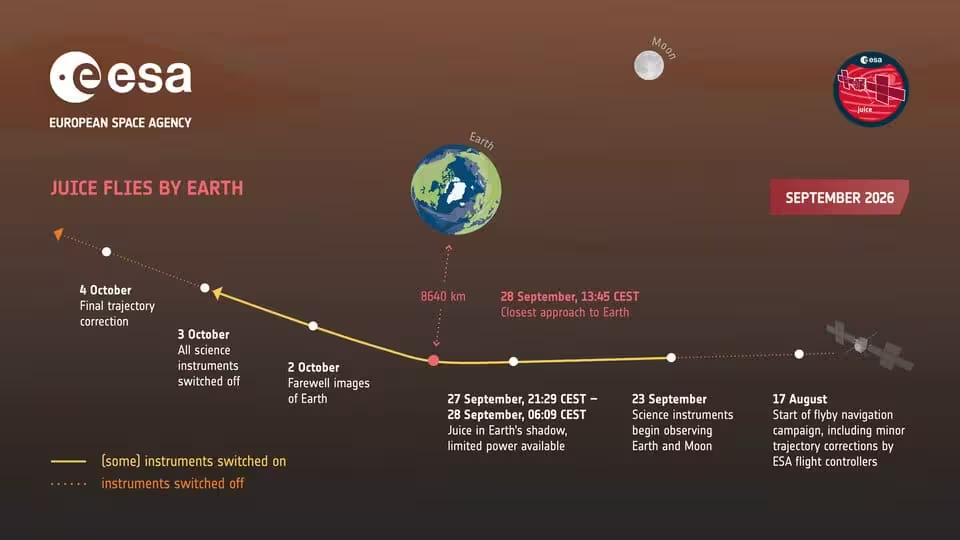
ESA’s JUICE spacecraft has successfully performed a lunar-Earth flyby, using gravity to slingshot toward its mission to explore Jupiter and its icy moons.

The European Space Agency’s (ESA) JUICE probe has successfully executed a gravity-assist maneuver, utilizing Earth’s gravitational pull to slingshot itself further into the depths of our Solar System. This high-stakes orbital adjustment serves as a critical milestone in the spacecraft’s multi-year trek toward Jupiter, where it is tasked with investigating the potential for life within the hidden oceans of the gas giant’s icy satellites.
Propelling Deep Space Exploration Through Orbital Mechanics
Launched in April 2023, the Jupiter Icy Moons Explorer (JUICE) faces a daunting 400-million-mile voyage. Given the immense energy required to reach the Jovian system, direct propulsion is impractical. Instead, mission architects rely on carefully choreographed planetary encounters to alter the craft’s velocity and trajectory.
By skimming past Earth, JUICE exchanged momentum with our planet, gaining a significant boost in speed without depleting its limited fuel reserves. This refined path is the result of years of trajectory modeling, ensuring that the probe remains perfectly aligned for future encounters that will eventually guide it to the outer reaches of the Sun’s influence.
Strategic Targets in the Jovian System
According to official updates from the ESA, the successful flyby keeps the mission on schedule for its 2031 arrival at Jupiter. Once it enters the Jovian neighborhood, the spacecraft will begin an intensive observation phase, targeting three major moons: Ganymede, Callisto, and Europa.
Ganymede is a primary focus for the team, as it stands out as the only known moon in the Solar System capable of generating its own magnetic field. JUICE is equipped to peer beneath these frozen exteriors to map subsurface oceans and characterize the interior structures that may harbor the building blocks of life.
Advanced Instrumentation for Planetary Science
The spacecraft carries a sophisticated suite of sensors, including high-resolution cameras, radar, and spectrometers. These tools are engineered to conduct a holistic study of the Jovian system, analyzing everything from the turbulent atmosphere of the planet itself to the tidal forces that keep the icy shells of its moons in a constant state of flux.
Researchers hope that by studying how these worlds evolve in the shadow of a massive gas giant, they can better understand the fundamental conditions that render a world habitable. This data will provide a necessary counterpoint to existing Earth-based observations, painting a more complete picture of planetary evolution.
The Road Ahead
Despite this successful maneuver, the mission is far from its final destination. JUICE must complete a series of additional gravitational assists before it can begin its primary scientific mission. This long-term commitment reflects Europe’s most ambitious push into deep-space exploration to date, with expectations that the findings will reshape our understanding of icy environments in the outer Solar System for decades to come.
This article has been fact checked for accuracy, with information verified against reputable sources. Learn more about us and our editorial process.
Last reviewed on .
Article history
- Latest version
Reference(s)
- “Juice to fly past Earth for third gravity assist.” <https://www.esa.int/Science_Exploration/Space_Science/Juice/Juice_to_fly_past_Earth_for_third_gravity_assist>.
Cite this page:
- Posted by Aisha Ahmed