Deep Learning Weighs Massive Galaxy Clusters Using Starlight Alone
Neural networks trained on hydrodynamical simulations successfully map invisible dark matter and cluster substructures from Hubble Space Telescope optical imaging.
Massive galaxy clusters spanning up to 500 kiloparsecs across can now be weighed in seconds using optical starlight alone, thanks to a deep-learning architecture that maps invisible dark matter directly from telescope images. The new study, available on the arXiv preprint server, demonstrates that artificial intelligence can bypass traditional gravitational lensing bottlenecks to reconstruct the hidden subatomic scaffolding of the universe.
Weighing Cosmic Giants Through Starlight
Galaxy clusters represent the final stage of hierarchical structure formation in the cosmos. Primarily composed of dark matter, which contributes roughly 85 percent of their total mass, these massive structures hide their true weight because dark matter does not interact with light. Ordinary baryonic matter, consisting of hot gas and shining stars, accounts for only the remaining 15 percent.
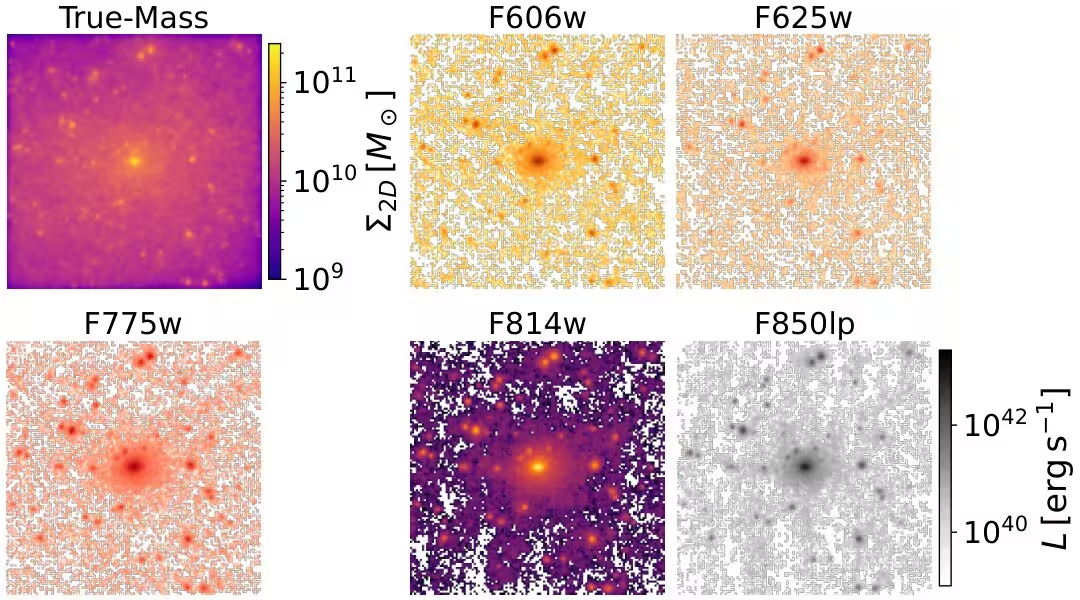
Traditionally, astronomers estimate cluster masses using gravitational lensing, where the gravity of a cluster bends the light of background galaxies. While powerful, lensing techniques often rely on smooth analytical profiles that wash out critical internal substructures. To solve this limitation, the researchers trained a series of advanced neural networks on mock telescope observations derived from The Three Hundred simulation suite, a collection of 324 simulated massive cluster regions spanning up to 1 gigaparsec across.
Neural Network Architecture and Training Details
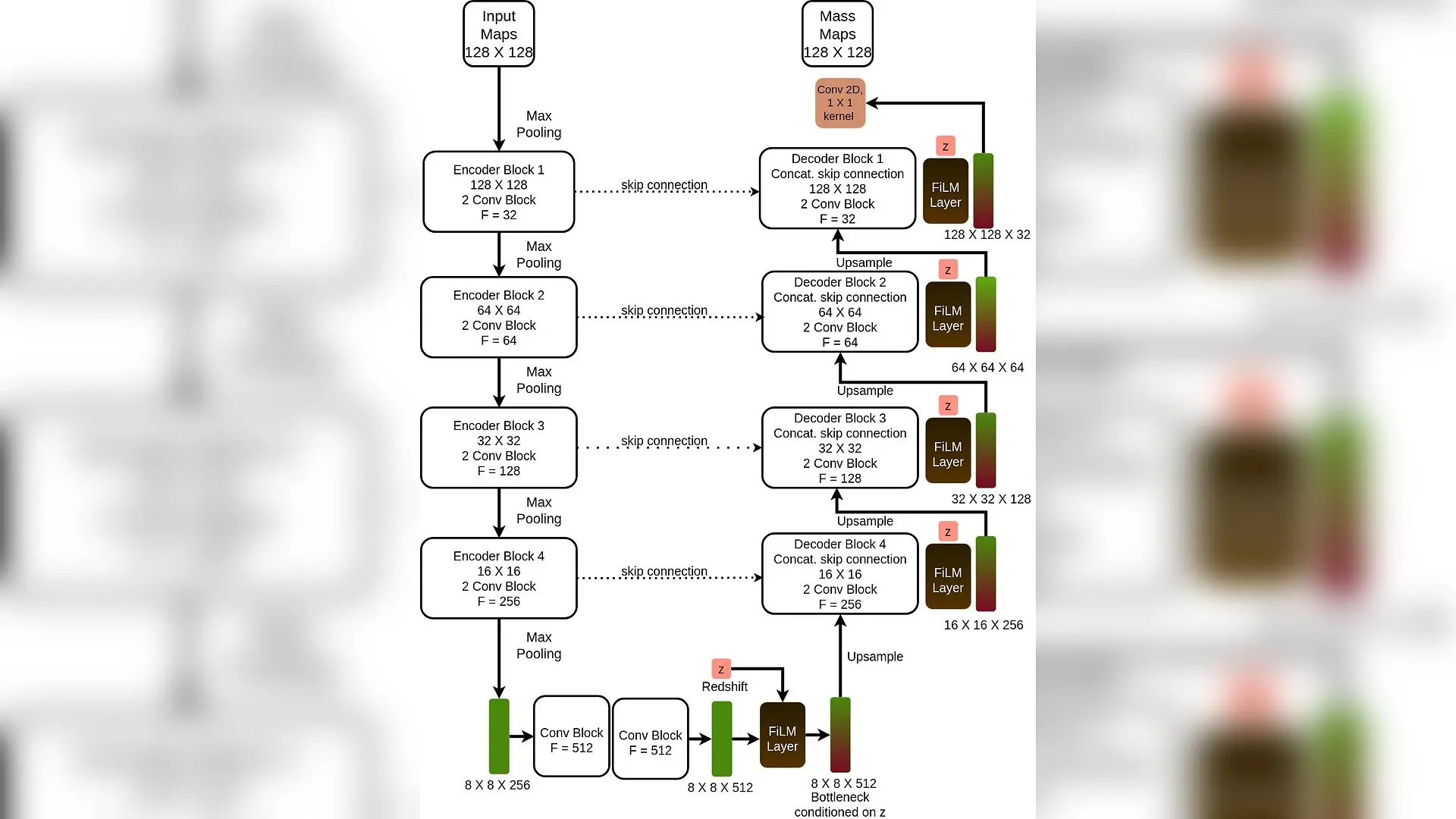
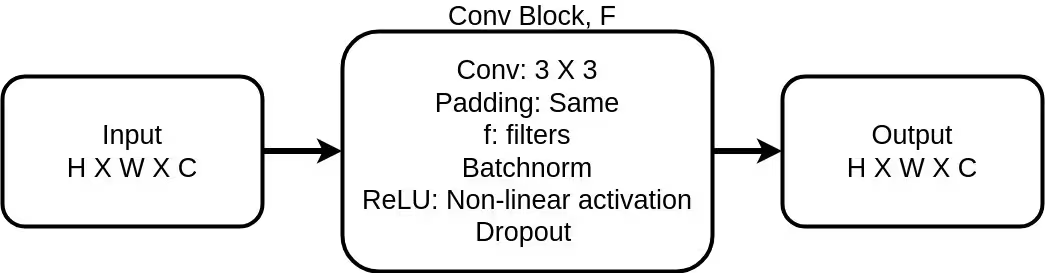
The research team employed a modified U-Net architecture originally designed for biomedical image segmentation. The network was trained using 3,273 simulated galaxy clusters matching the mass and redshift range of real observations from the Hubble Space Telescope Cluster Lensing and Supernova Survey with Hubble, known as the CLASH program. This survey comprises 25 massive clusters spanning redshifts from 0.19 to 0.89.
To prepare realistic training data, the authors used the PyMGal package to assign spectral energy distributions to simulation particles based on stellar population synthesis models. They incorporated instrumental point spread functions and realistic background noise templates extracted from blank-sky regions in actual Hubble images using the photutils package. The models process input images with a physical field of view of 500 by 500 kiloparsecs, down-sampled to 128 by 128 pixels.
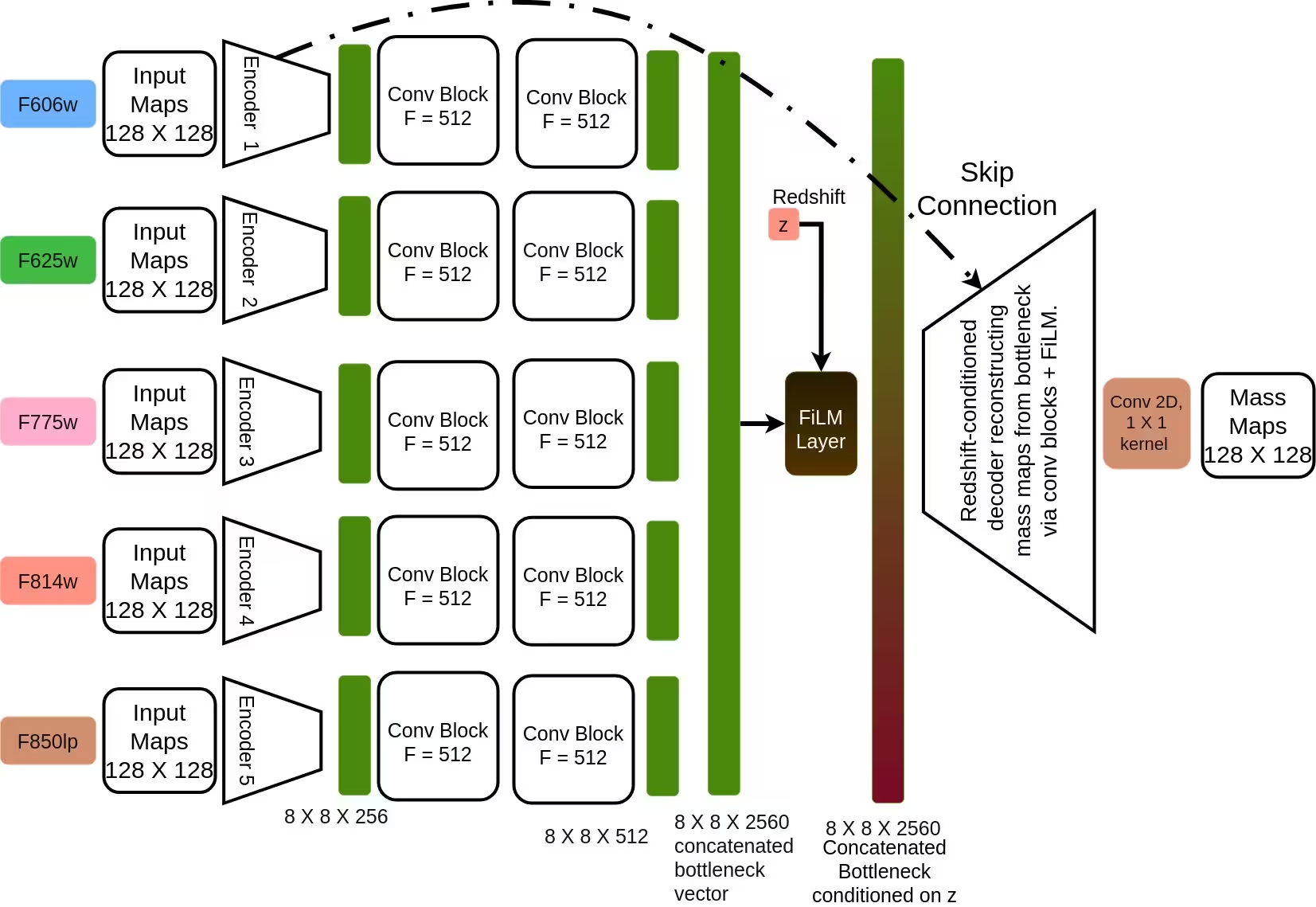
The framework integrates Feature-wise Linear Modulation layers to condition the network on cluster redshift, ensuring it adapts its internal feature representations accordingly. The models were optimized using the Adam optimizer with an initial learning rate of 10 to the minus 4th power for up to 150 epochs. Among the tested configurations, which included single-channel, multi-channel, and multi-encoder setups, the multi-encoder architecture demonstrated the most robust performance across independent simulation tests.
Validating Mass Maps Against Real Observations
When applied to real Hubble observations of 21 CLASH clusters, the deep-learning models successfully reconstructed projected mass maps that mirrored the overall morphology and radial mass profiles derived from independent lensing analyses. For five clusters with available spectroscopic data, including Abell 209 and MACS J0416 minus 2403, the authors masked non-member galaxies and point sources to isolate cluster subhalos.
The reconstructed mass maps revealed clumpier structures and higher contrast than traditional lensing maps. The authors attribute this difference to the fact that light-traces-mass lensing models rely on smooth analytical profiles, whereas the U-Net architecture utilizes the complex distribution of galaxy luminosities. Furthermore, the subhalo mass functions derived from the neural network predictions exhibited a power-law behavior with a mean logarithmic slope of minus 0.91, showing broad consistency with theoretical predictions from numerical simulations.
Limitations and Future Survey Applications
Despite the strong agreement, the authors note several potential sources of systematic uncertainty. Domain shift between simulated training data and real observations can arise from differences in stellar population histories, baryonic physics models, and imperfect foreground masking in photometric-redshift samples. Additionally, integrating over a line-of-sight depth of plus or minus 5 times the characteristic radius may exclude larger foreground and background structures.
The authors suggest that this simulation-based inference framework offers a scalable alternative for processing massive datasets from upcoming wide-field surveys such as Euclid, the Chinese Space Station Telescope, and the Legacy Survey of Space and Time. By operating on optical photometry alone, the approach provides reliable mass proxies even where shear measurements are unavailable.
The study was posted to the arXiv preprint server on November 13, 2026.
This article has been fact checked for accuracy, with information verified against reputable sources. Learn more about us and our editorial process.
Last reviewed on .
Article history
- Latest version
Reference(s)
- Srivastava, Atulit. “Precise Deep-Learning Reconstruction of Galaxy Cluster Mass Maps and Substructures from Optical Observations.” arXiv.org <http://arxiv.org/abs/2611.18487v1>.
Cite this page:
- Posted by Aisha Ahmed