Relativistic Galaxy Distortions Cannot Explain Cosmic Parity Violation
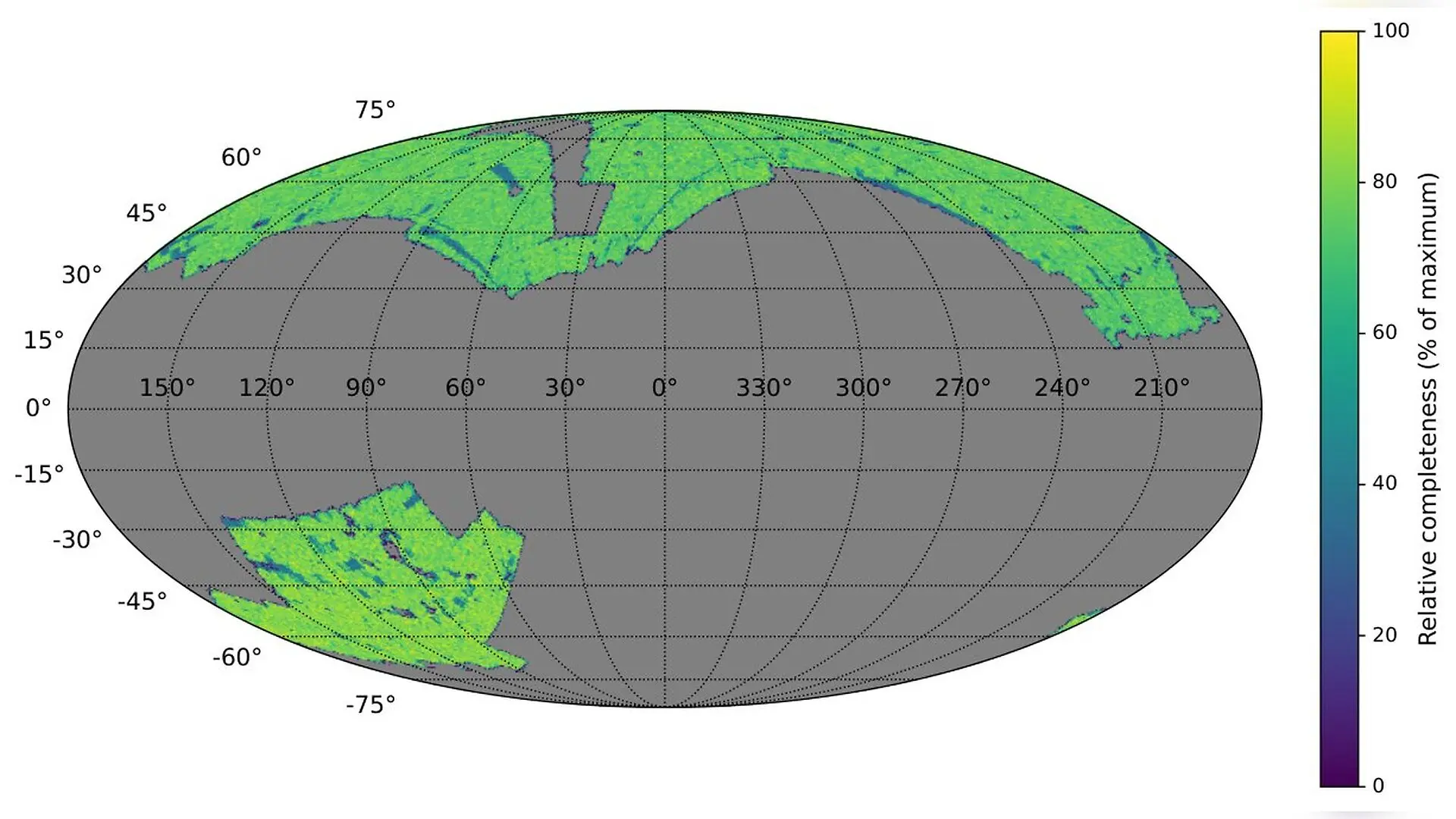
Cosmological observations of galaxy distributions across the universe reveal that standard cosmic motion cannot account for certain strange asymmetry signals, leaving scientists searching for explanations. A theoretical study has now evaluated whether standard observational distortions can fake these parity signals in large surveys spanning billions of light-years.
Can Relativistic Velocity Shifts Mimic Cosmic Mirror Asymmetry?
Recent measurements of galaxy clustering using four-point statistical tools, which map the geometric tetrahedrons formed by quadruplets of galaxies, have reported intriguing signs of parity violation. In physics, parity symmetry dictates that the laws of physics should remain identical if spatial coordinates are inverted through a mirror reflection. Because General Relativity strictly preserves parity, any true detection of asymmetry would point toward new fundamental physics beyond our standard models, such as exotic inflationary mechanisms or topological defects in the early universe.
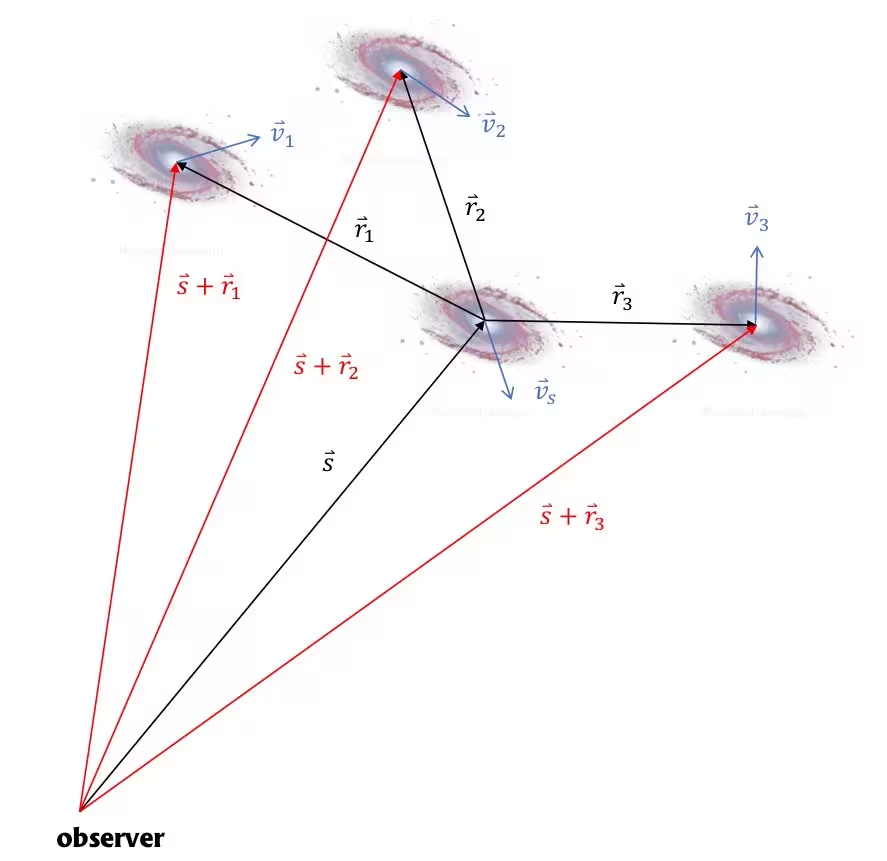
However, astronomers must first rule out instrumental and observational artifacts before claiming a paradigm-shifting discovery. The most prominent suspect is Redshift Space Distortion, a well-known phenomenon where the peculiar velocities of galaxies alter their measured redshifts, shifting their perceived positions along the line of sight. Because these velocity vectors depend on the observer viewing angle, they introduce directional projections that could theoretically create artificial parity imbalances in galaxy catalogs.
To investigate this possibility, a team of researchers led by Chanasorn Kongprachaya, Nicola Bartolo, Daniele Bertacca, and Sabino Matarrese carried out a rigorous mathematical examination of galaxy density fields. The work is published on the arXiv preprint server and explores perturbation theory up to third order. The authors specifically incorporated relativistic corrections up to the leading order of the ratio between the Hubble scale and the comoving wave number, alongside complex galaxy bias expansions and tidal field effects.
How Spherical Integrals Erase Directional Bias
The core of the investigation focused on whether these velocity-induced distortions survive the data processing pipelines used in modern astronomy. Galaxy surveys do not look at isolated directions, but instead average measurements across massive survey volumes and numerous lines of sight. When the researchers calculated the isotropic four-point correlation function estimator, they mapped the geometric projection factors onto spherical harmonics.
The mathematical framework demonstrates that any parity-odd contribution from redshift space distortions always couples directly to the observer line of sight through specific cosine factors. When the statistical estimator integrates these contributions over all possible orientations on the sky, angular momentum selection rules governed by Wigner 3-j symbols and Gaunt integrals force parity-odd terms to vanish completely. In simpler terms, the directional handedness introduced by galaxy peculiar velocities is entirely washed out by the spherical averaging process.
This conclusion holds true even when moving beyond the traditional plane-parallel approximation. By assigning unique local lines of sight to every galaxy in a tetrahedron to account for wide-angle effects in surveys spanning hundreds of megaparsecs, the team found that the total angular momentum sum remains strictly even, preserving parity conservation.
What This Means for Current and Future Surveys
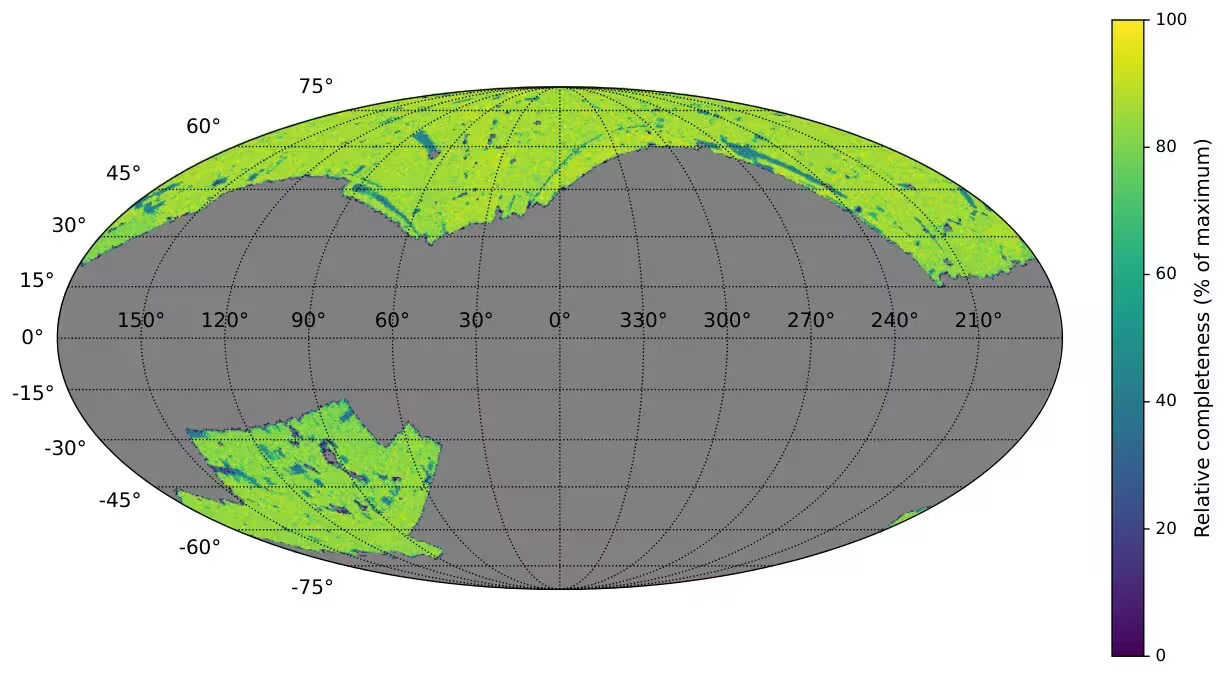
These findings indicate that standard redshift space distortions and their leading relativistic corrections cannot generate the parity-odd signals detected in major observational campaigns such as the Sloan Digital Sky Survey and the Dark Energy Spectroscopic Instrument. The analysis also evaluated potential caveats, such as incomplete sky coverage and survey window functions, noting that odd multipole leakage from masked galactic planes introduces only negligible corrections.
Ultimately, the results strengthen the interpretation that if future high-precision surveys confirm parity violation in the large-scale structure of the cosmos, the signal must reflect genuine physical phenomena originating in the early universe rather than a routine data artifact.
The study was posted to the arXiv preprint server on November 13, 2026.
This article has been fact checked for accuracy, with information verified against reputable sources. Learn more about us and our editorial process.
Last reviewed on .
Article history
- Latest version
Reference(s)
- Kongprachaya, Chanasorn. “Parity conservation of the isotropic galaxy 4PCF in redshift space.” arXiv.org <http://arxiv.org/abs/2611.18515v1>.
Cite this page:
- Posted by Aisha Ahmed