Cosmic Data Hints Dark Energy Changes Over Time in Past 6 Billion Years
A new non-parametric reconstruction of cosmic expansion and gravity points to a potential crossing of the phantom divide.
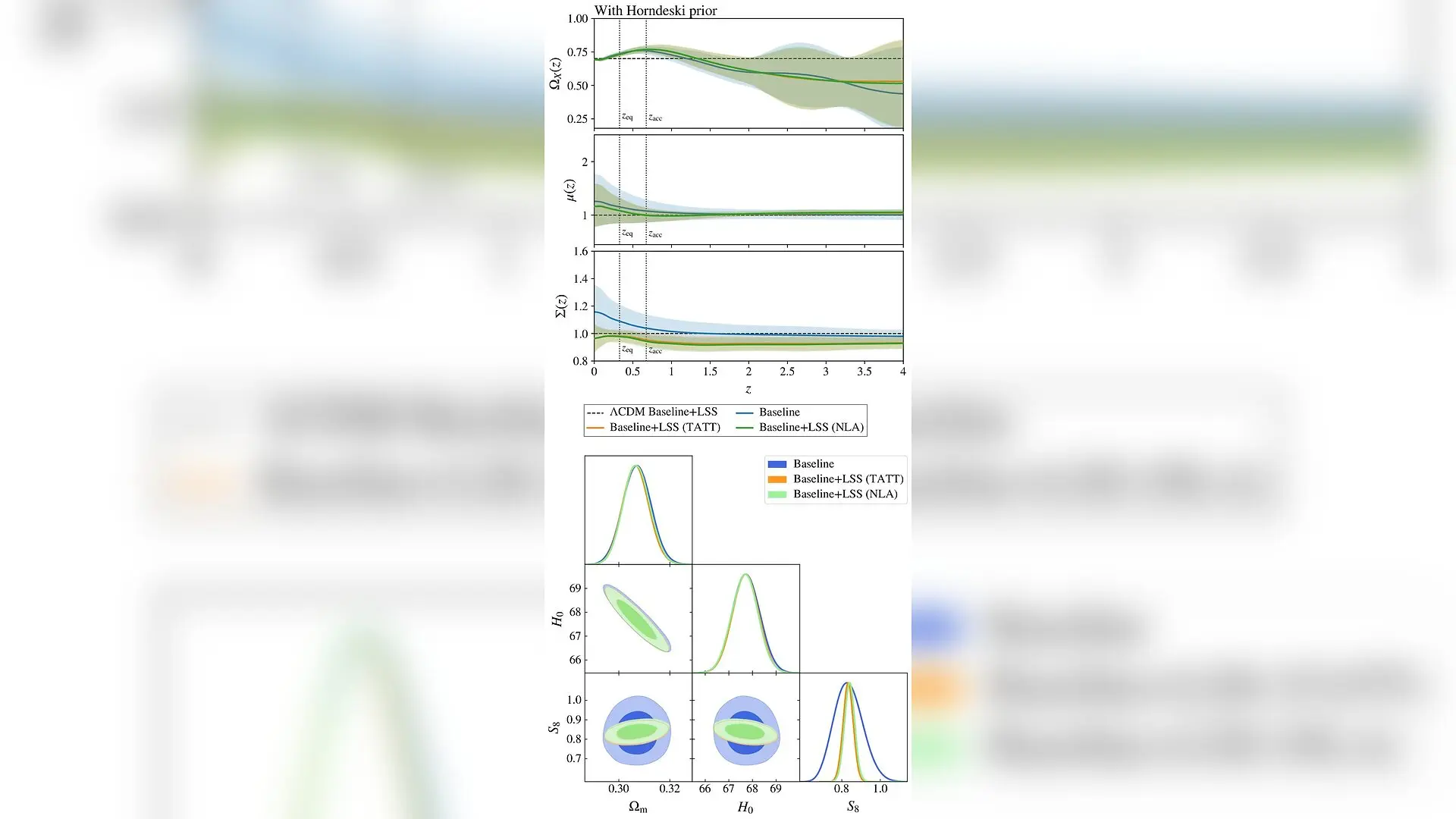
Cosmological data spanning billions of light-years suggest that dark energy might not be the unchanging cosmological constant that scientists long assumed. A team of researchers has analyzed recent precision measurements to reconstruct how the universe expanded and how gravity behaved over the last several billion years.
Led by Maria Luisa Gallavotti and Alessandra Silvestri from Leiden University, the study examined whether departures from standard cosmic evolution are accompanied by modifications to gravitational dynamics. Their work, available on the arXiv preprint server, combines observations from the Cosmic Microwave Background, the Dark Energy Spectroscopic Instrument, Type Ia supernovae, and large-scale structure surveys. The findings point to a persistent peak in the effective dark energy density at a redshift of roughly 0.5 to 0.7, corresponding to an era that began about 5 billion to 6 billion years ago.
What Does an Evolving Dark Energy Density Mean for the Universe?
In standard cosmology, dark energy is modeled as a constant energy density that drives the accelerated expansion of the universe. However, recent observations have hinted that this force might be dynamic, changing strength over time. To investigate this without assuming a specific mathematical formula, the authors performed a joint, non-parametric reconstruction of three key functions representing the effective dark energy density, matter clustering, and gravitational lensing.
When the researchers reconstructed the expansion history, they discovered a distinct maximum in the effective dark energy density at redshifts between 0.5 and 0.7. In terms of the derived effective equation of state, which describes how the pressure of dark energy relates to its energy density, this peak corresponds to crossing the phantom divide. This boundary separates standard cosmological behavior from more extreme scenarios where the energy density of dark energy increases over time.
How Robust is the Phantom Crossing Feature?
To ensure this feature was not an artifact of data overfitting or statistical noise, the team applied a theory-motivated correlation prior derived from stable Horndeski gravity models, alongside a statistical technique called covariant principal-component analysis. This allowed them to distinguish between variations genuinely constrained by observations and those shaped by theoretical smoothing.
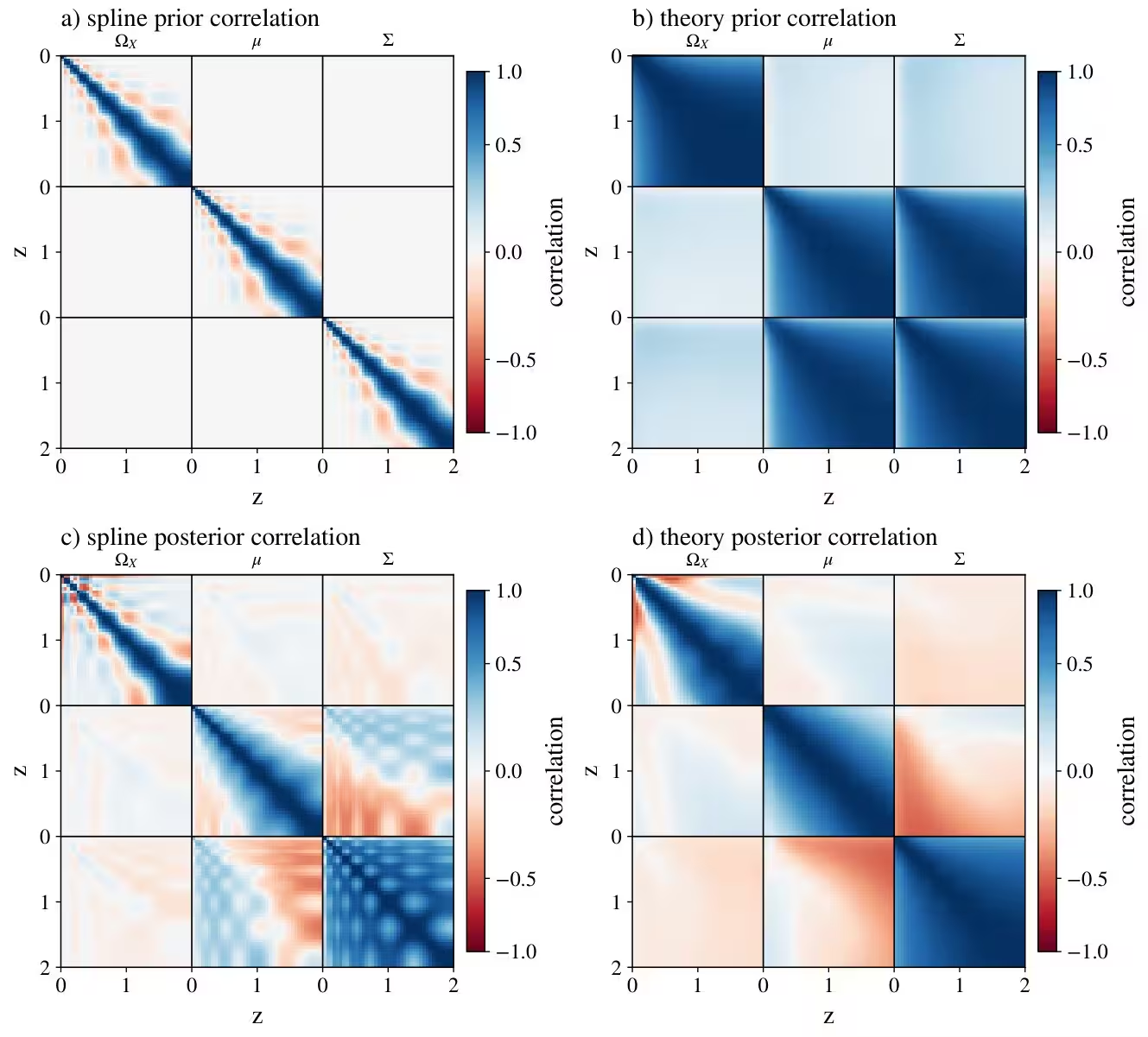
The analysis revealed that the low-redshift maximum in dark energy density remains robust across multiple dataset combinations. Furthermore, auxiliary background-only reconstructions demonstrated that the feature is already present in the combination of Cosmic Microwave Background and baryon acoustic oscillation data alone. Adding supernova measurements and large-scale structure data refines the shape and amplitude of the peak, but does not erase it.
Does Gravity Also Show Deviations from General Relativity?
While the background expansion history shows clear departures from the standard model, the perturbation sector presents a more subtle picture. The researchers tracked two gravitational response functions: one governing how matter clumps together, and another governing how gravity bends light. When incorporating large-scale structure data from the Dark Energy Survey Year 3 measurements, the data favored a reduced lensing response compared to standard expectations.
Interpreted within the framework of Generalized Brans-Dicke scalar-tensor theories, these trends suggest a delicate balance between a non-minimal coupling of gravity and an attractive scalar-mediated fifth force. While current data cannot definitively prove that gravity is modified on cosmic scales, the reconstructed responses leave open the possibility of correlated deviations that upcoming Stage IV cosmological surveys will be able to test with much higher precision.
The study was posted to the arXiv preprint server on November 13, 2026.
This article has been fact checked for accuracy, with information verified against reputable sources. Learn more about us and our editorial process.
Last reviewed on .
Article history
- Latest version
Reference(s)
- Gallavotti, Maria. “Reconstruction of Dynamical Dark Energy and Gravity from latest cosmological data.” arXiv.org <http://arxiv.org/abs/2611.18558v1>.
Cite this page:
- Posted by Karan Das