New AI-Operated Ocean Engine Tracks Billions of Virtual Particles Across Global Seas
Researchers developed a versatile particle tracking engine controlled by artificial intelligence agents, capable of mapping decades of ocean currents and massive global ensembles.
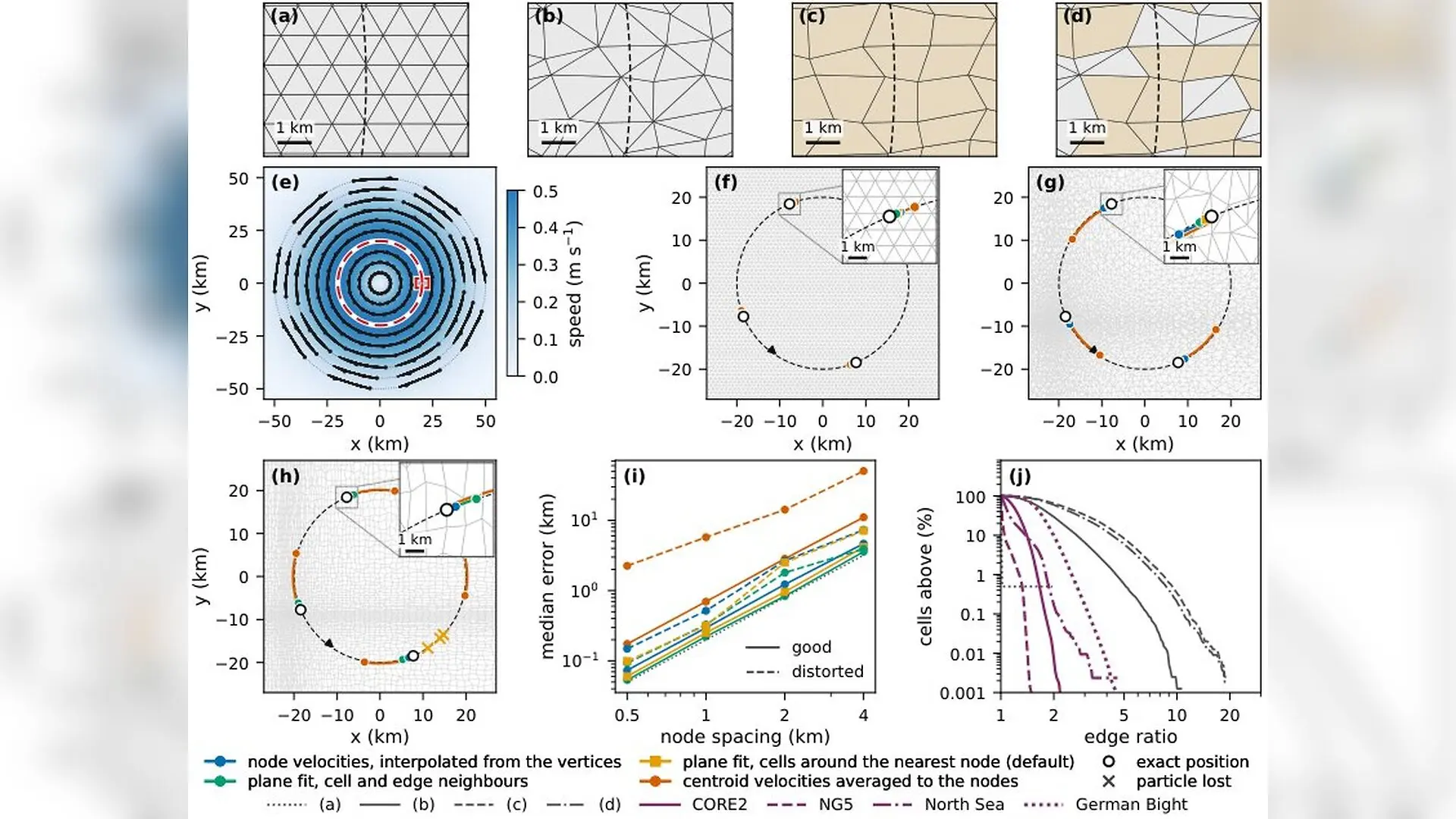
Billions of virtual ocean particles are now tracked with unprecedented speed using a novel computational engine designed specifically to be operated by artificial intelligence coding agents. Researchers at the Alfred Wegener Institute developed the software, named KELP v1.0, to handle complex ocean simulations across irregular grid structures without requiring manual grid conversions.
Oceanographers rely on Lagrangian particle tracking to follow the pathways of water masses, pollutants, carbon, and marine life across the globe. Traditionally, preparing these massive computing runs requires navigating complex technical pipelines. The new software package, published on the arXiv preprint server, introduces structured task instructions called skills that allow large language models to accurately write configurations, prepare particle releases, and execute cluster jobs.
Tracing Ocean Pathways Without Regridding
Modern ocean models utilize sophisticated unstructured meshes, which pack more grid cells near coastlines and straits where high detail is required. Meanwhile, kilometre-scale digital twins of Earth increasingly distribute their outputs on equal-area global grids known as HEALPix. Transforming velocity fields between these different grid types normally distorts coastlines and alters water flow pathways over time.
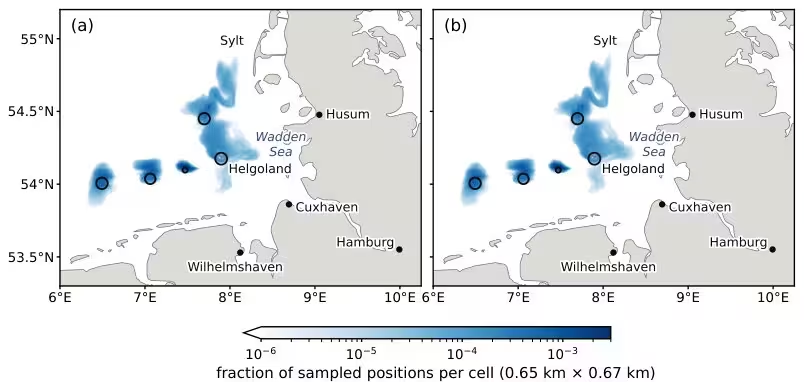
The KELP engine avoids this issue by computing two- and three-dimensional trajectories directly on triangular, quadrilateral, and mixed meshes, as well as on HEALPix grids, without splitting cells or changing the underlying velocity data. In benchmark comparisons against existing frameworks like Parcels, the system achieved near-identical particle distributions while maintaining high computational efficiency.
Decades of Arctic Freshwater Movement
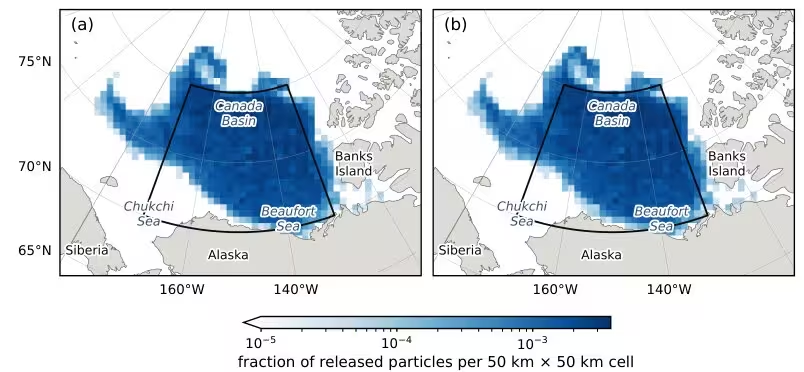
To demonstrate its capability over long temporal scales, the research team tracked nearly eight million particles released in the Beaufort Gyre over a 63-year period from 1958 to 2020. The massive simulation ran in just three hours and thirty-six minutes on a single 128-core computer node.
The trajectories revealed that freshwater transport from the Arctic gyre to the Fram Strait takes years to decades, with the median age of crossing sitting at 14.4 years. Because water released in different decades mixes extensively along the way, the authors emphasize that cohort comparisons must account for particle age rather than just calendar years.
Empowering Autonomous Coding Agents
A key innovation of the software is its integration with AI coding agents. In controlled evaluations, providing language models with specialized task instructions raised the completeness of prepared study files from a baseline of 75 to 93 percent up to 88 to 100 percent. While the agents successfully configured and executed complex scaling tests and regional data extractions, the authors note that human oversight remains essential to catch subtle setup errors.
Scaling tests demonstrated that the software can handle up to ten billion particles across sixteen cluster nodes, constrained primarily by available computer memory and storage limits for trajectory outputs rather than engine bottlenecks. Future development priorities include calculating transport diagnostics directly during model runs to minimize storage overhead.
The study was posted to the arXiv preprint server on November 13, 2026.
This article has been fact checked for accuracy, with information verified against reputable sources. Learn more about us and our editorial process.
Last reviewed on .
Article history
- Latest version
Reference(s)
- Kuznetsov, Ivan. “KELP v1.0: an agent-ready Lagrangian particle tracker for unstructured meshes and HEALPix grids.” arXiv.org <http://arxiv.org/abs/2611.18528v1>.
Cite this page:
- Posted by John Williams