Does Dark Energy Evolve and Cluster Across Cosmic Space
A joint analysis of recent cosmological data reveals intriguing low-redshift features in expansion and gravity.
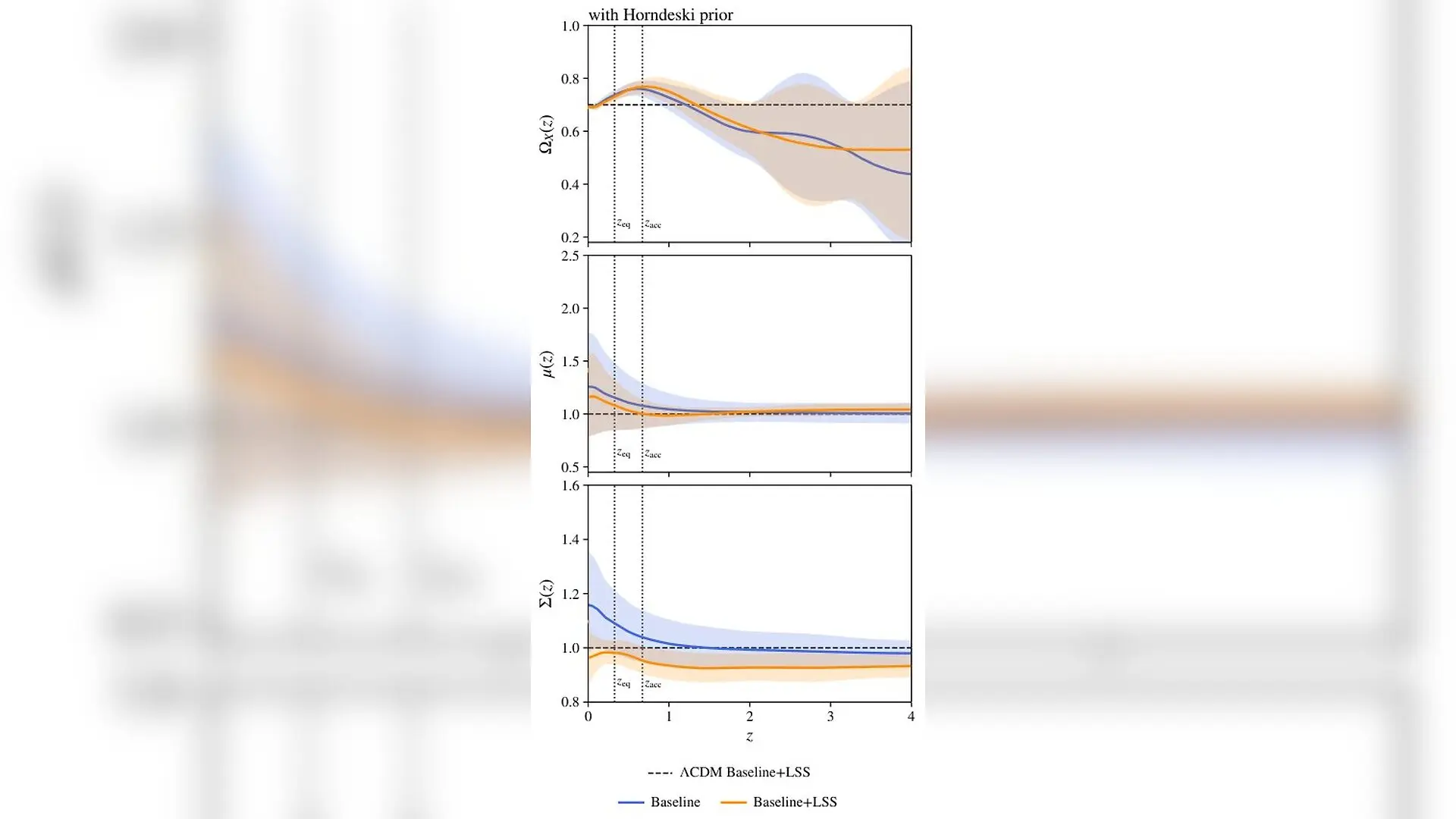
Cosmological data suggest that dark energy might be changing over time across a redshift range of 0.6 to 0.7, sparking new questions about how gravity behaves on cosmic scales. Researchers Maria Luisa Gallavotti and Alessandra Silvestri from Leiden University examined whether this apparent shift in the expansion of the Universe is linked to modifications in gravitational physics.
The standard cosmological model, known as $\Lambda$CDM, relies on a cosmological constant to drive the accelerated expansion of the Universe. Recent measurements from instruments like the Dark Energy Spectroscopic Instrument have challenged this picture by hinting at evolving dark energy. To test this thoroughly, the authors investigated whether background expansion changes are accompanied by alterations in how matter clumps together and bends light through gravitational lensing.
The study, available on the arXiv preprint server, utilized a flexible, non-parametric approach across eleven scale-factor nodes spanning redshifts from zero to four. By avoiding fixed theoretical assumptions between background expansion and perturbation sectors, the team combined data from the Planck satellite, the Atacama Cosmology Telescope, the Dark Energy Spectroscopic Instrument, and Pantheon+ supernovae. They later incorporated large-scale structure observations from the Dark Energy Survey and the Sloan Digital Sky Survey.
What Did the Joint Reconstruction Reveal About Cosmic Expansion?
The analysis uncovered a broad maximum in the effective dark-energy density at redshifts around 0.6 to 0.7. This peak points to a crossing of the effective phantom divide, where the equation of state transitions from greater than minus one below the maximum to less than minus one above it. This background feature remained robust even after adding large-scale structure information to the dataset.
In addition to background expansion, the researchers examined two key gravitational response functions. The first function controls how matter clumps under gravity, while the second governs light bending and relativistic motion. Initial baseline models showed mild enhancements of roughly twenty percent in both responses at low redshifts. However, incorporating comprehensive large-scale structure data shifted the lensing response downward while keeping matter clustering largely stable.
How Well Do Current Observations Constrain Gravitational Shifts?
To separate genuine signals from prior assumptions, the authors applied a statistical technique called covariant principal-component analysis. This method ranks combined modes by how precisely current data constrain them relative to theoretical priors. The leading constrained modes were found to be overwhelmingly dominated by the background expansion sector.
Because current data constrain the perturbation sector less precisely, the statistical significance of the low-redshift gravitational features remains modest. The signal-to-noise ratio for these modes stays relatively low, meaning current observations cannot definitively prove whether the background and perturbation trends share a single physical origin. Nevertheless, the findings offer an important framework for future investigation.
What Lies Ahead for Stage-IV Surveys?
The researchers emphasize that while the data hint at intriguing low-redshift phenomena, the current evidence remains inconclusive. Ongoing Stage-IV astronomical surveys will provide higher-precision measurements of large-scale structures, allowing scientists to test whether the gravitational enhancements persist and attain statistical significance.
The study was posted to the arXiv preprint server on November 13, 2026.
This article has been fact checked for accuracy, with information verified against reputable sources. Learn more about us and our editorial process.
Last reviewed on .
Article history
- Latest version
Reference(s)
- Gallavotti, Maria. “Does Dark Energy Evolve $\textit{and}$ Cluster?.” arXiv.org <http://arxiv.org/abs/2611.18557v1>.
Cite this page:
- Posted by Nida Rehman