Cosmic Radio Flashes Reveal How Invisible Gas Shapes Our Universe
New forecasts suggest that measuring the smeared-out signals of distant radio explosions could solve a major headache for dark energy surveys.
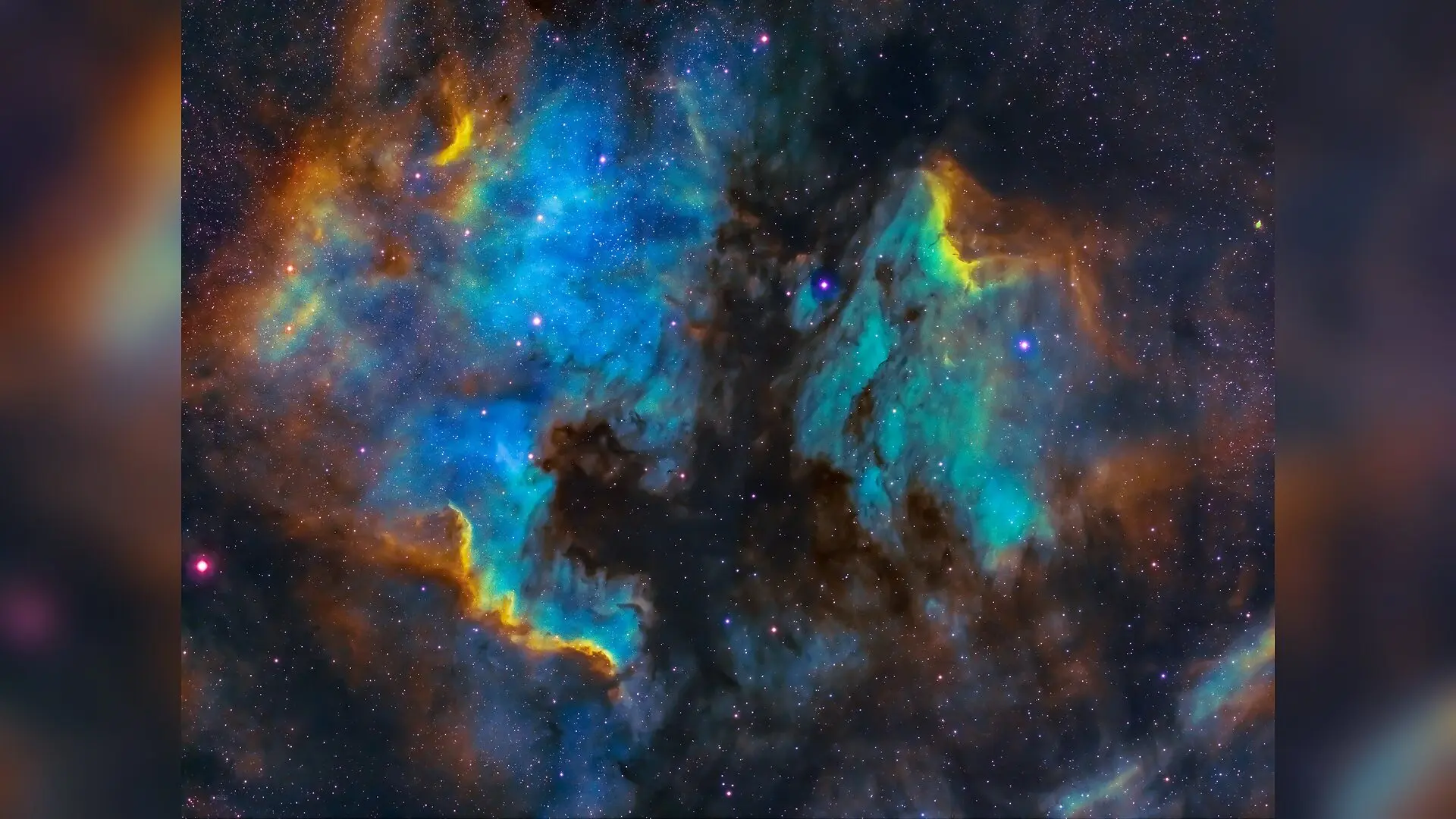
Cosmic explosions called fast radio bursts are offering astronomers a completely new way to weigh the invisible gas shaping our universe. By analyzing how these millisecond-long flashes of radio waves are smeared out across the cosmos, researchers can map the distribution of ordinary matter on scales of millions of light-years.
As modern telescopes prepare to detect tens of thousands of these transient sources every year, scientists are eager to use them to solve one of modern cosmology’s biggest headaches. The study was published in the arXiv preprint server by researchers Haruki Ebina and Martin White from the University of California, Berkeley and Lawrence Berkeley National Laboratory.
Decoding the Smear of Radio Waves
Fast radio bursts are immensely powerful pulses of radio emission originating from distant galaxies, though their exact triggers remain mysterious. As these signals travel across the universe toward Earth, they encounter free electrons floating in the gas between galaxies. This ionized material slows down lower radio frequencies more than higher frequencies, creating a measurable delay known as dispersion measure.
By measuring this delay, astronomers obtain a noisy but direct census of free electrons, which account for nearly 90 percent of all ordinary matter in the low-redshift universe. While current instruments catch only a modest number of localized bursts each year, next-generation facilities like the Deep Synoptic Array and the Square Kilometre Array are expected to detect roughly 10,000 localized sources annually. This massive influx of data will allow scientists to probe the cosmic web with unprecedented detail.
Why Baryonic Feedback Stymies Precision Cosmology
The primary motivation for mapping this gas is to control a major obstacle facing next-generation cosmic shear surveys, which study how gravity bends light from distant galaxies. These upcoming optical surveys will achieve extraordinary precision, but their accuracy is threatened by baryonic feedback. Powerful astrophysical processes, such as stellar winds and supermassive black holes erupting in galactic centers, eject vast amounts of gas out of galaxies and heat the surrounding medium.
This movement alters the distribution of matter and suppresses the matter power spectrum on intermediate scales. If left unaccounted for, baryonic feedback can severely bias cosmological measurements. Cosmologists generally need to control these feedback effects to within one percent precision to extract reliable cosmological parameters from Stage IV weak lensing surveys.
Modeling the Cosmos Using Hybrid Effective Field Theory
To determine whether fast radio bursts can provide the necessary external constraints, the authors employed Hybrid Effective Field Theory, a mathematical framework commonly used in large-scale structure cosmology. This technique models the clustering of matter, galaxies, and free electrons simultaneously down to small scales. Instead of relying solely on raw data, the team combined fast radio burst dispersion measures with galaxy catalogs from the Dark Energy Spectroscopic Instrument.
Cross-correlating the radio bursts with well-mapped galaxy populations helps isolate specific redshift slices and reduces statistical noise. Through a Fisher forecasting analysis, the researchers evaluated how effectively future combined surveys can constrain matter power spectrum suppression caused by baryonic physics. Their baseline models suggest that under ideal conditions, combining fast radio burst and galaxy datasets can achieve the one percent precision required by lensing surveys.
The Hidden Hurdles of Small-Scale Complexity
However, the analysis also revealed significant challenges that could degrade these constraints. Galaxy bias and electron clustering are not completely scale-independent, meaning that non-linear effects and stochastic noise between tracers can introduce uncertainties. When the team incorporated more realistic complexities, such as higher-order electron biases and potential cross-stochasticity between electrons and galaxies, the constraining power weakened beyond the desired one percent threshold.
The authors point out that our current understanding of these small-scale electron behaviors relies heavily on complex hydrodynamic simulations rather than direct measurements. Improving observational bounds on higher-order electron biases and tracer stochasticity will be essential for unlocking the full potential of fast radio bursts. Ultimately, integrating radio burst cross-correlations into global cosmological fits offers a promising path forward for reining in baryonic feedback and securing the accuracy of future dark energy missions.
The study was posted to the arXiv preprint server on November 13, 2026.
This article has been fact checked for accuracy, with information verified against reputable sources. Learn more about us and our editorial process.
Last reviewed on .
Article history
- Latest version
Reference(s)
- Ebina, Haruki. “Probing baryonic feedback using fast radio bursts and galaxy surveys.” arXiv.org <http://arxiv.org/abs/2611.18512v1>.
Cite this page:
- Posted by Karan Das