Roscosmos Cosmonauts Complete Critical Spacewalk To Advance Science On The ISS
Critical pre-eruption signals observed hours before a rare solar flare could revolutionize space weather forecasting.
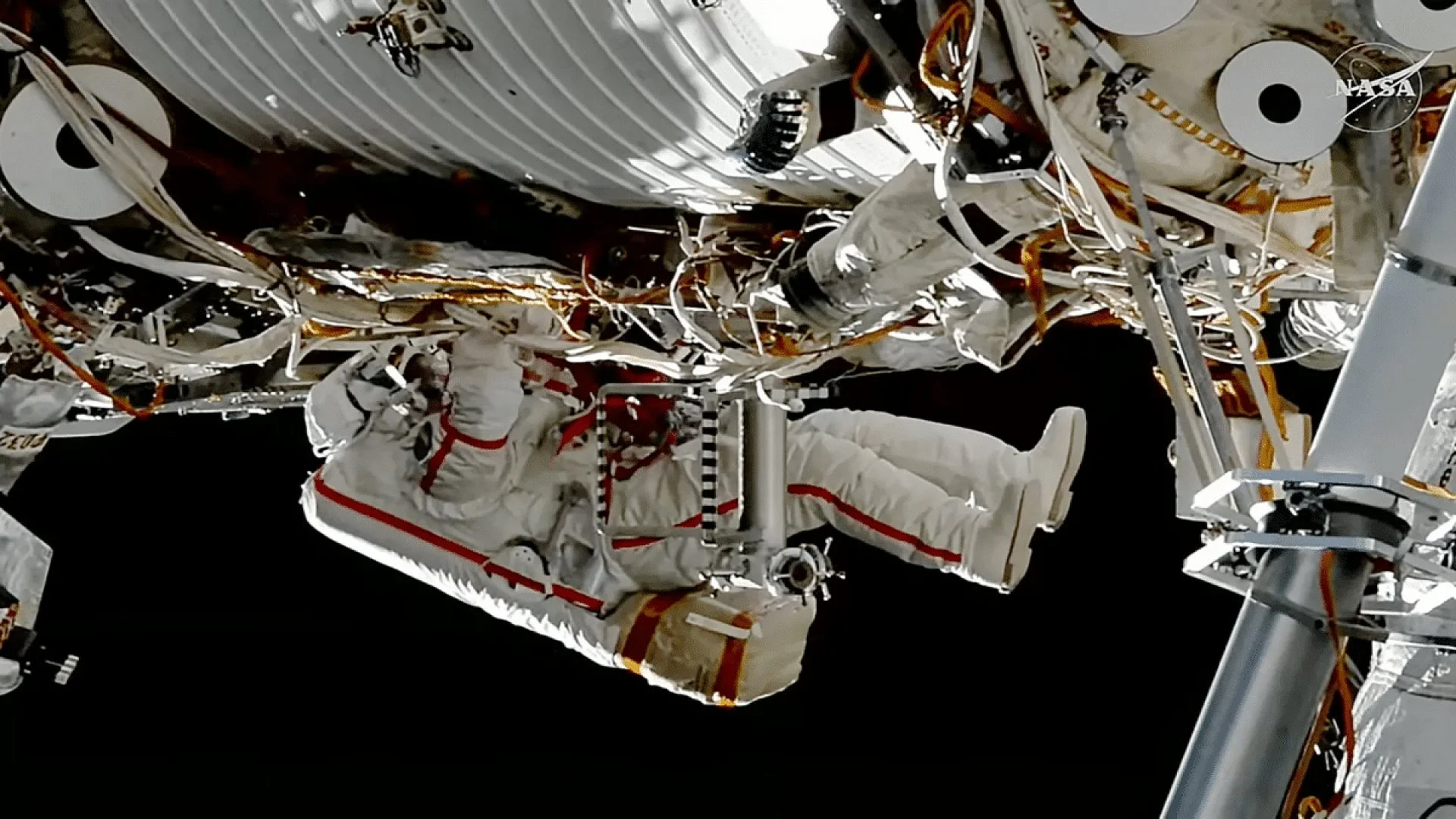
A six‑hour, five‑minute extravehicular activity concluded Wednesday with two Russian cosmonauts safely re‑entering the International Space Station, according to NASA. The sortie, carefully choreographed, allowed the crew to advance several research projects while also addressing a lingering hardware issue on a docked cargo vehicle.
NASA Emphasizes Ongoing Laboratory Work in Orbit
In a post on the agency’s official blog, NASA highlighted the station’s role as a unique microgravity laboratory, noting that the retrieval and installation of experiments are vital for progress in fields ranging from materials science to microbiology and space‑weather monitoring. Real‑time updates shared by the crew underscore the program’s commitment to public transparency.
Scientific Payloads Handled During the EVA
Cosmonauts Sergey Kud‑Sverchkov and Sergei Mikaev removed a microbial research container from the Poisk module, yielding data that could shape future studies of how microorganisms behave in weightlessness. They also extracted a cassette from the Nauka module that records semiconductor growth patterns in space, a finding that may inform the development of advanced electronic components both aboard the station and on Earth.
The team installed a new instrument on the Zvezda service module designed to capture bursts of solar radiation associated with solar flares. Such events can interfere with satellite links and pose health hazards to crew members, making the new sensor a valuable addition for improving space‑weather predictions.
Two cosmonauts are over five hours into their spacewalk installing a solar radiation experiment and removing physics and microbiology research gear. Watch on @NASA+. https://t.co/zWXIG7gD62https://t.co/zWXIG7gD62
— International Space Station (@Space_Station) May 27, 2026
Technical Fix for Docked Cargo Vehicle
The EVA also served to resolve a problem with the Progress 94 resupply craft, whose Kurs rendezvous antenna failed to deploy after launch in March. Kud‑Sverchkov and Mikaev photographed the stuck antenna and secured it with a tie‑down, a precaution that preserves the spacecraft’s functionality for future operations and reinforces overall station safety.
This mission marked Kud‑Sverchkov’s second spacewalk and Mikaev’s inaugural sortie, adding to the cumulative total of 279 EVAs performed on the ISS for assembly, upgrades, and upkeep. The precise coordination between ground controllers and the crew demonstrates the intricate planning required to keep the orbital laboratory operational.
This article has been fact checked for accuracy, with information verified against reputable sources. Learn more about us and our editorial process.
Last reviewed on .
Article history
- Latest version
Reference(s)
- “https://x.com/i/broadcasts/1nxeLyOmoPWJX.” <https://t.co/zWXIG7gD62>.
Cite this page:
- Posted by Farah Siddiqui