Student Astronomer Uncovers Cosmic ‘Rosetta Stone’ Explaining Mysterious Signals
New white dwarf binary system solves cosmic radio signal mystery unlocking extreme physics secrets
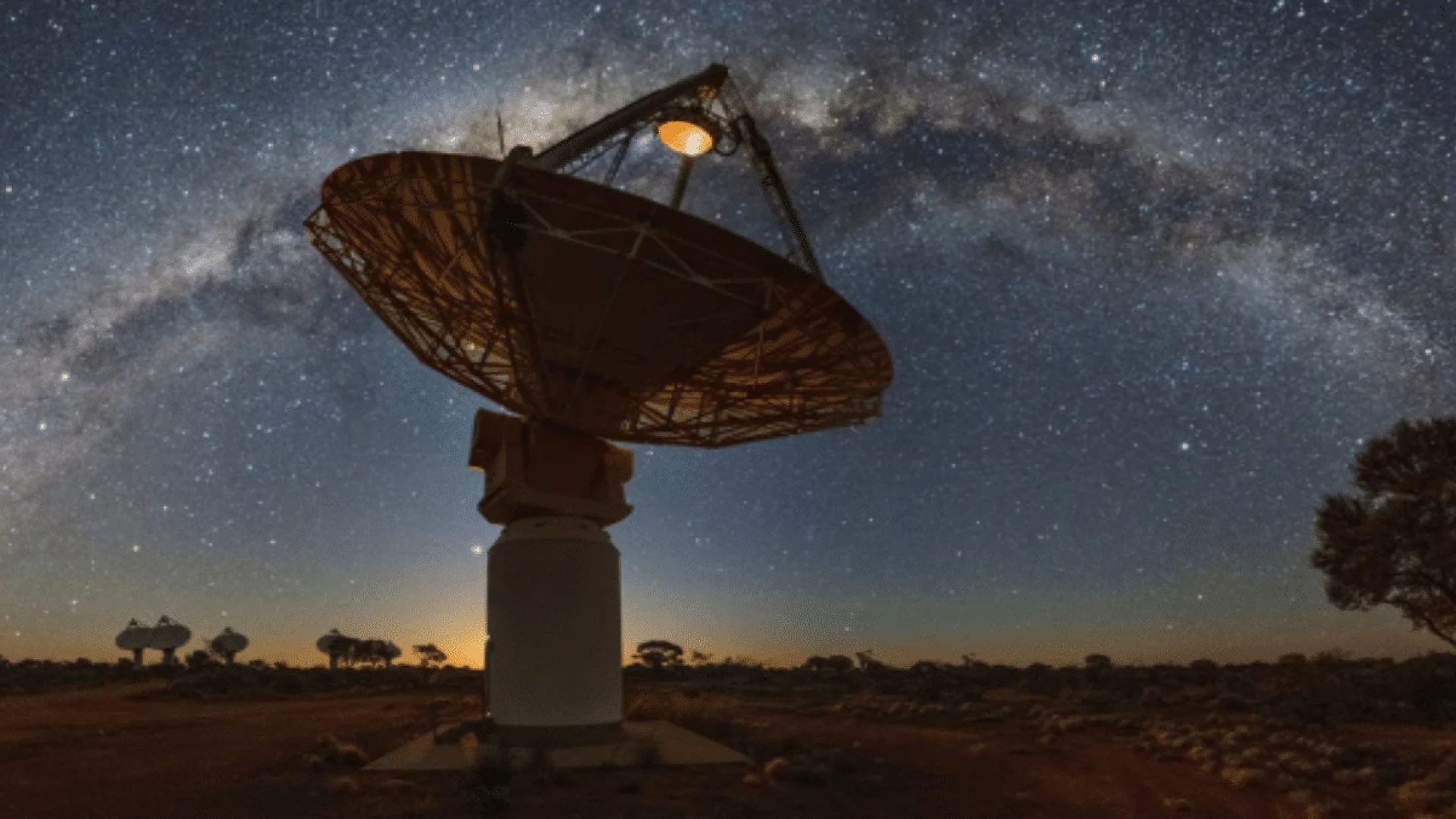
Astronomers at the University of Sydney have pinpointed the source of a perplexing class of astronomical phenomena known as long‑period radio transients. Their findings, appearing in Nature Astronomy, rely on observations made with CSIRO’s ASKAP radio telescope and reveal a previously unrecognised binary star configuration that could reshape theories of extreme stellar behaviour.
A Unique Binary Pair Illuminates a Cosmic Riddle
The object, designated ASKAP J1745−5051, comprises a white dwarf—a compact, Earth‑sized stellar remnant whose mass rivals that of the Sun—paired with a red dwarf roughly one‑tenth the Sun’s mass. The two stars orbit each other in just over an hour, creating a vigorous exchange of material: gas from the red dwarf is drawn toward the white dwarf, heating as it spirals inward and generating bursts of radio and X‑ray radiation.
“For the first time we have pinpointed the origin of these signals, confirming the source to be a ‘cataclysmic variable,’ or an accreting white dwarf star,” said Ph.D. student Kovi Rose, lead author. “Long-period radio transients have puzzled astronomers for years. We’ve only found about a dozen, and their origins have been unclear. Now, we’ve been able to show that the source for one of these transients comes from a white dwarf actively pulling material from a companion star.”
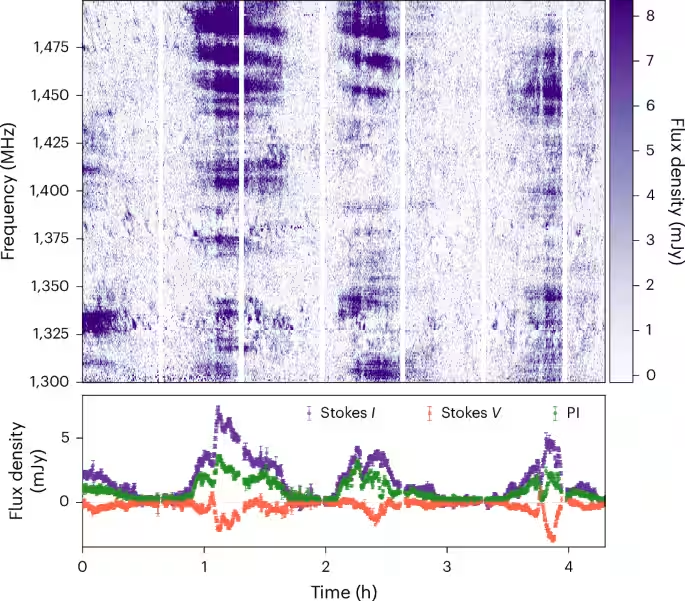
Emission from the system repeats in step with its orbital period, yet the peaks in radio and X‑ray light do not coincide, implying that each type of radiation arises in a distinct region of the binary. “These emissions are all tied to the orbital motion of the system,” Mr. Rose explained, “but interestingly, the radio and X‑ray signals don’t peak at the same time, which tells us they’re being produced in different regions of the system.”

Credit: Carl Knox (OzGrav/Swinburne) and Dr. Joshua Preston Pritchard (CSIRO).
Multi‑Wavelength Data Cracks a Long‑Standing Mystery
Before this discovery, scientists had speculated that slowly rotating neutron stars—pulsars—might be responsible for long‑period radio transients, but theoretical models struggled to reproduce the observed signals. The clear detection of a white‑dwarf binary now offers concrete evidence that such systems can generate at least a portion of these enigmatic bursts.
“Some similar objects had been linked to binary systems before, but this is the first one where we can clearly see both stars and the accretion process in action,” said Professor Murphy, Head of School at the University of Sydney and Chief Investigator at OzGrav.
ASKAP J1745−5051 also produces periodic X‑ray flares, making it only the second known long‑period radio transient with a regular X‑ray component and the first where that regularity has been directly traced to the binary’s orbital dynamics.
The combination of ASKAP’s wide‑field sensitivity and high angular resolution was essential for catching these fleeting signals, which would otherwise escape detection. Researchers liken the system to a “stellar Rosetta Stone,” a reference point that can help decode the nature of other long‑period transients.
“This system gives us a way to decode these signals. It could help us determine whether other long‑period transients are more like pulsars or like white dwarf systems, acting like a stellar Rosetta Stone,” Mr. Rose said.
Credit: Nature Astronomy
A Natural Testbed for Extreme Physics
Beyond solving a signal mystery, the binary offers a rare laboratory for probing plasma behavior, magnetic field interactions, and strong‑gravity effects that cannot be reproduced on Earth.
“These systems are natural laboratories,” said Mr. Rose. “They allow us to test our understanding of how matter behaves in strong magnetic fields and under intense gravitational forces.” The finding underscores how uncommon binary configurations can drive advances in both radio astronomy and fundamental astrophysics.
Future Campaigns Aim to Map the Transient Landscape
The collaborative team, spanning institutions in Australia, the United States, China, Canada, Spain and Israel, plans coordinated observations with radio, optical and X‑ray facilities to investigate the burst mechanisms in greater detail and to assess whether similar processes operate across the broader population of long‑period radio transients.
“Each new discovery is helping us piece together the bigger picture,” Mr. Rose remarked. “We’re only just beginning to understand this new class of cosmic events.” The full report is available in Nature Astronomy, marking a significant step toward decoding some of the universe’s most elusive signals.
This article has been fact checked for accuracy, with information verified against reputable sources. Learn more about us and our editorial process.
Last reviewed on .
Article history
- Latest version
Reference(s)
- Rose, Kovi., et al. “Periodic radio and X-ray emission from an accreting white dwarf binary.” Nature Astronomy, June 1, 2026 Springer Science and Business Media LLC, doi: 10.1038/s41550-026-02882-x. <https://dx.doi.org/10.1038/s41550-026-02882-x>.
Cite this page:
- Posted by Farah Siddiqui