Scientists Finally Detect Pines’ Elusive ‘Demon’ Quasiparticle After 67 Years
After 67 years hidden, a strange massless particle was uncovered in exotic metal, exposing Pines’ elusive demon that evaded traditional experiments.

A team from the University of Illinois at Urbana‑Champaign has reported the first observation of a bizarre quantum excitation that had been theorized more than six decades ago. The particle, dubbed “Pines’ demon,” appears in a three‑dimensional metal without mass, electric charge, or interaction with light, fulfilling a prediction made by physicist David Pines in 1956.
A 67‑year quest for an invisible collective mode
Pines suggested that electrons occupying multiple energy bands could lock together in a way that cancels their charges, creating a neutral collective oscillation. He referred to this hypothetical entity as a “demon,” borrowing terminology from James Clerk Maxwell’s thought experiments and using an acronym for “distinct electron motion.” Because the mode would not couple to photons, conventional optical probes had repeatedly missed it, leaving the idea confined to theoretical discussions.
In ordinary metals, plasmons—charged electron density waves—are readily detected through their interaction with light. The neutral counterpart, however, leaves no optical trace, demanding an alternative experimental strategy. “Most measurements rely on light, so a neutral excitation slips through the net,” explained Peter Abbamonte, the study’s lead author. “We needed a technique that could directly sense momentum‑dependent energy losses.”
Spotting the signal in a superconducting ruthenate
The researchers turned their attention to strontium ruthenate (Sr₂RuO₄), a material known for its multiband electronic structure and low‑temperature superconductivity. Using momentum‑resolved electron energy‑loss spectroscopy (M‑EELS), they bombarded the crystal with electrons of a well‑defined momentum and recorded the energy transferred to the system.
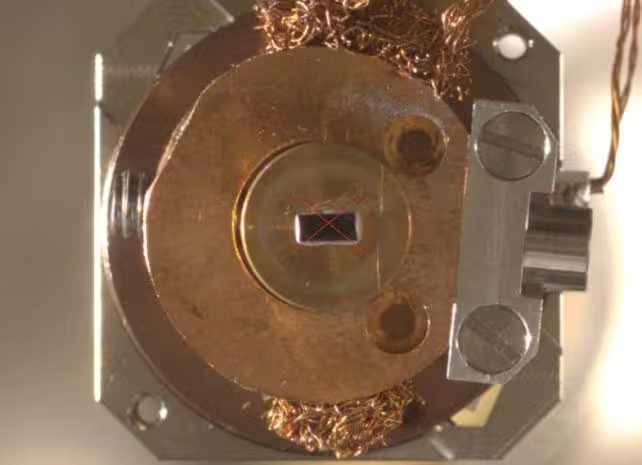
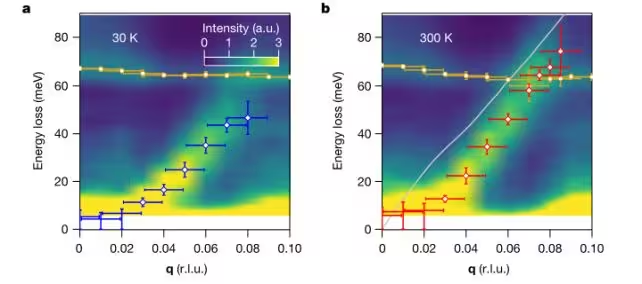
Ali Husain, a former graduate student on the project, noticed an anomalous excitation that did not match any known quasiparticle. Its propagation speed, roughly 1.065 × 10⁵ m s⁻¹ at room temperature, fell between the typical ranges for acoustic phonons and surface plasmons, and the mode behaved as if it were massless. “Initially we thought it was a fluke,” Husain recalled, “but as we eliminated other possibilities, the demon interpretation became compelling.”
The team corroborated the observation with theoretical calculations performed by Edwin Huang, showing that the β and γ electron bands in Sr₂RuO₄ could indeed oscillate out of phase, generating the neutral mode described by Pines.
Demonstrating electrical neutrality
To prove the excitation’s charge‑free nature, the scientists examined how the signal intensity varied with momentum. Charged modes obey a specific scaling law linked to electron‑energy conservation, while neutral modes display a steeper momentum dependence. The measured intensity followed approximately a q⁻¹·⁸ trend, surpassing the −5 threshold expected for charged excitations and confirming the neutral character of the observed mode.
Repeated measurements on four separate crystals yielded consistent results, ruling out experimental artifacts. Additional analysis revealed that the mode’s damping was weaker than theoretical estimates, possibly because the quasi‑one‑dimensional character of the β band suppresses the usual Landau‑damping processes. Cooling the sample to 30 K reduced the mode’s velocity by about 31 percent, a temperature dependence not fully captured by existing models.
Implications for other multiband conductors
The discovery suggests that neutral collective excitations may be a common feature of multiband metals, a broad class of materials that includes many unconventional superconductors and topological semimetals. Earlier spectroscopic studies missed the demon because their momentum resolution was insufficient; the M‑EELS instrument employed here achieved roughly five‑fold finer momentum discrimination, enabling the detection.
Nevertheless, the current theoretical framework does not fully explain all observed aspects, such as the quadratic dispersion at very low momentum. The authors propose that future experiments using a meV‑resolved scanning transmission electron microscope in a defocused geometry could provide the necessary resolution to explore these subtleties and to search for similar modes in other compounds.
This article has been fact checked for accuracy, with information verified against reputable sources. Learn more about us and our editorial process.
Last reviewed on .
Article history
- Latest version
Cite this page:
- Posted by Farah Siddiqui