Light-Induced Contactless Friction Slows Graphene Nanotubes in Water
Scientists discover light‑induced friction in graphene, where photo‑driven electron shifts hinder movement in water without contact.
A team of physicists has uncovered a novel form of drag that slows graphene nanotubes in water when they are illuminated, revealing that friction can arise from purely electromagnetic interactions rather than direct surface contact.
Traditional concepts of friction focus on the mechanical interlocking of rough surfaces, from tire treads on asphalt to microscopic asperities between sliding solids. Over the past decade, researchers have begun to recognize that charge fluctuations at interfaces—such as those between water molecules and carbon—can also generate resistance to motion.
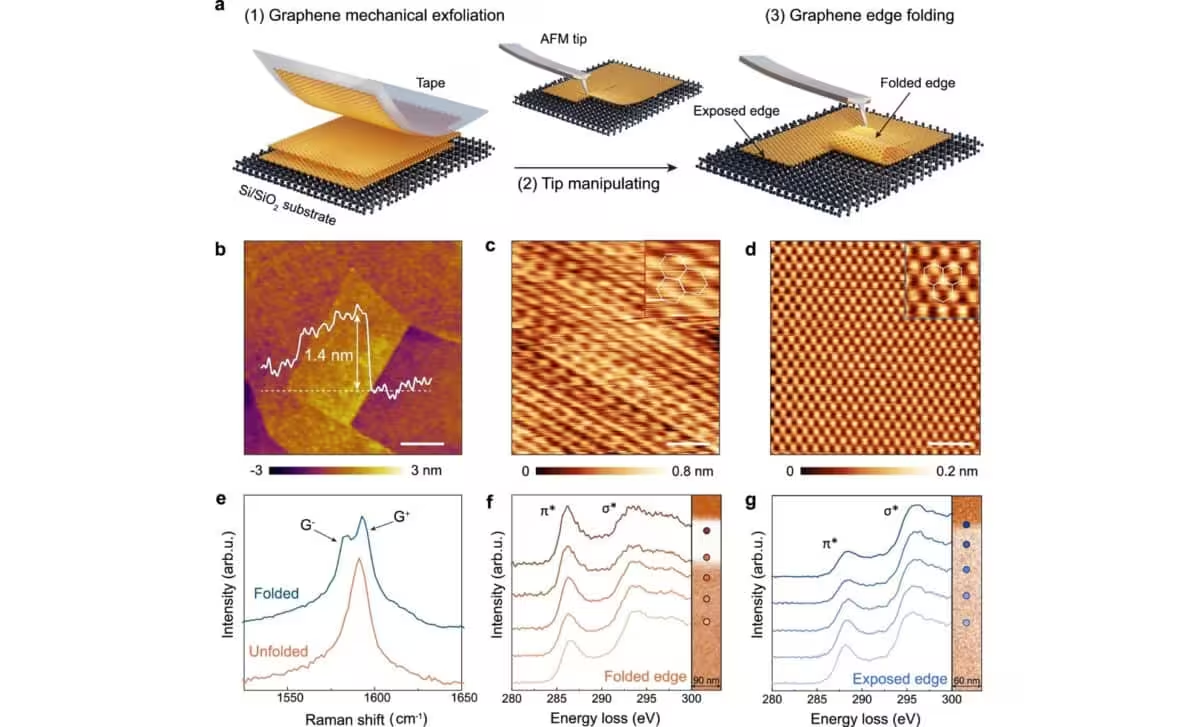
Earlier work documented unusual frictional behavior in folded ultrathin graphene sheets, where alterations in electronic structure modified how the material slipped against its surroundings. Building on those insights, physicist Sebastian Kruss at Ruhr‑University Bochum set out to explore how graphene nanotubes behave when immersed in water and exposed to varying light intensities.
Illumination Triggers Unexpected Slow‑Down of Nanotubes
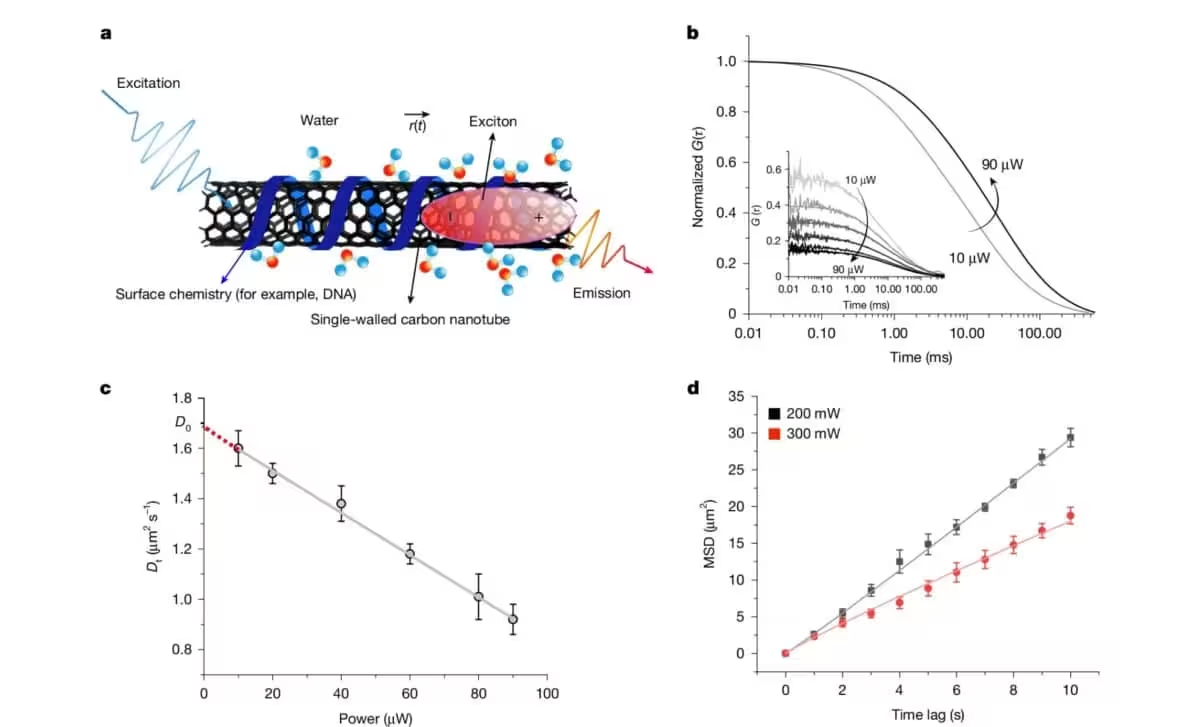
In the experiment, researchers placed graphene nanotubes in a water bath and progressively increased the brightness of the incident light. While a rise in temperature was anticipated to boost molecular agitation and accelerate diffusion, the measurements showed the opposite: the nanotubes migrated more slowly as illumination grew stronger, pointing to an additional resistive force at play.
The phenomenon was documented in a study published in Nature, which explains that friction can intensify when a material’s response overlaps with low‑frequency motions in the surrounding solvent. The authors linked the effect to interactions at the water‑carbon boundary and the rapid cooling of excited electrons within the graphene lattice.
Because graphene consists of a single, atom‑thin lattice of carbon atoms, its surface is exceptionally smooth, eliminating conventional surface‑roughness friction. The researchers therefore concluded that the observed drag originates from electronic, not mechanical, interactions.
Excitons Produce Contactless Friction via Charge Fluctuations
The team identified light‑generated excitons as the root cause. When photons excite electrons in graphene, the electrons jump to higher energy levels, leaving behind positively charged holes. Although the electron‑hole pair carries no net charge, excitons can convey energy and emit light, accounting for the fluorescent glow observed in the illuminated nanotubes.
Exciton formation induces rapid fluctuations of electrical charge on the graphene surface. These fluctuations transfer momentum to nearby water molecules at the graphene‑water interface, creating a friction‑like resistance that does not rely on direct contact.
Increasing illumination produces more excitons, amplifying the charge‑fluctuation interaction and further decelerating the nanotubes. Terahertz spectroscopy confirmed the mechanism, and experiments that suppressed exciton generation eliminated the slowdown, reinforcing the link between excitons and the observed drag.
Potential for Light‑Controlled Nanomotion
The discovery opens a pathway to steer nanoscale objects in liquids using light. By tuning illumination levels, scientists could modulate the speed of nanomaterials, a capability that may prove valuable for guiding microswimmers, nanorobots, or other colloidal systems.
Kruss noted, “Light‑induced slowing of motion can be physically or chemically manipulated to affect the movement of a nanomaterial in an aqueous solution,” and suggested that the principle could be extended to other platforms featuring high exciton mobility and pronounced charge fluctuations.
Overall, the work reframes friction as a phenomenon that can arise from quantum and electromagnetic processes, expanding the toolbox for controlling motion at the nanoscale without relying on mechanical contact.
This article has been fact checked for accuracy, with information verified against reputable sources. Learn more about us and our editorial process.
Last reviewed on .
Article history
- Latest version
Reference(s)
- “Weirdly flowing water finally has an explanation: 'quantum friction'.”, February 2, 2022 <https://www.nature.com/articles/d41586-022-00313-1>.
- Zakharchenya, B.P.., et al. “Excitons in Crystals.” Encyclopedia of Condensed Matter Physics, January 1, 2005, pp. 171-179. Elsevier, doi: 10.1016/B0-12-369401-9/01147-5. <https://www.sciencedirect.com/science/chapter/referencework/abs/pii/B0123694019011475>.
Cite this page:
- Posted by Farah Siddiqui