MAVEN Finds Earth‑Style Magnetic Cycle Powers Unexpected Martian Auroras
NASA’s MAVEN mission uncovers a new magnetic process driving localized auroras on Mars, reshaping our view of the planet’s atmospheric dynamics.
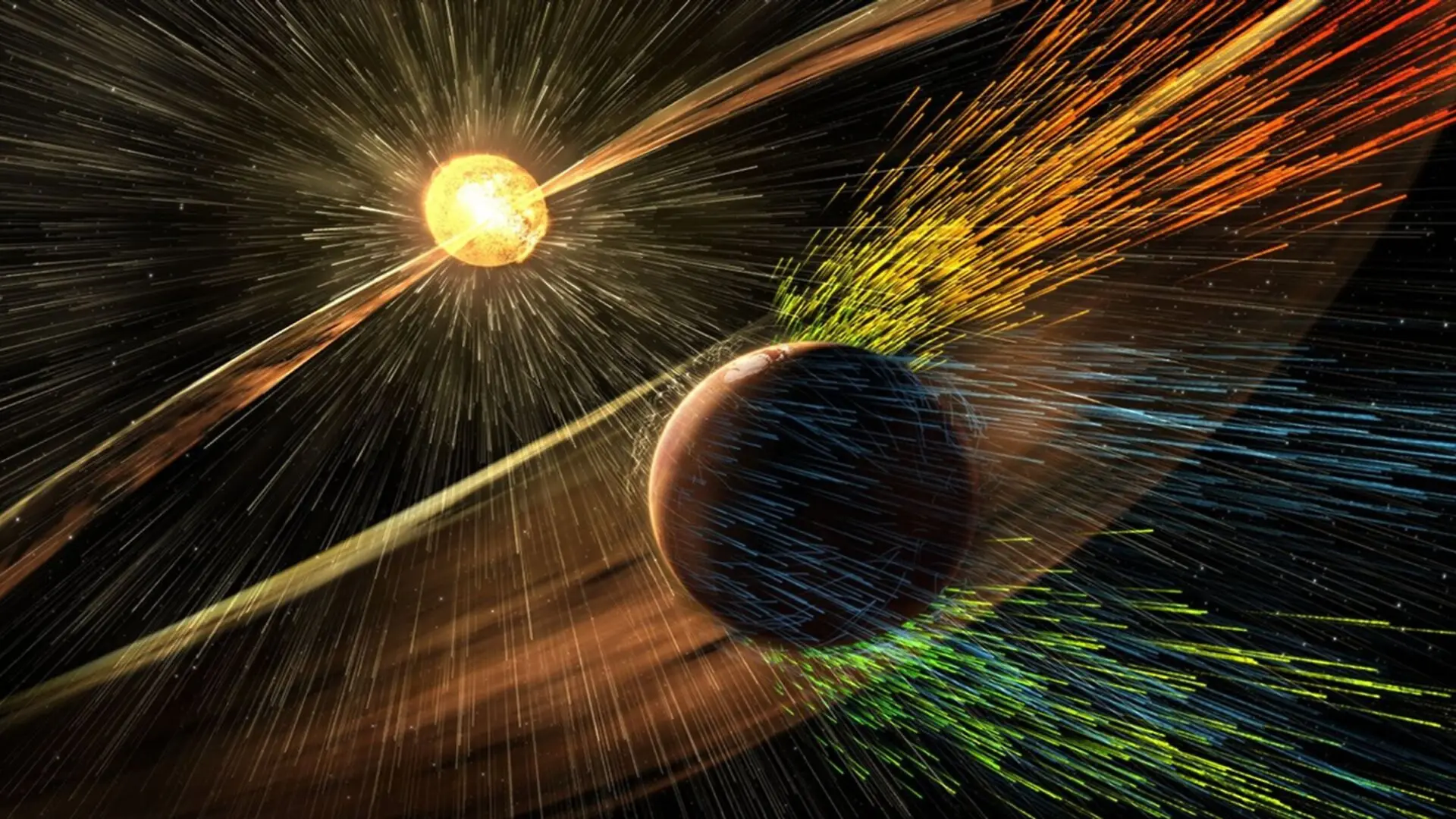
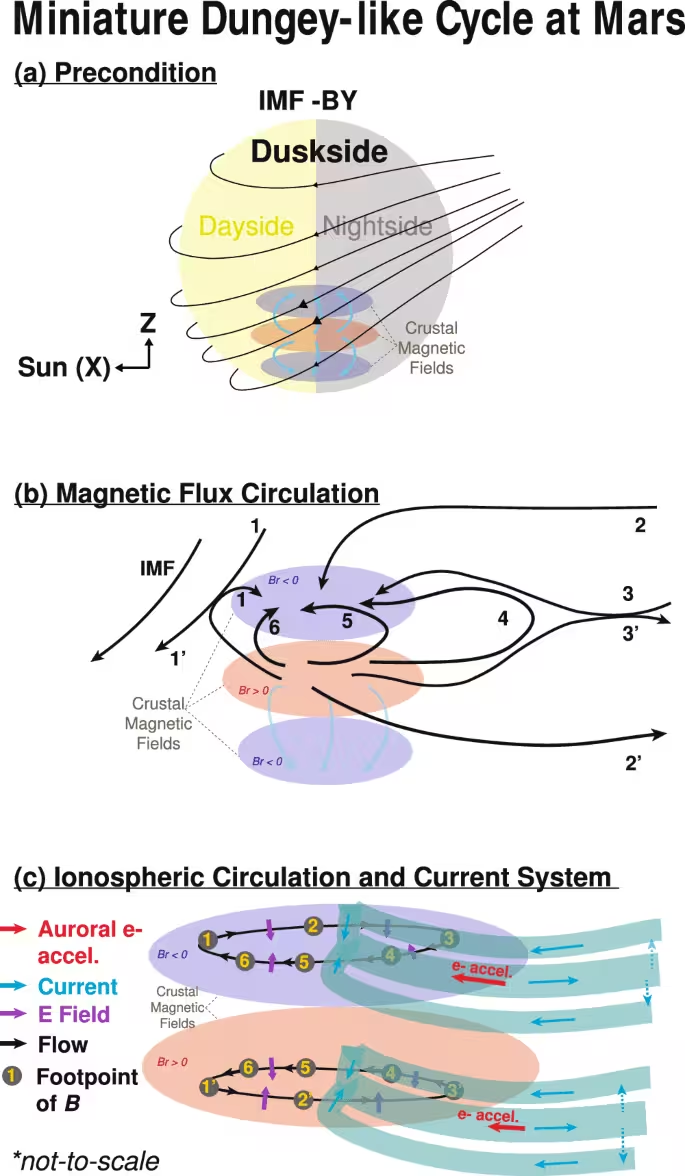
NASA’s MAVEN probe has identified a previously unknown magnetic circulation that can generate localized auroras on Mars, despite the planet’s lack of a global magnetic shield. The findings, reported in Nature Communications, show that crustal magnetic fields can interact with the solar wind in a way that mirrors Earth’s well‑known Dungey cycle.
Magnetic reconnection on a planet without a global field
For decades, scientists have puzzled over how the Red Planet produces auroral glows without the protective magnetosphere that surrounds Earth. After its ancient dynamo ceased billions of years ago, Mars retained only isolated magnetic patches embedded in its crust, creating a patchwork of tiny magnetic domains that braid with the incoming solar wind.
Analysis of data from the Mars Atmosphere and Volatile Evolution (MAVEN) mission revealed that these crustal fields can undergo reconnection with the interplanetary magnetic field, forming a localized cycle that funnels charged particles into the upper atmosphere and triggers ultraviolet auroral emissions.
“We knew that magnetic reconnection was happening at Mars but did not expect it to be like the Dungey cycle,” said Shaosui Xu, lead author and associate research physicist at the Space Sciences Laboratory, University of California, Berkeley.
Instrument insights that completed the puzzle
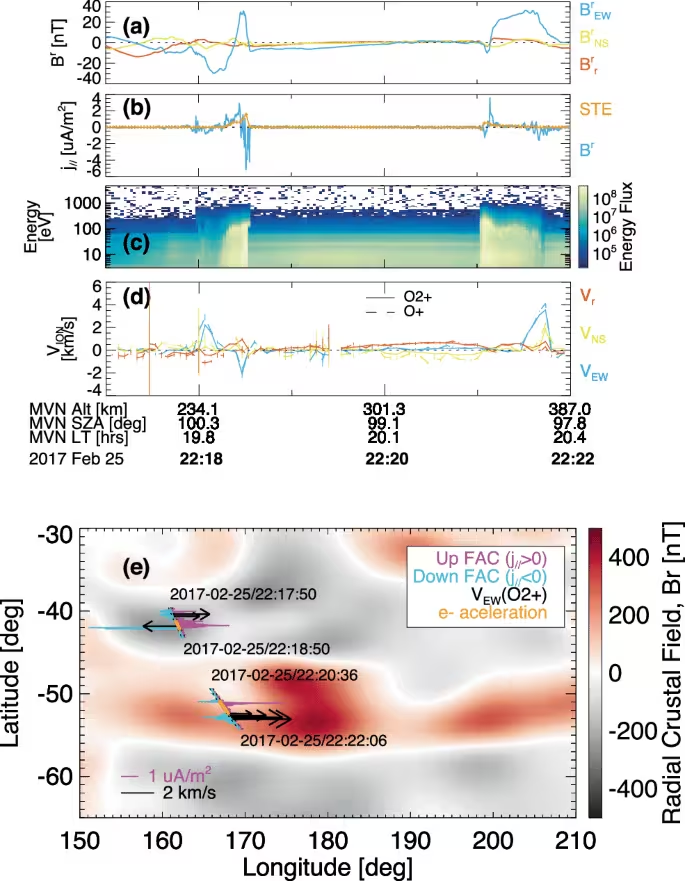
The breakthrough hinged on measurements from MAVEN’s Solar Wind Ion Analyzer (STATIC), which has been charting ion escape and solar‑wind interactions since the spacecraft entered Martian orbit in 2014. By scrutinizing ion and electron flows during auroral episodes, the team demonstrated that crustal magnetic structures can repeatedly store and unleash energy, explaining why auroras are confined to specific regions rather than encircling the whole planet.
“We really pushed the limit of STATIC to get the data we needed,” said Xu. “It was the final piece to the puzzle in understanding these localized auroras.”
Broader impact on planetary magnetic science
These observations bridge a conceptual gap between Mars and Earth, underscoring that identical physical laws can generate vastly different outcomes when a planet’s magnetic history diverges. While Earth retained a robust global field, Mars lost its dynamo, reshaping how each world shields its atmosphere from solar radiation.
“This is a remarkable result that changes how we think of Martian auroras and is another important step toward understanding why Mars and Earth have evolved so differently despite being governed by the same underlying physics,” said Shannon Curry, MAVEN principal investigator and research scientist at the Laboratory for Atmospheric and Space Physics, University of Colorado Boulder. “I am incredibly proud of our team’s work on this discovery and excited to uncover new insights into the Red Planet and its evolution.”
Resolving a long‑standing theoretical question
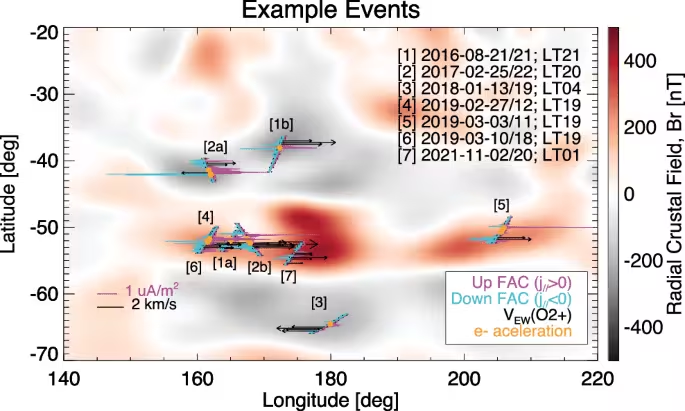
Prior models had speculated that Mars’ scattered crustal magnets might drive organized magnetic activity, but empirical confirmation remained elusive. By coupling MAVEN measurements with sophisticated magnetic‑field simulations, researchers finally captured the dynamic reconnection process in action, providing the missing link that explains the planet’s region‑specific auroras.
“I remember in graduate school discussing with my advisor how the cycling of crustal magnetic fields could work at Mars,” said Xu. “It’s incredible to be part of the team that found the answer to that question.”
The new mechanism opens avenues for future exploration, offering a framework to assess how magnetic interactions influence atmospheric loss, particle transport, and the long‑term evolution of rocky worlds.
This article has been fact checked for accuracy, with information verified against reputable sources. Learn more about us and our editorial process.
Last reviewed on .
Article history
- Latest version
Reference(s)
- Xu, Shaosui. “Miniature Dungey-like cycle at Mars - Nature Communications.”, vol. 17, no. 1, July 23, 2026, pp. 6129 Nature, doi: 10.1038/s41467-026-75019-3. <https://www.nature.com/articles/s41467-026-75019-3>.
Cite this page:
- Posted by Farah Siddiqui