Dark Matter May Decay Into Gravitons, Turning Cosmic Filaments Into Gamma‑Ray Beacons
Physicists suggest hunting dark matter decay into unseen gravitons, a mechanism that may generate gamma‑ray signals via cosmic magnetic fields.
Only a small fraction of the Universe’s matter can be seen directly. Roughly fifteen percent consists of ordinary particles that form galaxies, stars and interstellar gas, while the remaining mass appears to be composed of dark matter, a substance inferred from its gravitational pull.
For decades, experiments have chased dark matter either by looking for rare collisions inside ultra‑cold liquid‑xenon detectors or by searching for signals that could arise when dark‑matter particles annihilate near the heart of the Milky Way. Neither strategy has yet revealed the particle’s identity.
A recent analysis published in Physical Review D proposes a different angle: if dark matter decays into gravitons—hypothetical carriers of gravity—those gravitons might transform into high‑energy photons while traveling through vast magnetic fields, producing detectable gamma‑ray flashes.
Detecting Dark Matter via Graviton‑Photon Conversions
The conversion relies on the Gertsenshtein effect, a process in which a graviton passing through a magnetic region can turn into a photon. Should dark‑matter particles have emitted gravitons in the early Universe, those gravitons could later become gamma‑ray photons as they traverse intergalactic magnetic fields.
Gravitons remain theoretical entities, analogous to photons that mediate electromagnetism, but associated with the force of gravity. Their extraordinarily weak interaction with matter has kept them beyond the reach of direct detection for more than a century.
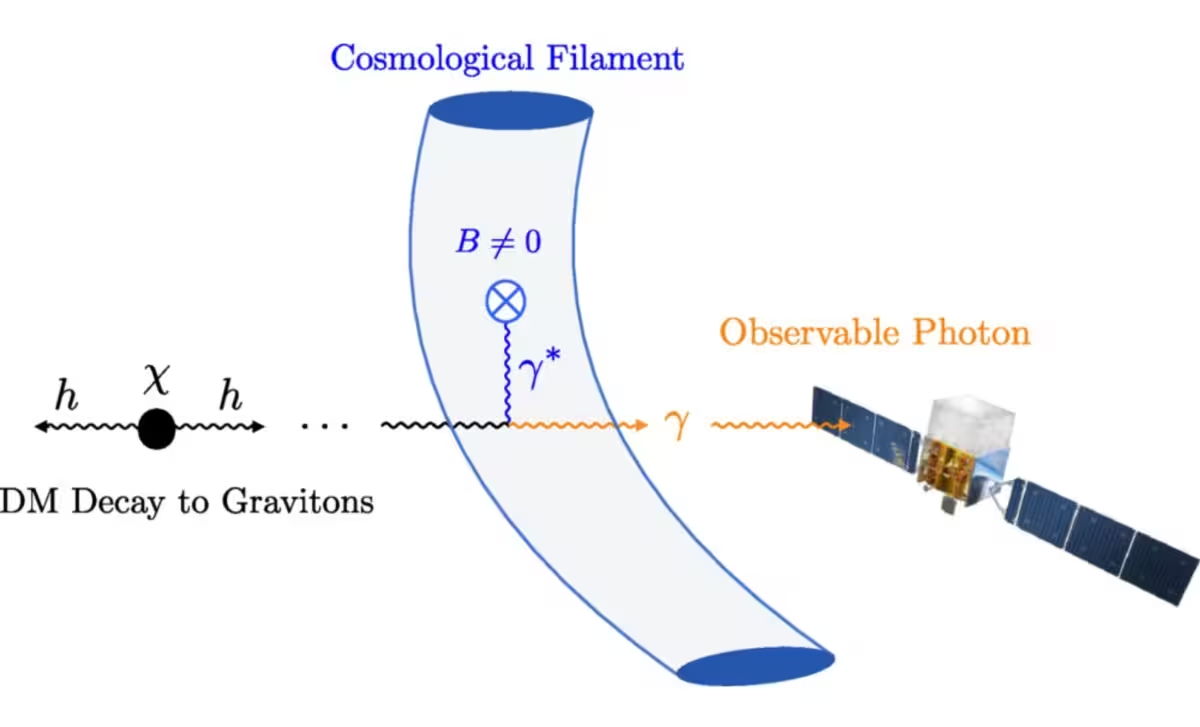
The authors argue that the most favorable environment for graviton‑to‑photon conversion lies within cosmic filaments—vast bridges of gas, dust and galaxies that weave the large‑scale structure of the Universe. These filaments are thought to occupy up to thirty percent of the observable Hubble volume.
Intergalactic Filaments Emerge as Promising Observation Sites
Magnetic fields threading these filaments are extremely weak, on the order of a billionth of a gauss, yet they extend coherently across millions of light‑years. By contrast, Earth’s surface field measures about half a gauss, and a typical refrigerator magnet is roughly one hundred times stronger.
Because the conversion requires propagation over cosmological distances, the expected gamma‑ray signal would originate predominantly from extragalactic regions rather than from the Milky Way’s central halo, a point emphasized by the study’s authors.
Detecting this signal entails searching for a surplus of gamma rays above the background measured by the Fermi Gamma‑ray Space Telescope. Any statistically significant excess aligned with known filament locations could hint at the proposed graviton‑photon pathway.
Leveraging Established Physics to Probe Dark Matter Decay
The proposed mechanism does not invoke new forces; it builds on a Standard Model process—photon production in magnetic fields—while adding only the hypothesis that dark matter can decay into gravitons. This modest extension distinguishes the approach from many other dark‑matter searches that require entirely novel particle interactions.
Looking ahead, the authors suggest that the Advanced Particle‑astrophysics Telescope, a next‑generation space observatory under consideration, could improve sensitivity to this decay channel by roughly an order of magnitude compared with the current Fermi data.
Although dark matter has remained elusive despite extensive experimental effort, this new strategy highlights how indirect signatures—such as faint gamma‑ray glows produced by graviton‑photon conversions—might eventually illuminate the dark sector.
This article has been fact checked for accuracy, with information verified against reputable sources. Learn more about us and our editorial process.
Last reviewed on .
Article history
- Latest version
Reference(s)
- Dunsky, David I.., et al. “Observing dark matter decays to gravitons via graviton-photon conversion.” Physical Review D, vol. 114, no. 1, July 29, 2026 American Physical Society (APS), doi: 10.1103/yvs5-67cj. <https://journals.aps.org/prd/abstract/10.1103/yvs5-67cj>.
- “Advances in Space AstroParticle Physics (ASAPP2025) - 2nd edition.” Indico <https://indico.cern.ch/event/1463191/contributions/6434146/>.
Cite this page:
- Posted by Farah Siddiqui