Could Black Holes Power the Universe’s Fastest Supercomputers and Enable Interstellar Travel
Oxford physicist suggests black holes could enable interstellar travel, ultra‑fast computing, and help spot advanced alien civilizations.
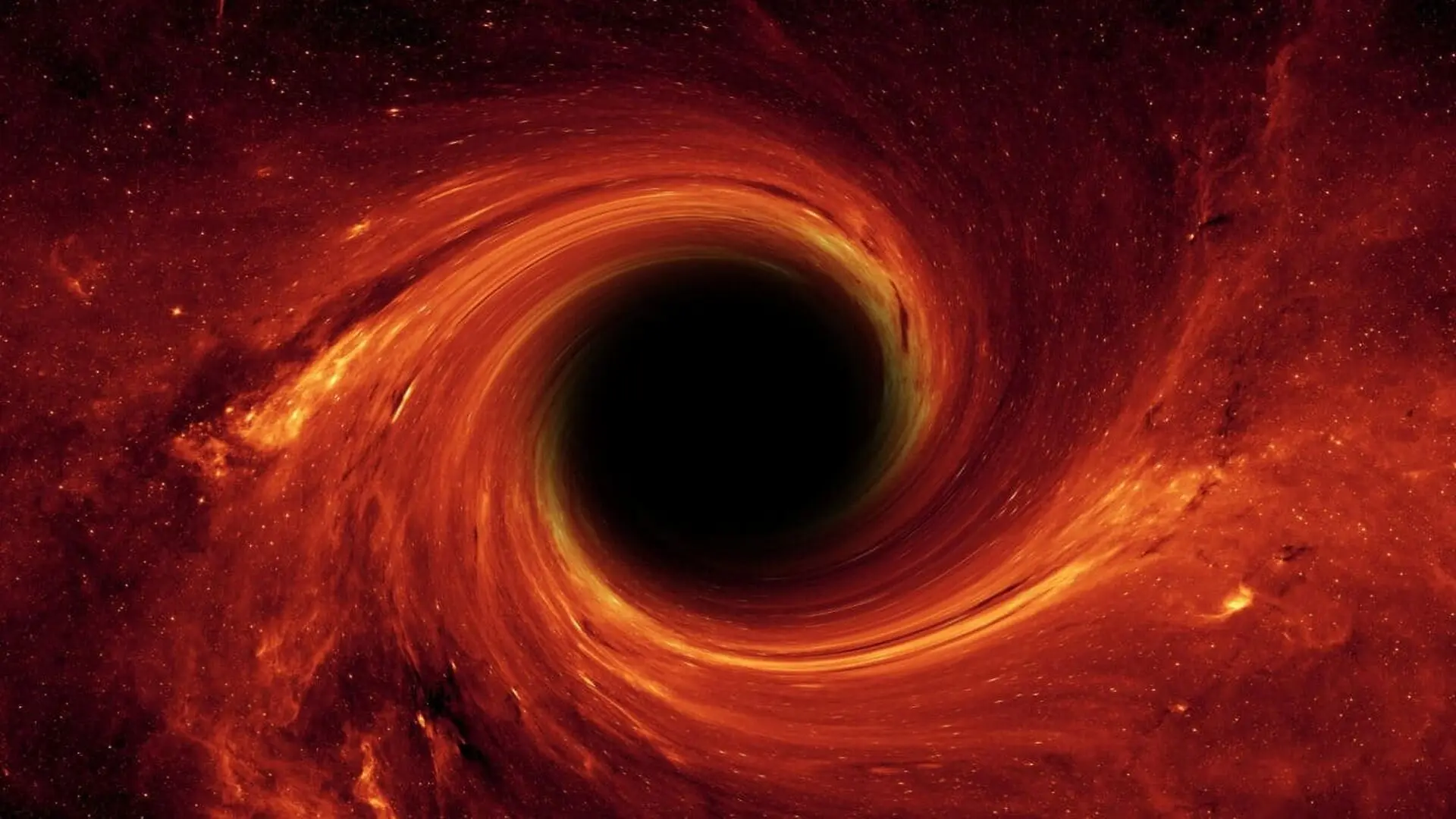
Decades of research into the extreme physics of black holes have spawned speculative ideas about their possible technological roles. While still firmly in the realm of theory, these concepts blend well‑established discoveries with newer proposals that imagine harnessing the power of these cosmic objects.
From Dark Stars to Event Horizons: A Brief History
The notion that a star could become invisible dates back to 1783, when English astronomer John Michell argued that a sufficiently massive body would have an escape velocity exceeding the speed of light. The idea gained rigorous footing in 1916 after German physicist Karl Schwarzschild solved Einstein’s general relativity equations for such an object, defining the radius now known as the Schwarzschild radius or event horizon—a boundary from which nothing, not even light, can return. The term “black hole” was later popularized by American physicist John Wheeler during the 1960s.
Three Lines of Evidence Confirm Their Existence
Early theoretical work by Robert Oppenheimer and his student Hartland Snyder in 1939 described how massive stars could collapse into these objects, but direct proof was lacking because black holes emit no visible light. Modern astronomy relies on three independent observational strategies.
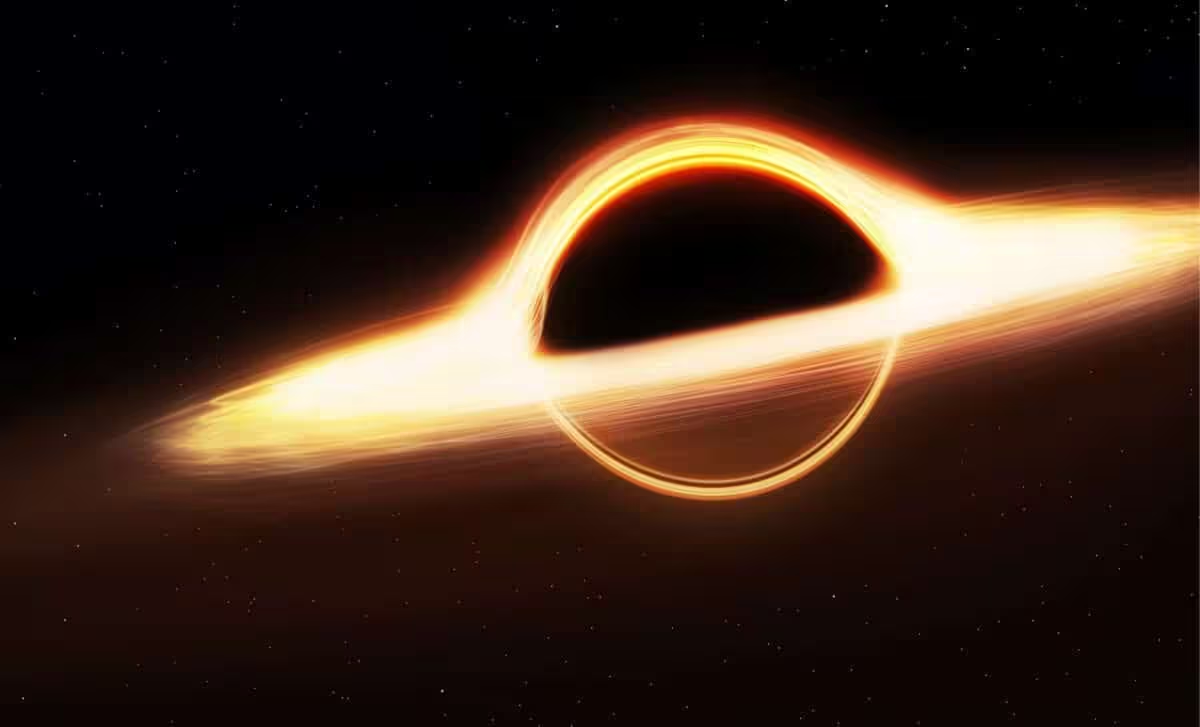
First, radio telescopes capture high‑energy X‑ray emissions from hot material spiraling toward a black hole, allowing scientists to reconstruct images of the surrounding accretion disks. These reconstructions, rather than conventional photographs, reveal the dynamic environment near the event horizon.
Second, the detection of gravitational waves from merging black holes provides waveforms that match predictions from general relativity, confirming that the observed ripples indeed originate from colliding singularities. These breakthroughs have contributed to several Nobel Prizes.
Third, astronomers track the motions of stars orbiting an unseen massive companion. Precise measurements of stellar velocities reveal the gravitational influence of an invisible object, allowing researchers to infer the presence of a black hole even without direct visual evidence. See an example here.
Imagining Black Holes as Propulsion Engines
Beyond confirming their existence, scientists have speculated about using black holes for space travel. The gravitational slingshot technique, already employed by spacecraft that swing around planets like Jupiter, could be amplified dramatically by a pair of orbiting black holes, delivering a far stronger boost. The closest known black hole lies roughly 1,500 light‑years from Earth, meaning such a venture would first require either reaching that distance or fabricating black holes artificially.
Theoretical Limits of Black‑Hole Computing
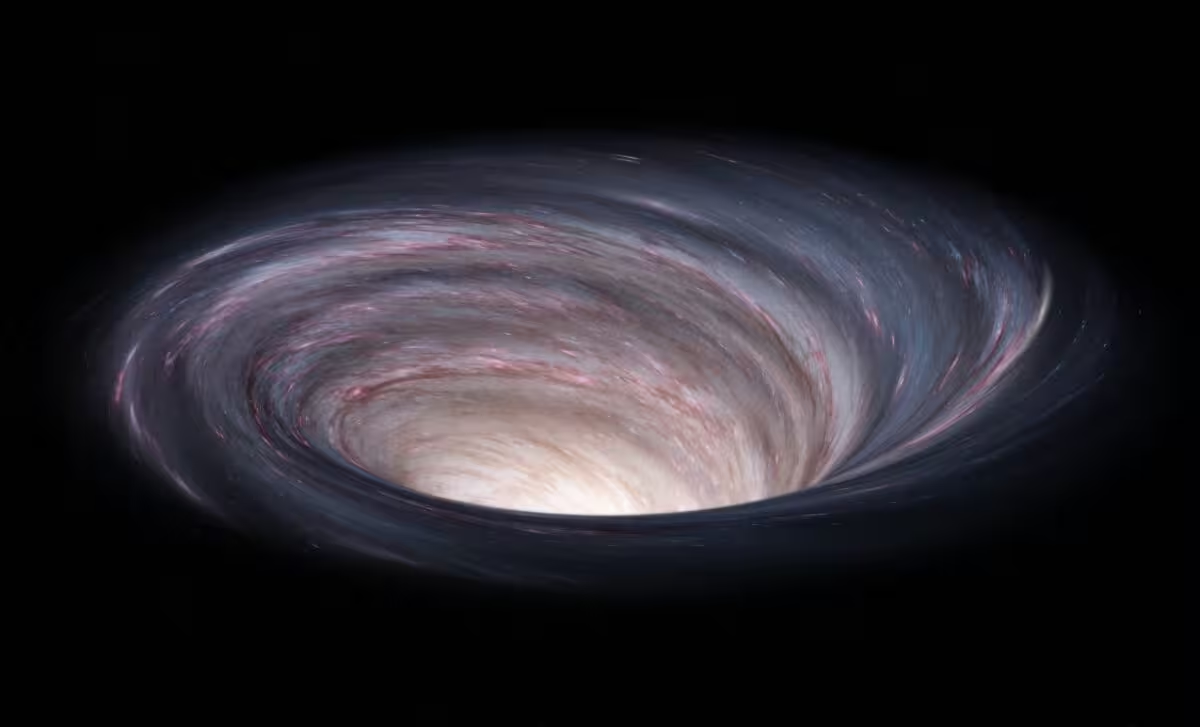
Israeli physicist Jacob Bekenstein proposed a bound indicating that a single bit of information can be stored in a Planck‑scale patch of a black hole’s event horizon, translating to roughly 1069 bits per square meter. By contrast, today’s most powerful supercomputers handle on the order of 1012 bits. Building on this, physicist Seth Lloyd estimated a maximal processing rate of about 1033 operations per second per joule—many orders of magnitude beyond any existing machine.
Hawking Radiation and the Search for Artificial Signals
A key challenge for black‑hole computing is extracting results when the event horizon prevents direct readout. In 1974, Stephen Hawking showed that quantum effects cause black holes to emit a faint glow now known as Hawking radiation. This radiation would carry transformed information, but decoding it would require waiting for the black hole to evaporate completely—a timescale far beyond human horizons.
Some theorists speculate that an advanced extraterrestrial civilization could engineer black holes for information processing, producing radiation patterns that differ from natural astrophysical emissions. Georgian physicists Gia Dvali and Zaza N. Osmanov, as reported by Popular Mechanics, suggest that such artificial Hawking signatures might betray the presence of sophisticated alien technology. The concept mirrors how intelligence agencies infer computer activity by monitoring subtle heat variations, with each bit potentially emitting a distinct energy trace.
This article has been fact checked for accuracy, with information verified against reputable sources. Learn more about us and our editorial process.
Last reviewed on .
Article history
- Latest version
Cite this page:
- Posted by Farah Siddiqui