Human Ancestors Took a Sudden Size Leap: New Study Reveals Sharp Growth Spike in Homo
New PNAS study shows hominin size didn’t rise steadily; the biggest growth spurt occurred in a single Homo branch, reshaping evolutionary views.

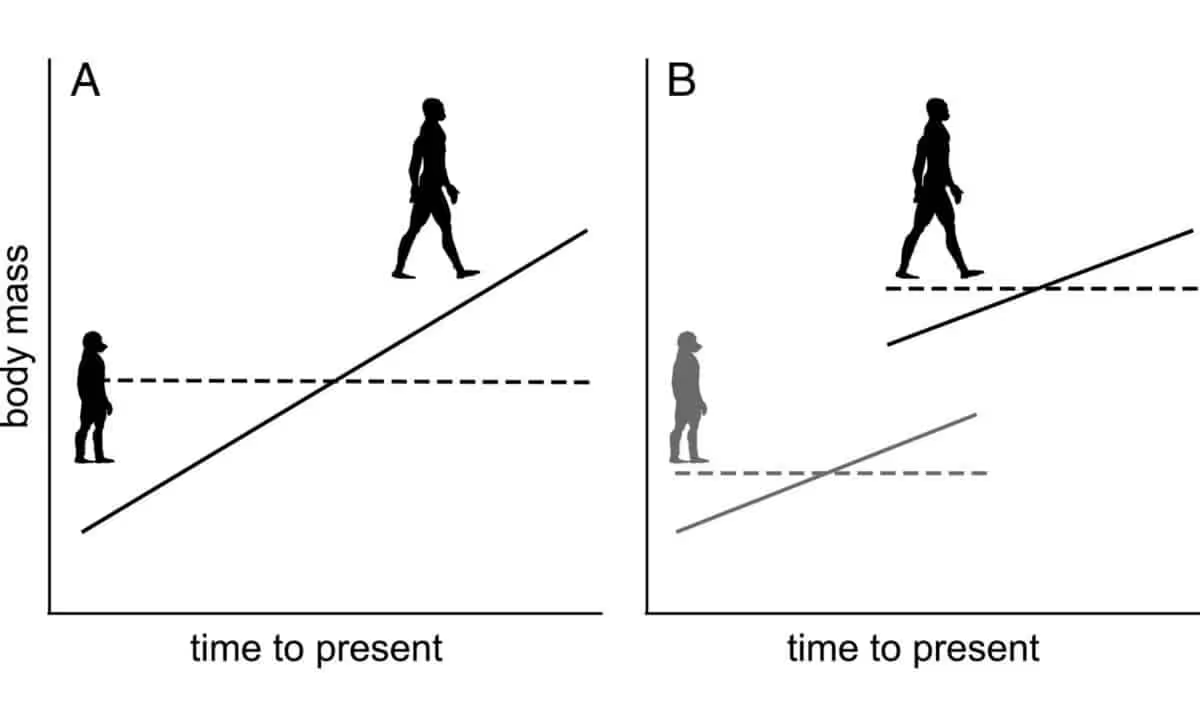
A team from the University of Reading examined body‑mass estimates for 386 fossil specimens representing 21 hominin species, from early australopiths through to modern humans. Using statistical models that incorporate phylogenetic relationships, they concluded that the trajectory of human body‑size evolution was characterised less by a smooth increase and more by a pronounced, lineage‑specific surge that occurred relatively late in the Homo lineage.
Rapid Size Expansion in Later Homo
The most striking pattern emerging from the data is a substantial increase in body mass among Homo species that appear after Homo habilis. Taxa such as Homo ergaster and Homo erectus show a clear jump in size, coinciding with other major adaptations like a stronger commitment to bipedal locomotion and higher meat consumption. By contrast, earlier hominins such as Australopithecus averaged roughly 40 kg and were no taller than a child.
Lead author Dr. Jacob Gardner explained that earlier studies reached divergent conclusions because they focused on isolated fragments of a much larger picture. When the entire fossil record is considered together and the evolutionary ties among species are accounted for, a clearer signal emerges—one that blends a modest, long‑term trend with a more dramatic, later shift within Homo.
While the analysis did detect modest support for a gradual increase in body size across all hominins, this result proved sensitive to the choice of fossil datasets and the methods used to estimate mass, a factor that has fueled ongoing debate. By contrast, the pronounced size jump in non‑habilis Homo remained robust across 1,000 alternative phylogenetic trees and data configurations tested by the researchers.
Outliers: Tiny Hominins Defying the Trend
Two taxa consistently emerged as exceptions: the diminutive Homo floresiensis from Indonesia and Homo naledi of South Africa. Both species fall well below the expected body‑mass range for their ages, and neither conforms to the gradual or stepped growth patterns observed elsewhere in the hominin record.
Co‑author Dr. Thomas Püschel of the University of Oxford highlighted that the major size shift aligns with broader changes in locomotion and resource exploitation, underscoring a tight link between physical stature and ecological or behavioural transitions. The anomalous positions of floresiensis and naledi serve as a reminder that evolutionary pathways are rarely uniform.
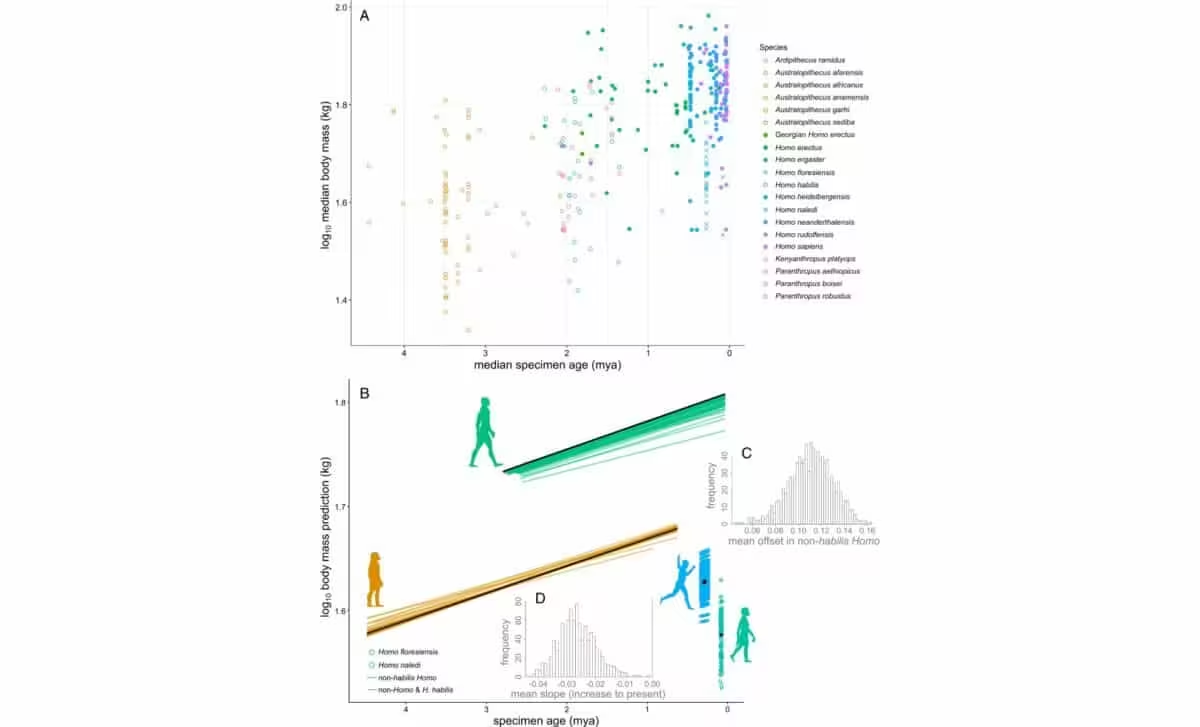
The authors also stress that methodological choices—especially the proxies used to infer body mass from skeletal remains—can heavily sway outcomes. Past studies have reached conflicting conclusions because of differing reference samples and estimation techniques. By embedding multiple sources of uncertainty within a unified statistical framework, the team was able to evaluate competing hypotheses simultaneously, an advance over earlier analyses.
Overall, the research does not discard earlier observations of a general increase in hominin size, but it reframes them. A modest upward trend exists, yet the dominant feature of human body‑size evolution, as outlined in the study, is a concentrated change that arose within our own genus, while other branches—including the surprisingly small relatives—pursued distinct trajectories.
This article has been fact checked for accuracy, with information verified against reputable sources. Learn more about us and our editorial process.
Last reviewed on .
Article history
- Latest version
Reference(s)
- “Jacob Gardner.” Jacob Gardner <https://www.jacobdgardner.com/>.
- “Thomas A. Püschel.” Thomas A. Püschel <https://www.thomaspuschel.com/>.
- Gardner, Jacob D.., et al. “Competing models of hominin body size evolution.” Proceedings of the National Academy of Sciences, vol. 123, no. 27, June 22, 2026 National Academy of Sciences, doi: 10.1073/pnas.2521732123. <https://www.pnas.org/doi/10.1073/pnas.2521732123>.
Cite this page:
- Posted by Elizabeth Taylor