Ancient DNA Reveals American Horses Crossed China Before Reaching Europe
Genetics

Ancient DNA Reveals American Horses Crossed China Before Reaching Europe

Ancient Dalian horses transported North American DNA across Asia, revealing a new twist in the story of horse migration.
By Elizabeth Taylor
Published:
Email this Article
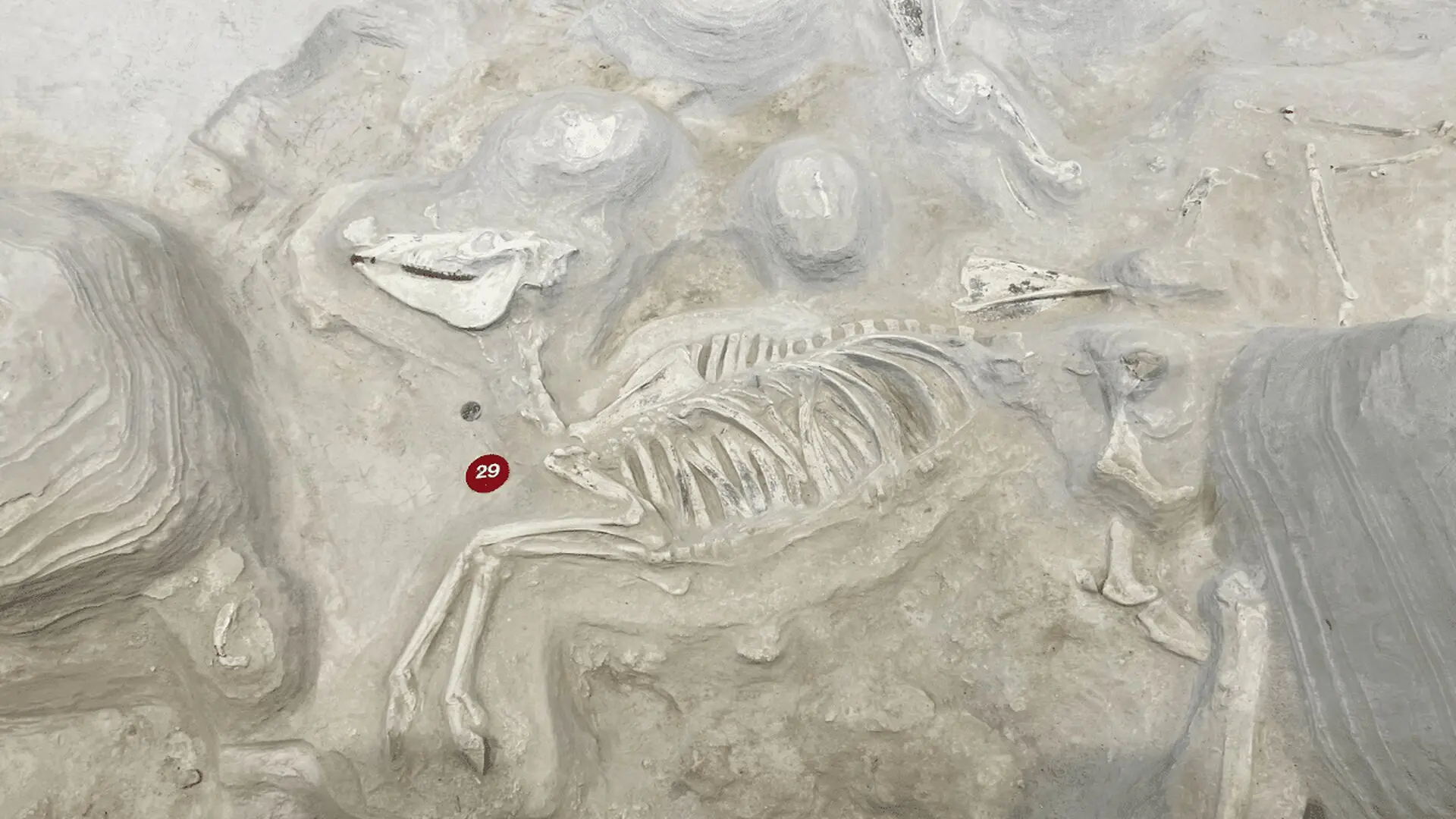
Fossil Study Shows Horses Originated In America And Passed Through China To Europe Scaled
Credit: Shutterstock | Dungrela Publishing

A new genetic analysis overturns the long‑standing view that early horses reached Europe solely from the continent, showing that they carried a North‑American genetic component that traveled through China before arriving in Europe. The study spotlights the extinct Dalian horse as a pivotal conduit for this intercontinental gene flow, reshaping current ideas about equid movements during the late Pleistocene.

Ancient Horse DNA Reveals a Trans‑Beringian Highway

The research, published in Proceedings of the Royal Society B: Biological Sciences, focuses on the Dalian horse, a lineage previously thought to be confined to northeastern China. By sequencing mitochondrial DNA from fossil remains, the team identified a distinctive North‑American ancestry that later appears in Siberian horse populations, indicating that the Dalian horse functioned as a genetic bridge between continents.

“Dalian horses likely served as one route through which North American-related genetic ancestry entered Northeast Eurasian horse populations,” the researchers wrote.

Fossil material from Qinggang County and Harbin supplied the mitochondrial genomes that revealed extensive gene flow across the Bering Strait, positioning the Dalian horse as a major player in the exchange of equine lineages between North America and Eurasia.

“[The] findings position the Dalian horse as a key lineage for elucidating late Pleistocene equid evolution in Northeast Asia and the dynamics of trans‑Beringian genetic exchange,” the study noted.

Wider Distribution Than Previously Thought

Earlier work limited the Dalian horse to a narrow area in northeastern China, but the new data extend its range into Yakutia and southern Siberia. The evidence suggests that the species migrated northward across China, then northwest into Siberia and northeast into Yakutia during the late Pleistocene, acting as a conduit for Eastern Beringian ancestry to enter the northeast Siberian gene pool.

“In light of spatiotemporal overlap between Dalian and northeast Siberian horses and the documented gene flow between them, our findings suggest that Dalian horses likely served as a conduit for the introduction of Eastern Beringian ancestry into the northeast Siberian gene pool,” researchers said.

This broader geographic footprint revises the narrative of horse dispersal across Eurasia, portraying the Dalian horse as a significant contributor to the genetic composition of later domestic and wild equids.
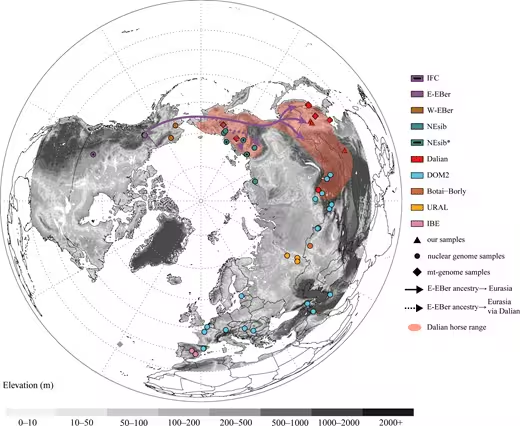
M Rspb.2026.0314.f001
Geographic locations of Dalian horse samples analysed in this study (triangles) plus those from publications that with geographic information in the whole-genome dataset (circles) and the samples with only mitochondrial data (diamonds). Population designations follow Running Horse Collin et al. [8]. Each filled colour indicates a different caballine horse group. Purple: Eastern Beringia (E-EBer). Purple with a black central marker: ice-free corridor (IFC). Brown: an Eastern Beringian sublineage descended from Eurasian horses (W-EBer). Dark green: Northeast Siberian (NEsib). Dark green with a black central marker: a genetically distinct and more regionally restricted sub-lineage within Northeast Siberian horses (NEsib*). Red: Dalian horses (Dalian). Light blue: domestic horses (DOM2). Reddish brown: Botai domestic horses (Botai-Borly). Orange: Ural (URAL). Pink: Iberian (IBE). Purple arrows indicate the direction of E-EBer ancestry spreading into Eurasia, while dashed purple arrows indicate the direction of E-EBer ancestry spread in Eurasia mediated by Dalian horses. The light pink area represents the inferred distribution range of Dalian horses. Shading on the map represents elevation, with darker colours indicating higher altitude. Credit: Proceedings of the Royal Society B: Biological Sciences

Genomic Portrait of Ancient Caballine Horses
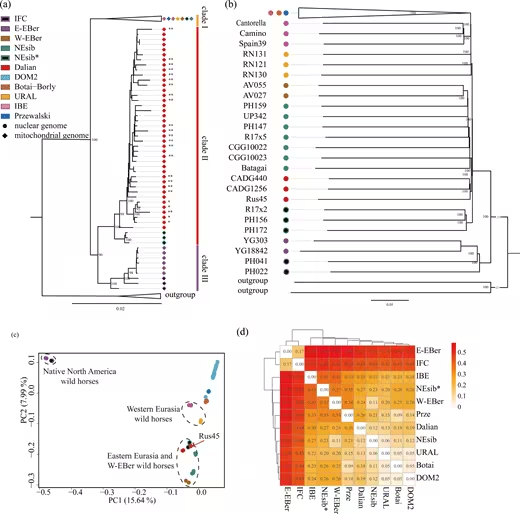
M Rspb.2026.0314.f002
Phylogenetic position and distinctiveness of caballine horses. The colour and shape assignments for all groups follow those in figure 1, and Przewalski’s horse is shown in bright blue. (a) Maximum likelihood (ML) tree of caballine horses based on mitochondrial genome data. Numbers in the branches indicate bootstrap support values. The asterisk denotes individuals that have been assigned as the Dalian horse from Yakutia and South Siberia. Clade names follow Yuan et al. [13], with equivalence to the nomenclature of Vershinina et al. [5] as follows: clade I corresponds to clade A, clade II to clade C and clade III to clade B [5,13]. (b) Neighbour-joining (NJ) tree of caballine horses based on genome-wide genetic distances, with branch lengths representing genetic distances and numbers indicating bootstrap support values. Names of several samples are labelled to facilitate understanding of the discussion. (c) Principal component analysis (PCA) matrix of caballine horses constructed using the identity-by-state (IBS) method, with the clustering of wild horse groups highlighted with dashed circles. (d) Genetic differentiation among caballine horse groups, with darker colours indicating higher levels of differentiation (greater values). Credit: Proceedings of the Royal Society B: Biological Sciences

Specialized Diet and Climate Shift Sealed Its Fate

Stable isotope measurements indicate that the Dalian horse depended on a highly specific grazing regime, limiting its capacity to cope with rapid environmental transformations. As the late Pleistocene climate cooled around 40,000 years ago, expanding wetlands and peatlands replaced the open grasslands that sustained the species, constraining food availability.

“Dalian horses’ specialised dietary niche constrained its ability to adapt to rapid late Pleistocene environmental change, ultimately contributing to its extinction,” the study said.

Combined with its large body size and limited ecological flexibility, these factors led to the disappearance of the Dalian horse, mirroring the decline of other megaherbivores such as North American horses and giant camels at the end of the Pleistocene.

Fact Checked

This article has been fact checked for accuracy, with information verified against reputable sources. Learn more about us and our editorial process.

Last reviewed on .

Article history

  • Latest version

Cite this page:

Taylor, Elizabeth. “Ancient DNA Reveals American Horses Crossed China Before Reaching Europe.” BioScience. BioScience ISSN 2521-5760, 20 June 2026. <https://www.bioscience.com.pk/en/subject/genetics/fossil-study-shows-horses-originated-in-america-and-passed-through-china-to-europe>. Taylor, E. (2026, June 20). “Ancient DNA Reveals American Horses Crossed China Before Reaching Europe.” BioScience. ISSN 2521-5760. Retrieved June 20, 2026 from https://www.bioscience.com.pk/en/subject/genetics/fossil-study-shows-horses-originated-in-america-and-passed-through-china-to-europe Taylor, Elizabeth. “Ancient DNA Reveals American Horses Crossed China Before Reaching Europe.” BioScience. ISSN 2521-5760. https://www.bioscience.com.pk/en/subject/genetics/fossil-study-shows-horses-originated-in-america-and-passed-through-china-to-europe (accessed June 20, 2026).

Follow us on social media

End of the article