Spot The 150-Year-Old Tempel 2 Comet This Summer For One Of The Best Views In Decades
See the 1873 comet as it swings close to Earth, giving binoculars a rare view and marking 150 years of scientific observations.
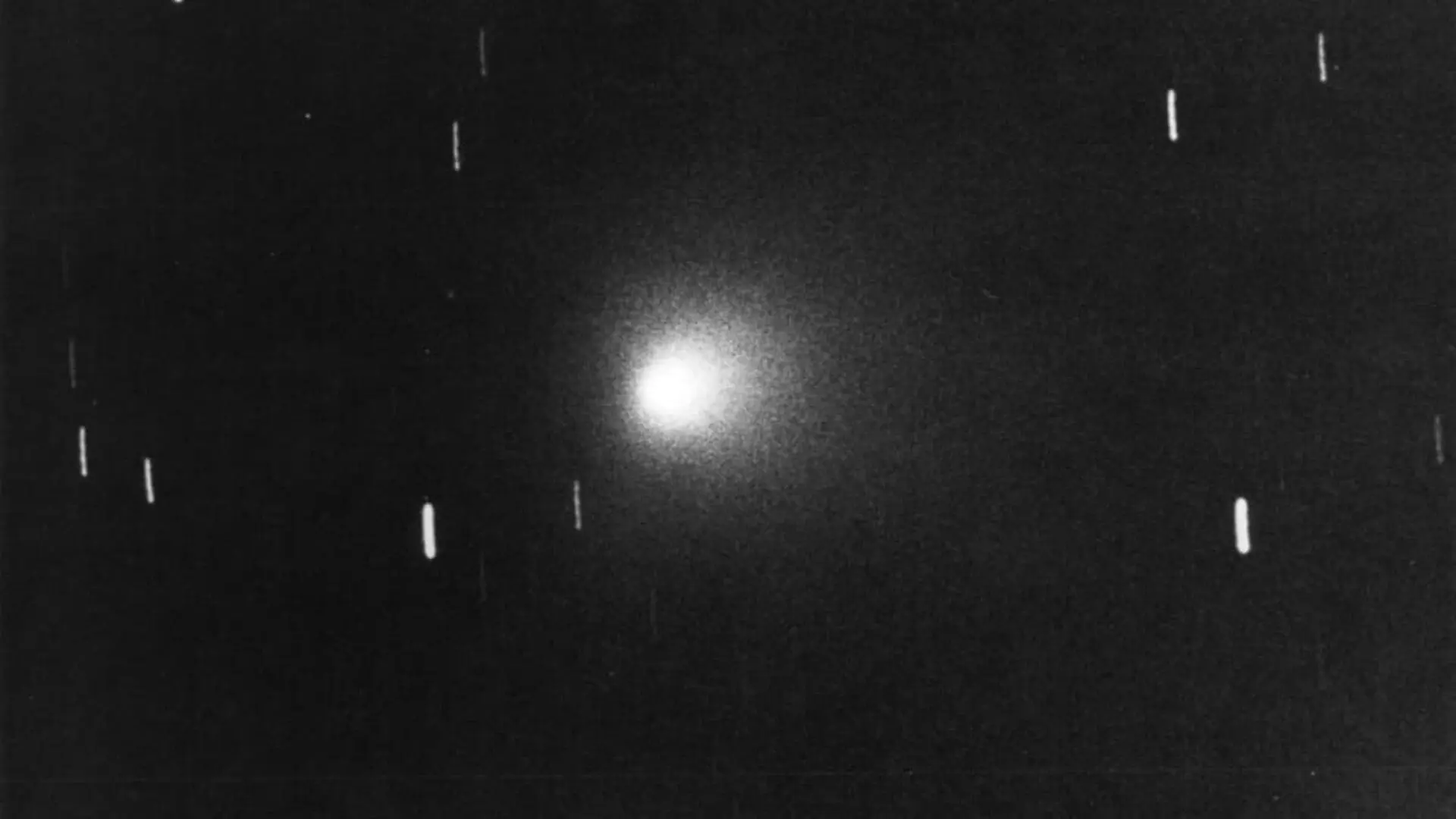
Comet 10P/Tempel 2, discovered in the 19th century, will swing through the inner Solar System this summer under one of the most favorable alignments in decades, offering backyard astronomers a rare chance to spot a roughly 10‑kilometre nucleus with modest equipment.
The closest approach to Earth is slated for 3 August 2026, when the comet will be about 0.4144 AU away – roughly 62 million kilometres (38.5 million miles). IFLScience notes that the combination of distance and predicted brightness makes this apparition one of the clearest opportunities to observe the periodic visitor in recent memory.
Repeated passes of short‑period comets like 10P/Tempel 2 provide a valuable laboratory for tracking how such bodies evolve as they repeatedly heat and cool near the Sun, allowing scientists to monitor changes in composition, rotation and activity over many decades.
Century‑Old Visitor Returns With Prime Viewing Conditions
German astronomer Wilhelm Tempel first recorded the comet on 4 July 1873 while scanning the Pisces region of the sky. According to IFLScience, he continued to monitor the object until it faded from view on 20 October, and early calculations suggested an orbital period of about five to five‑and‑a‑half years.
A subsequent apparition on 19 July 1878 allowed astronomers to refine the period to roughly 5.16 years. Modern measurements place the comet’s true orbital cycle at 5.37 years, confirming its status as a regular, short‑period visitor.
With an estimated diameter of 10 kilometres, 10P/Tempel 2 is comparable in size to the asteroid believed to have ended the reign of the dinosaurs. Its orbit, however, remains safely bounded between the orbits of Mars and Jupiter, never approaching Earth closely enough to pose a hazard.
Scientific Value of This Return
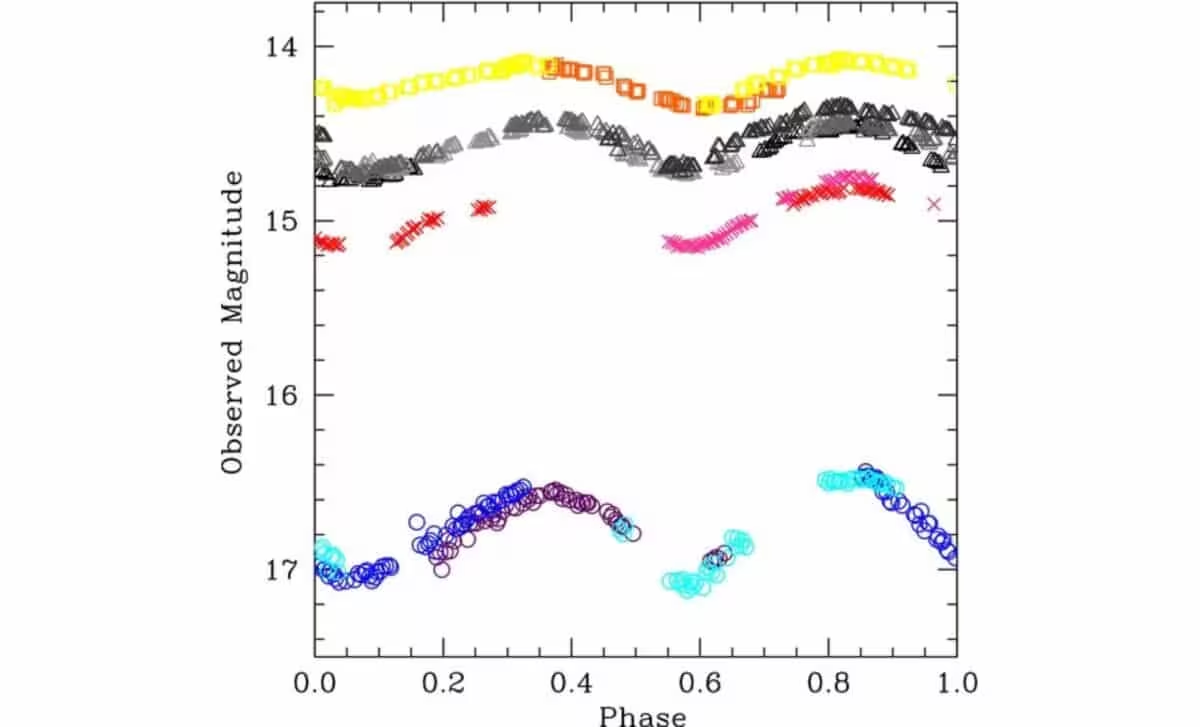
Although the comet resurfaces every 5.37 years, the geometry of each approach varies, alternating between favorable and less‑optimal viewing configurations. A study published in the Astronomical Journal—cited by IFLScience—highlights that the comet was especially well‑placed in 1978, 1988 and 1999, while returns in 1983, 1994 and 2004 suffered from perihelion occurring on the far side of the Sun.
Advances in detector sensitivity and telescope optics now enable astronomers to record data on every apparition, even when the comet appears fainter or lower on the horizon. Long‑term monitoring has revealed that, as 10P/Tempel 2 approaches the Sun, sublimation of volatile ices drives changes in its surface composition and spin rate.
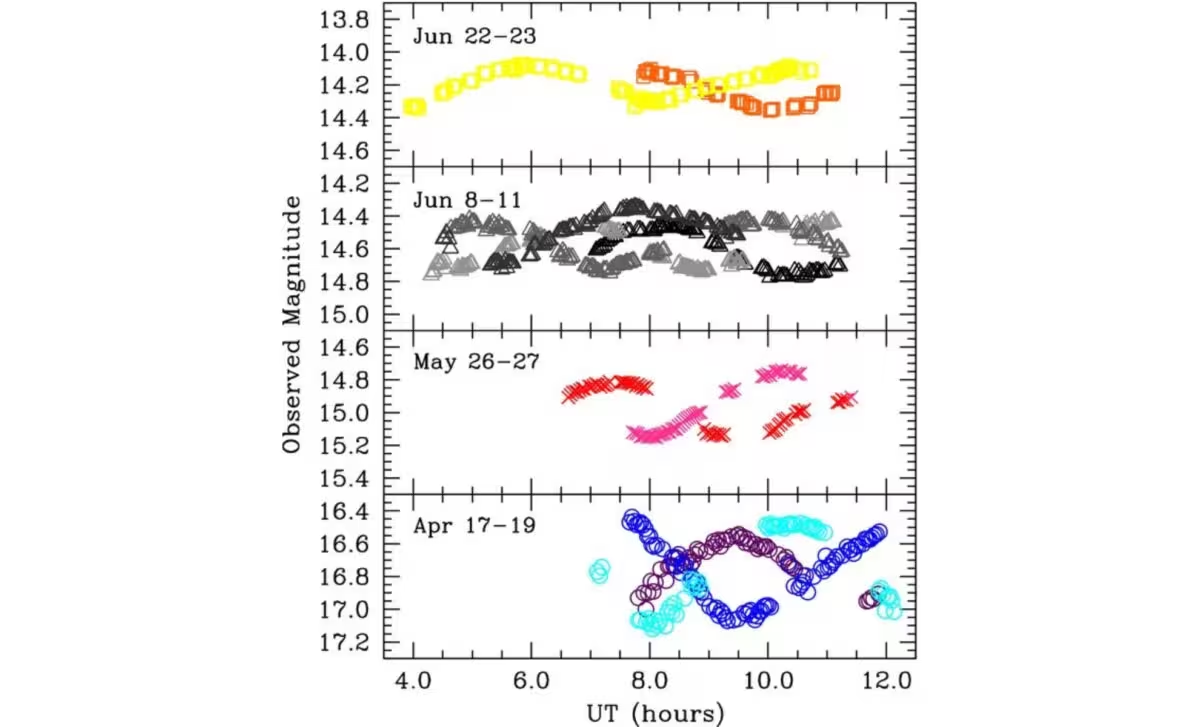
Repeated observations have also documented a measurable slowdown in the comet’s rotation, a phenomenon researchers attribute to uneven outgassing that creates torque on the nucleus as it heats and cools during each orbit.
Because of its relatively short orbital period and proximity compared with more distant comets, 10P/Tempel 2 has attracted occasional mission concepts, including a proposal that would have employed NASA’s Mariner 3 probe. None of these plans progressed to launch, but the comet remains a compelling target for future exploration.
For skywatchers, the comet becomes visible with binoculars or modest telescopes from early July, rising in the constellation Capricornus and moving toward Piscis Austrinus near perihelion. It is expected to reach about magnitude 7, making it observable from both northern and southern latitudes, with a higher placement in the southern sky.
This article has been fact checked for accuracy, with information verified against reputable sources. Learn more about us and our editorial process.
Last reviewed on .
Article history
- Latest version
Reference(s)
- <https://www.iflscience.com/a-10-kilometer-comet-discovered-in-1873-is-about-to-make-its-best-return-in-decades-84027>.
- Knight, Matthew M.., et al. “THE INCREASING ROTATION PERIOD OF COMET 10P/TEMPEL 2.” The Astronomical Journal, vol. 141, no. 1, December 6, 2010, pp. 2 American Astronomical Society, doi: 10.1088/0004-6256/141/1/2. <https://iopscience.iop.org/article/10.1088/0004-6256/141/1/2>.
Cite this page:
- Posted by Aisha Ahmed