James Webb Finds Mysterious Infrared Signal on Pluto and Titan, Unknown Molecule
James Webb’s odd signal sparks fresh scrutiny of Pluto and Titan, as scientists chase a mysterious clue that defies known patterns.

Data from the James Webb Space Telescope have uncovered an unexpected infrared absorption band near 5.11 µm on both Pluto and Saturn’s moon Titan, hinting at a molecular species that has never been recorded elsewhere in the Solar System or on known exoplanets, according to a pre‑print posted on arXiv.
The signal emerged after researchers focused on a relatively under‑explored region of the infrared spectrum. By comparing the spectra of the two bodies, they found a missing wavelength at about 5.11 µm that does not align with any documented molecular fingerprint in existing planetary datasets.
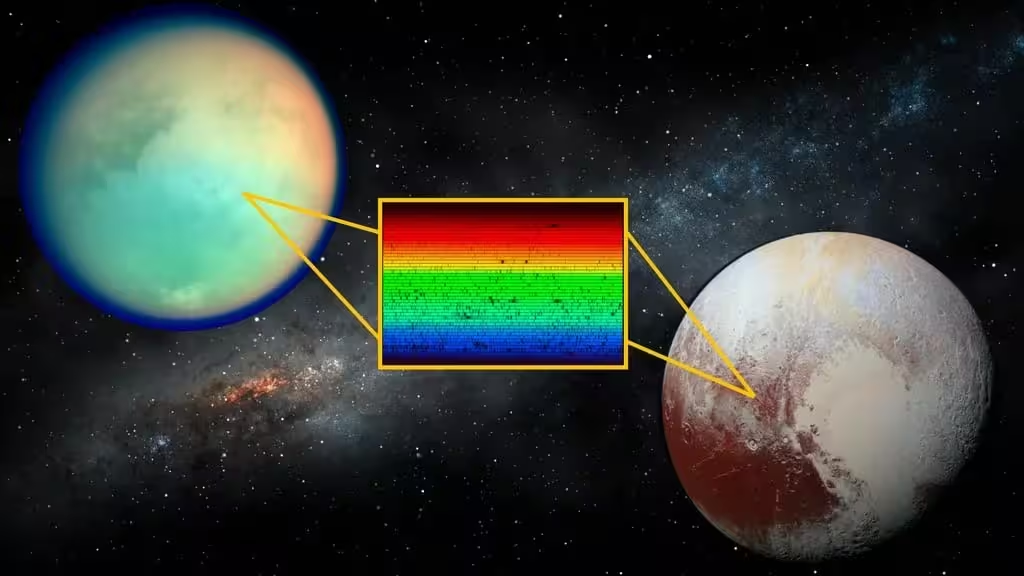
Pluto and Titan are strikingly different worlds, yet both host atmospheres rich in methane and nitrogen. The authors argue that the mysterious absorption most likely originates from surface material rather than atmospheric gases, adding an extra layer of complexity to the interpretation.
A New Spectral Feature Defies Existing Catalogues
Astronomers identify the makeup of remote objects by examining how matter absorbs electromagnetic radiation. Each chemical species leaves a unique set of absorption lines that serve as a diagnostic signature.
In a paper uploaded to arXiv on June 11, the team described their analysis of James Webb observations of Pluto and Titan, concentrating on the seldom‑studied infrared window. Their work uncovered a distinct absorption line centered at 5.11 µm in the spectra of both objects.
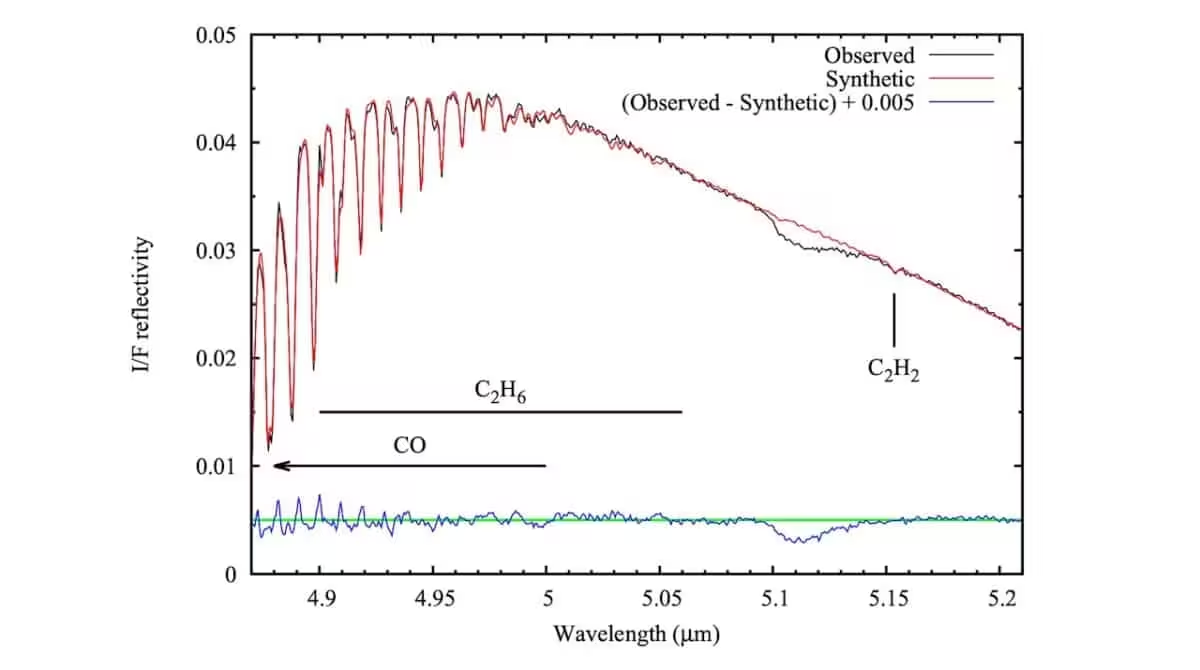
When the authors cross‑checked the feature against existing planetary spectra, they reported:
they “did not find any band referenced in these publications that corresponds to the location of the observed absorption in Titan and Pluto.”
Consequently, the detected line does not match any known chemical compound identified elsewhere in the Solar System or on observed exoplanets. While James Webb has already demonstrated its capacity to pinpoint atmospheric constituents on distant worlds, this finding pushes the telescope’s reach to a puzzling molecular signature much closer to home.
Why Pluto and Titan Share This Odd Signature
The coincidence is surprising because the two bodies differ dramatically in size, composition and orbital distance. Titan, Saturn’s largest moon, exceeds Mercury in diameter and hosts liquid hydrocarbon lakes on its surface. Pluto, by contrast, is a frozen dwarf planet roughly half the size of Titan and orbits four times farther from the Sun than the moon.
Despite those disparities, both worlds maintain atmospheres dominated by methane and nitrogen. The researchers note that the newfound absorption appears tied to surface constituents rather than to gaseous components, a conclusion that complicates existing models.
Quantitatively, the absorption on Pluto is about three times stronger than on Titan, implying a higher abundance of the unidentified material on the dwarf planet. On Titan, the feature is not evenly distributed; it is more pronounced on the moon’s trailing side than on its leading side as it circles Saturn.
Possible Molecular Candidates and Future Tests
The exact nature of the molecule responsible for the 5.11 µm band remains elusive. The authors propose several tentative explanations, including a combination of benzene with an unknown partner, or icy forms of acetylene or ketene. None of these hypotheses have been confirmed, and further laboratory work will be needed to assess their viability.
A forthcoming opportunity to probe the mystery comes from NASA’s Dragonfly mission, slated for launch no earlier than 2028 and scheduled to explore Titan’s atmosphere in 2034. The spacecraft will carry a spectrograph capable of directly sampling surface materials, potentially identifying the same compound on Titan and clarifying whether it also exists on Pluto.
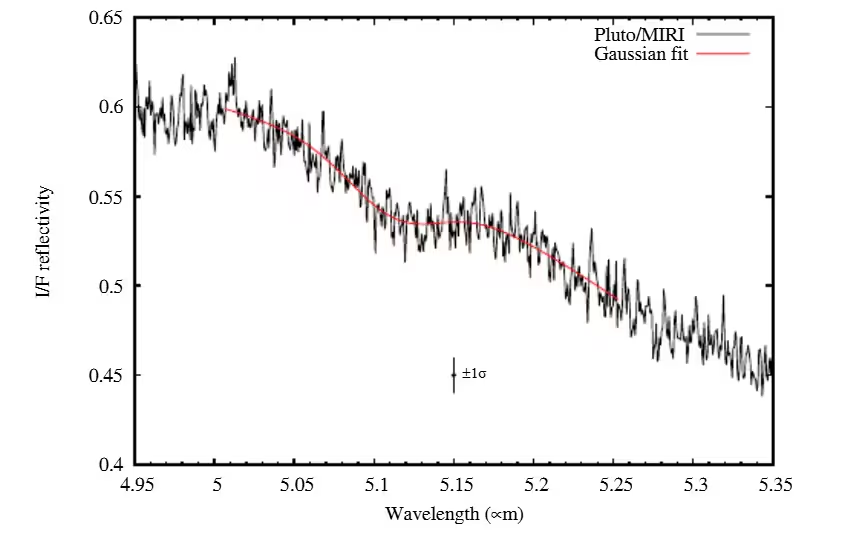
Until Dragonfly or similar missions deliver in‑situ measurements, the 5.11‑micrometer absorption remains an open question, challenging scientists to expand the inventory of known planetary compounds.
This article has been fact checked for accuracy, with information verified against reputable sources. Learn more about us and our editorial process.
Last reviewed on .
Article history
- Latest version
Reference(s)
- Bézard, B.. “An unidentified absorption feature at 5.11 $μ$m on the surface of Titan and Pluto from JWST spectroscopy.” arXiv.org <https://arxiv.org/abs/2606.13350>.
- dghernandez, “Dragonfly.”, June 15, 2023 NASA <https://science.nasa.gov/mission/dragonfly/>.
Cite this page:
- Posted by Aisha Ahmed