Violent Stellar Collisions May Explain How Supermassive Black Holes Formed So Early
New simulations reveal how dense star clusters in the early universe may have forged massive black holes through repeated stellar collisions.
The dawn of the cosmos may have been far more chaotic than previously imagined, with densely packed star clusters acting as cosmic incubators for supermassive black holes. A study led by researchers at the University of California, Los Angeles (UCLA) suggests that in the cramped conditions of the early universe, frequent stellar collisions could have triggered runaway mergers, creating massive progenitor stars that eventually collapsed into oversized black holes long before galaxies fully matured.
This theoretical model, which appears as a preprint on arXiv and is published in The Astrophysical Journal, offers a compelling explanation for a modern observational puzzle: why the James Webb Space Telescope (JWST) is detecting gargantuan black holes at such early stages of cosmic history.
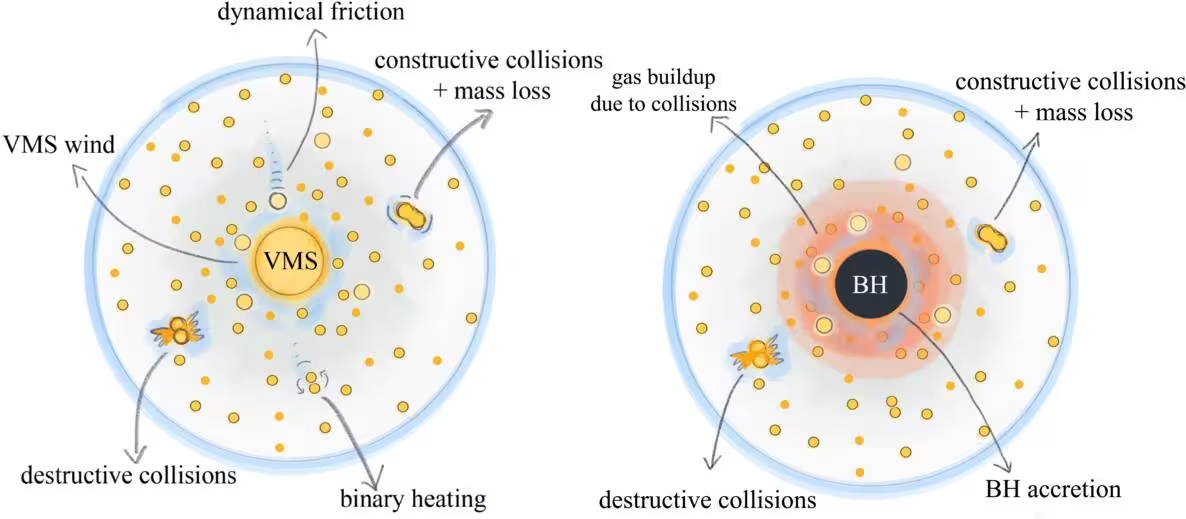
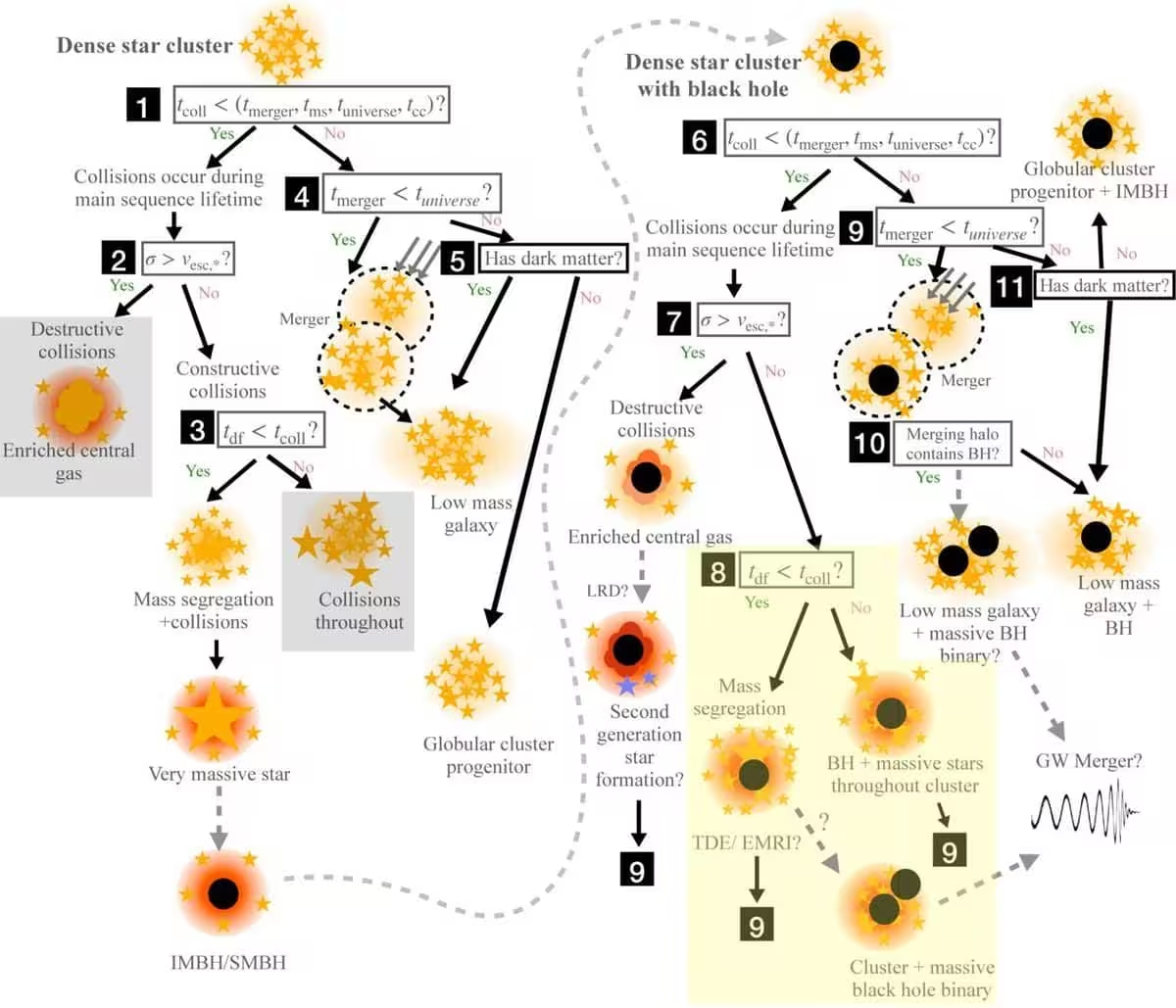
In our current neighborhood, the Milky Way’s stars are spread so thin that direct collisions are virtually non-existent. However, the simulation indicates that in the infant universe, clusters were so tightly packed that stars could collide and merge, effectively pooling their mass. The outcome of these encounters was dictated by velocity; slow-speed collisions tended to result in mergers, while high-velocity impacts often shredded stars, scattering their material into the surrounding environment.
Building Cosmic Giants Through Stellar Runaways
The most extreme scenarios in the team’s research involve “runaway” mergers. In these high-density environments, a single star can continue to consume its neighbors, eventually growing to a size that accounts for a massive portion of the cluster’s total stellar population. When these runaway stars reach the end of their lifecycle, they collapse directly into black holes that are significantly heavier than the typical remnants of standard stellar evolution.
“Perhaps the strangest outcome of our simulations is that stars can merge repeatedly within the cluster until they form one gigantic star with a mass equal to that of an entire cluster,” said lead author and UCLA doctoral student Claire Williams. “When a star this huge reaches the end of its life, models suggest that it may have no option but to collapse into itself and form a massive black hole.”
This provides a “head start” for black hole growth. Instead of relying on the slow, incremental accretion of matter, these massive seeds arrive in the early universe already possessing significant heft, allowing them to reach the supermassive proportions detected by JWST much faster than conventional models would predict.
Feedback Loops in the Galactic Core
While the early universe was unique, the center of the Milky Way provides a modern, albeit smaller-scale, analog. The nuclear star cluster surrounding the supermassive black hole Sagittarius A* serves as a laboratory for how these systems interact. The study suggests that once a massive black hole forms, it essentially acts as a traffic controller, altering the velocities of surrounding stars. High-velocity stars near the black hole no longer merge—they collide destructively, liberating gas that could then be consumed by the black hole itself.
This dynamic creates a complex feedback loop where the very environment that produces a black hole is later reshaped by the gravitational influence of that same object.
Untangling the Mystery of Little Red Dots
The researchers believe their findings may also shed light on “little red dots”—mysterious, compact, reddish objects identified by JWST that have confounded astronomers. Because these objects don’t fit perfectly into standard galactic classifications, they have been the subject of intense debate.
The UCLA team posits that these “dots” could be the remnants of exceptionally dense stellar systems where these violent mergers have occurred. “Little red dots are a hot topic in astronomy,” noted co-author and UCLA astrophysicist Smadar Naoz. “You can compare studies of people trying to understand LRDs to the tale of blind people who are trying to describe an elephant by touching it, and each person describes it differently based on what part they’re touching. Our research connects several of those perspectives together and may help us see more of the elephant.”
While the model remains a hypothesis, it provides a crucial new framework for interpreting the data streaming back from the James Webb Space Telescope. By examining the signatures of these dense clusters, astronomers may finally be able to verify whether the giants of the early universe truly were born from the wreckage of their own crowded nurseries.
This article has been fact checked for accuracy, with information verified against reputable sources. Learn more about us and our editorial process.
Last reviewed on .
Article history
- Latest version
Reference(s)
- Cheng, Zihan. “Pseudoentanglement from tensor networks.” arXiv.org, doi: 10.1103/7p1r-r2p6. <https://arxiv.org/abs/2410.02758>.
- Williams, Claire E.., et al. “A Cosmological Framework for Stellar Collisions at High Redshift in Proto-globular Clusters, Nuclear Star Clusters, and Little Red Dots.” The Astrophysical Journal, vol. 1012, no. 1, October 26, 2026, pp. 1 American Astronomical Society, doi: 10.3847/1538-4357/aea577. <https://iopscience.iop.org/article/10.3847/1538-4357/aea577>.
Cite this page:
- Posted by Farah Siddiqui