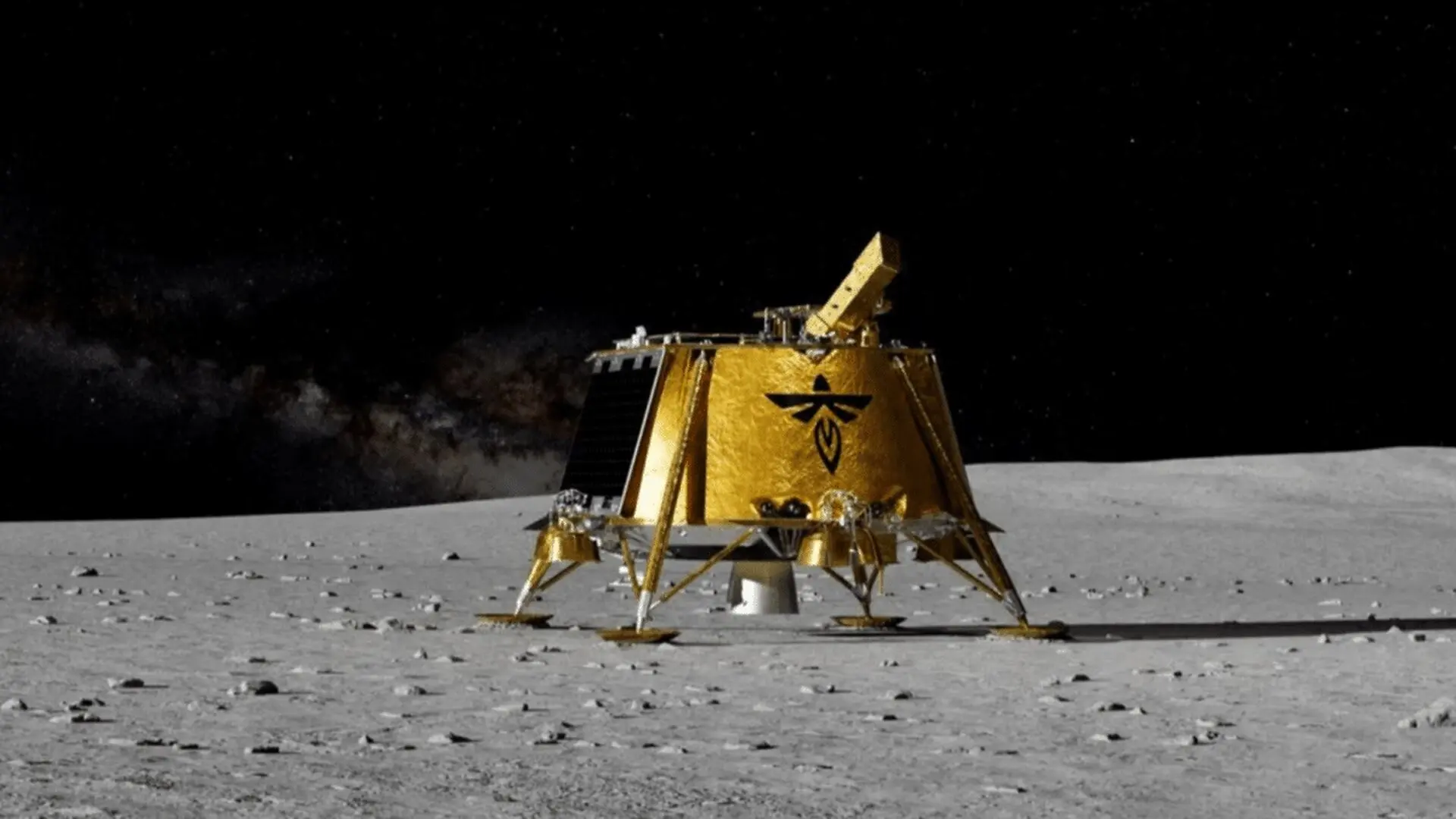
Two American aerospace firms are gearing up for 2028 lunar missions that could reveal a critical vulnerability for NASA’s long-term Moon base ambitions: the destructive potential of spacecraft landing in close proximity to one another. As reported by SpaceNews, these upcoming tests aim to refine precision landing capabilities while evaluating how high-velocity lunar dust impacts neighboring infrastructure.
Evaluating the Risks of Close-Proximity Landings
Future lunar exploration depends on the ability to land spacecraft repeatedly within concentrated zones. This operational requirement is driving the development of new missions from Firefly Aerospace and Voyager Lunar Systems, both operating under the auspices of NASA’s Commercial Lunar Payload Services (CLPS) program.
During an October 14 gathering of the Lunar Surface Innovation Consortium, representatives from both companies detailed their plans to conduct precision landings near existing lunar hardware. Firefly Aerospace, which successfully landed its first Blue Ghost craft in March 2025, plans to deploy a second lander to that same vicinity in 2028. According to Allen Butler, Firefly’s director of spacecraft integration, test, and launch operations, the team hopes to capture footage of the landing, which would provide critical visual data on how the descent affects nearby hardware.
Voyager Lunar Systems—formerly known as Astrobotic Technologies—is pursuing a similar objective. Their 2028 plans involve two Peregrine landers touching down within a few kilometers of each other. Dan Hendrickson, vice president of business development at Voyager, noted that this proximity creates a practical model for assessing the environmental hazards involved in establishing a permanent Moon base.
Peep our Elytra orbiter being assembled in the cleanroom
.
This spacecraft is part of our Riders 2 the Dark mission — America’s first mission to land on the Moon’s far side.
Without direct line-of-sight to Earth, communication on the far side is impossible without a relay. That’s where our Elytra orbiter comes in
. Elytra will serve as a transfer vehicle and communications bridge between Blue Ghost and Earth, enabling critical science operations on the lunar surface and setting the stage for future missions.
The primary concern for mission planners is “plume-surface interaction.” When a lander approaches the lunar surface, its engine exhaust kicks up the loose layer of regolith—crushed rock and dust—that covers the Moon. In the absence of an atmosphere, these particles are not slowed down; they are ejected at extreme velocities. Research from Phil Metzger at the University of Central Florida suggests these particles can travel at speeds of up to 2 kilometers per second, or roughly 4,470 miles per hour.
At those speeds, even microscopic dust becomes a lethal projectile capable of shredding solar panels, damaging communication arrays, and compromising the insulation of existing landers like the original Blue Ghost. Voyager’s upcoming missions are explicitly designed to monitor these interactions to guide future site planning.
Why Predicting Dust Behavior Remains Elusive
Despite decades of activity on the Moon, engineers still struggle to accurately forecast how rocket exhaust interacts with the lunar surface. The physics of supersonic gas expanding into a near-vacuum, combined with the chaotic nature of turbulent flow over loose, fragmented regolith, creates a modeling challenge that current simulations cannot fully resolve.
“None of those models contain all the physics,” noted experts familiar with the challenge, pointing to the unpredictable nature of these interactions. With NASA planning dozens of landings in specific, high-traffic regions over the coming decade, the cumulative impact of these “dust storms” poses a significant threat to long-term infrastructure.
The Financial Case for Hardened Landing Pads
One potential remedy is the construction of prepared landing pads. Redwire is currently exploring this through its Mason program, which aims to process local lunar regolith into stable construction materials. While the upfront costs of delivering the necessary machinery to the Moon are immense, industry analysis suggests that the alternative is far more expensive. A study by Redwire indicated that mitigating dust-related damage could save the industry roughly $1 billion over a five-year window.
As Patrick Flowers, the Mason program’s principal investigator, explained, the cost of building a landing pad is high, but the cost of ignoring the risk is far higher. The 2028 demonstrations by Firefly and Voyager will not solve the problem overnight, but they will provide the empirical data required to refine landing safety and determine the necessary spacing for future lunar outposts. For NASA, the goal is clear: ensuring that every new mission contributes to the growth of the Moon base, rather than endangering the progress already achieved.
Fact Checked
This article has been fact checked for accuracy, with information verified against reputable sources. Learn more about us and our editorial process.
Last reviewed on .
Article history
Latest version
Cite this page:
Siddiqui, Farah. “Why NASA Is Testing Dangerous Precision Landings That Could Destroy Future Moon Bases.” BioScience. BioScience ISSN 2521-5760, 16 October 2026. <https://www.bioscience.com.pk/en/subject/physics/two-lunar-lander-companies-plan-to-land-spacecraft-near-each-other-on-the-moon>.
Siddiqui, F. (2026, October 16). “Why NASA Is Testing Dangerous Precision Landings That Could Destroy Future Moon Bases.” BioScience. ISSN 2521-5760. Retrieved October 16, 2026 from https://www.bioscience.com.pk/en/subject/physics/two-lunar-lander-companies-plan-to-land-spacecraft-near-each-other-on-the-moon
Siddiqui, Farah. “Why NASA Is Testing Dangerous Precision Landings That Could Destroy Future Moon Bases.” BioScience. ISSN 2521-5760. https://www.bioscience.com.pk/en/subject/physics/two-lunar-lander-companies-plan-to-land-spacecraft-near-each-other-on-the-moon (accessed October 16, 2026).