Quantum Geometry Revealed Through Spreading Wave Packets in Flat Bands
Physicists show that watching atomic clouds expand under a weak force can expose hidden geometric properties of quantum materials.
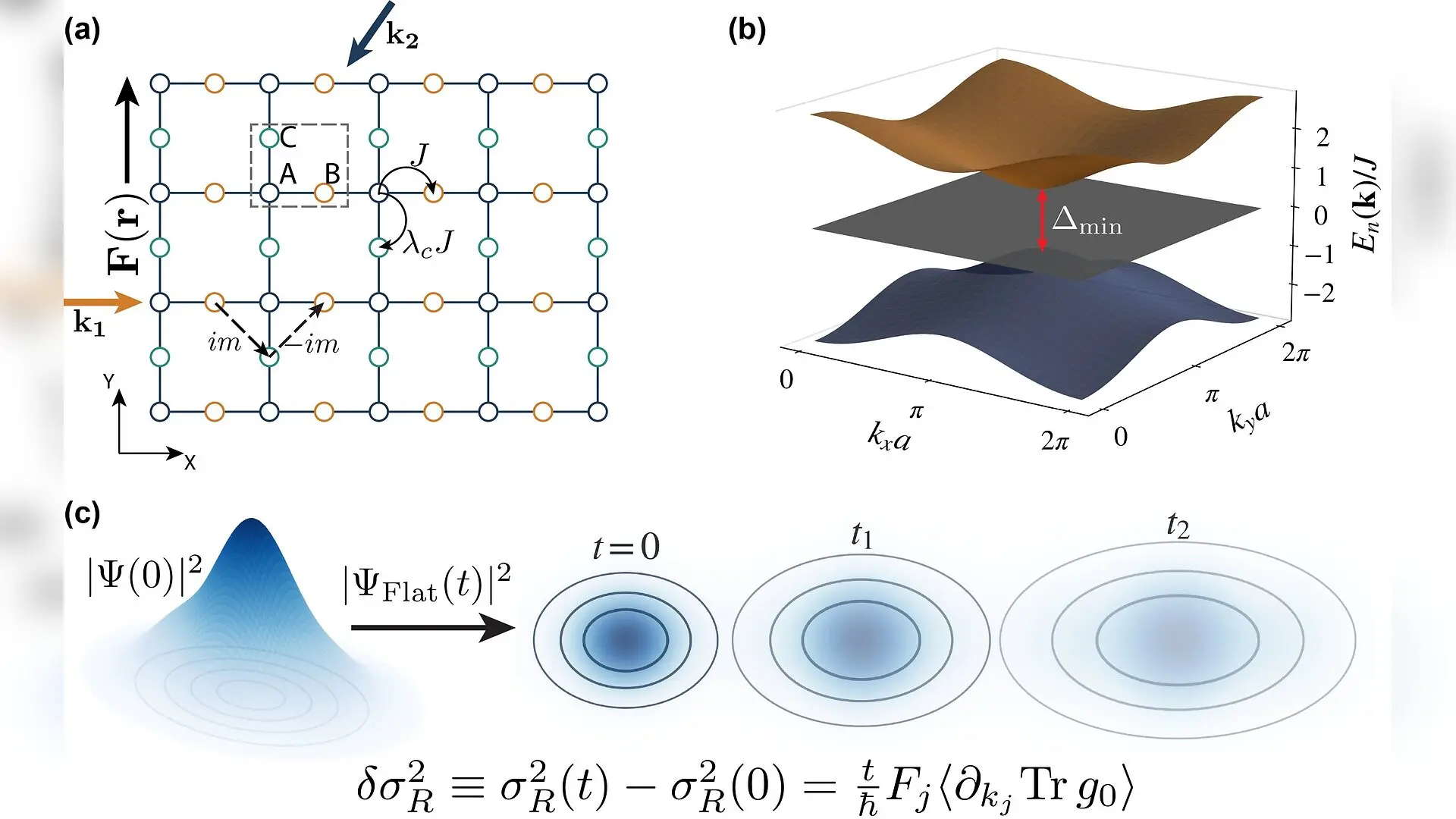
Physicists have devised a way to directly map the hidden geometric properties of quantum materials by watching microscopic clouds of ultracold atoms spread out over time. In a new theoretical study available on the arXiv preprint server, researchers investigated how particle wave packets behave when confined to flat electronic bands where conventional kinetic energy is almost entirely suppressed.
Probing the Invisible Quantum Metric
In standard materials, electrons move because their energy changes with momentum, creating a familiar kinetic flow. However, in flat-band systems, particle energies remain completely flat across crystal momentum space, stalling normal motion. Despite this standstill, the underlying quantum states possess a rich internal geometry described by the quantum metric and Berry curvature. While Berry curvature acts like a magnetic field that deflects particles sideways, the quantum metric governs subtle spatial distributions that have proven notoriously difficult to measure directly in experiments.
To overcome this challenge, Rishi Gangadhar, Binayyak Roy, Vito Scarola, and Sumanta Tewari analyzed the real-space dynamics of an isolated Gaussian wave packet subjected to a weak, constant external force. The authors demonstrated analytically that the center of mass stays put when Berry curvature vanishes, but the spatial variance of the wave packet expands linearly with time. This spreading is directly proportional to the momentum-space derivative of the quantum-metric trace along the direction of the applied force.
Simulating Flat-Band Dynamics in Optical Lattices
To test these theoretical predictions, the team modeled a gapped Lieb lattice, which features three inequivalent sites per unit cell arranged in a square grid. By introducing complex next-nearest-neighbor tunneling between specific sublattices using laser-assisted techniques, the researchers opened a band gap while keeping the middle band perfectly flat and free of Berry curvature. This configuration allowed them to isolate the contribution of the quantum metric to wave-packet spreading without competing drift effects.
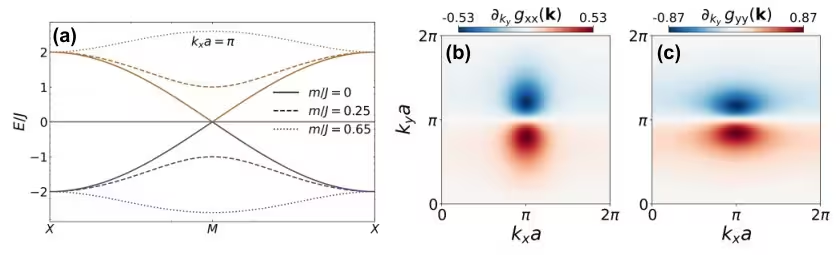
Numerical simulations confirmed that when a uniform force is applied to the system, the wave packet develops a distinct bimodal profile and expands outward. The rate of this real-space broadening closely matched the analytical predictions in the short-time and weak-force regimes. When the applied force became too strong, however, higher-order corrections and interband mixing caused deviations as particles leaked into neighboring dispersive bands.
New Pathways for Quantum Simulation
The proposed measurement protocol relies on experimental techniques already established in cold-atom laboratories, including optical Lieb lattices, coherent flat-band preparation, and high-resolution fluorescence imaging. By tracking how atomic cloud widths grow over time using site-resolved imaging, experimentalists can extract quantum-metric variations without needing to reconstruct full Bloch wave functions.
The authors note that this dynamical approach provides a real-space counterpart to anomalous transport measurements, offering a clean route for studying quantum geometry in engineered multiband platforms where conventional dispersion is heavily suppressed.
The study was posted to the arXiv preprint server on November 5, 2026.
This article has been fact checked for accuracy, with information verified against reputable sources. Learn more about us and our editorial process.
Last reviewed on .
Article history
- Latest version
Reference(s)
- Gangadhar, Rishi. “Flat-band systems: A platform to realize the moments of Quantum Metric.” arXiv.org <http://arxiv.org/abs/2611.08479v1>.
Cite this page:
- Posted by Farah Siddiqui