Quantum Distillation Shrinks AI Models But Reveals Hardware Limits
A new survey of thirty-three studies reveals how physicists are teaching quantum processors deep learning secrets, despite severe noise and output hurdles.
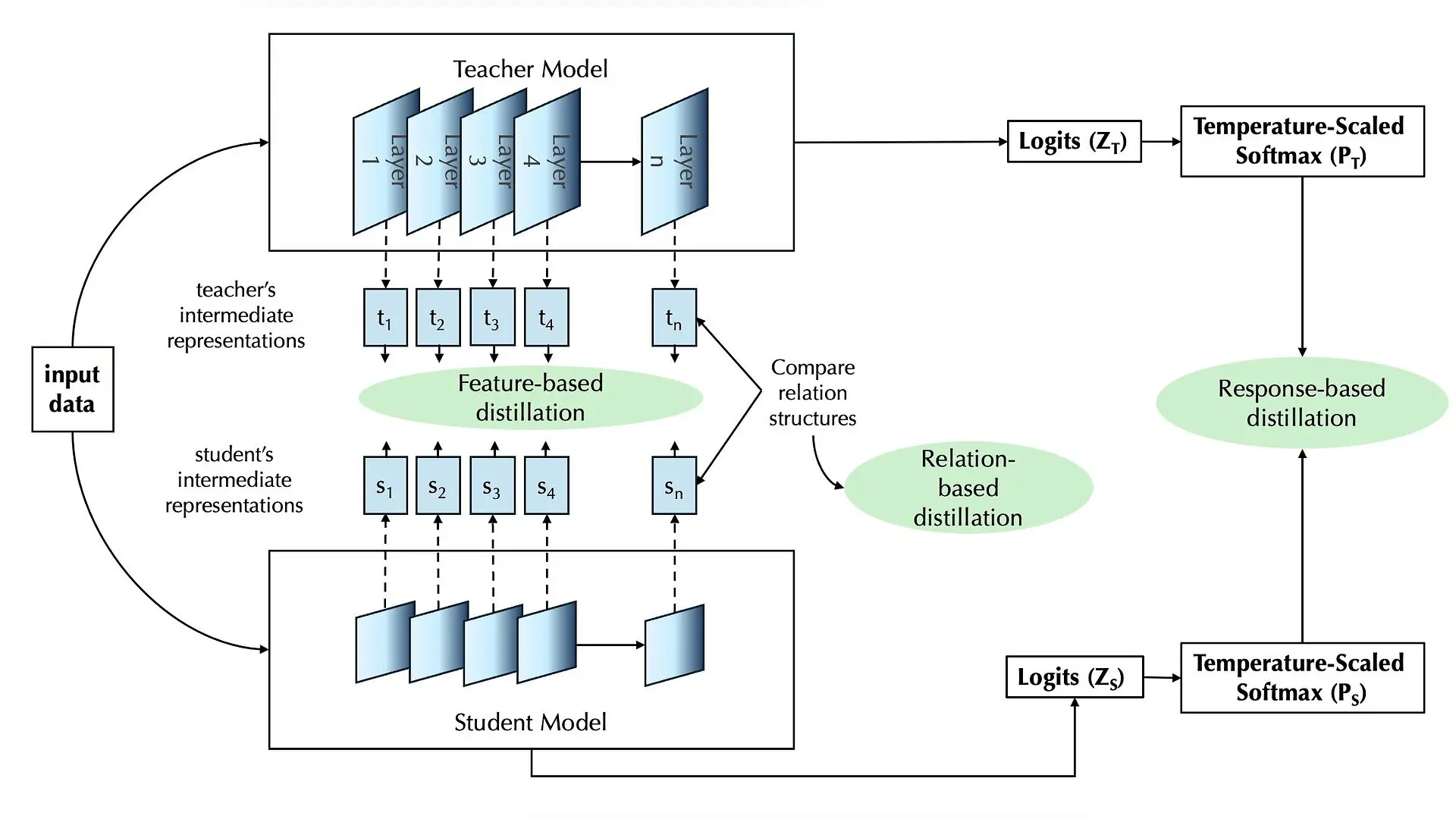
Physicists are shrinking massive artificial intelligence networks down to compact sub-atomic models by teaching quantum processors the secrets of deep learning. Researchers have reviewed thirty-three recent studies published in arXiv, revealing how training algorithms can successfully transfer information between classical computers and fragile qubits.
How Quantum Knowledge Transfer Works in Practice
Knowledge distillation traditionally acts as a high-tech tutoring system, where a massive computer model with billions of parameters guides a nimble student model until the smaller system matches the teacher’s predictive accuracy. When applied to quantum mechanics, this process forces researchers to translate classical probabilities into quantum states or transform measurement outputs like expectation values into standard classification categories.
The primary hurdle in these hybrid setups is output mismatch. While standard neural networks output smooth numerical scores called logits that feed directly into software functions, quantum processors yield discrete measurement outcomes dictated by probabilistic rules. Scientists bridge this gap using classical readout layers or temperature-scaled mathematical adjustments to align the two architectures.
Surprising Compression Gains and Hardware Hurdles
The reviewed literature highlights dramatic architectural shrinkage across multiple testing domains. In certain topological phase experiments, researchers shrank large quantum setups down to compact two-qubit student circuits while retaining high performance. Across thirty-three analyzed papers, investigations spanned four distinct configuration pathways, including classical-to-quantum learning, quantum-to-quantum compression, and quantum-to-classical transfer.
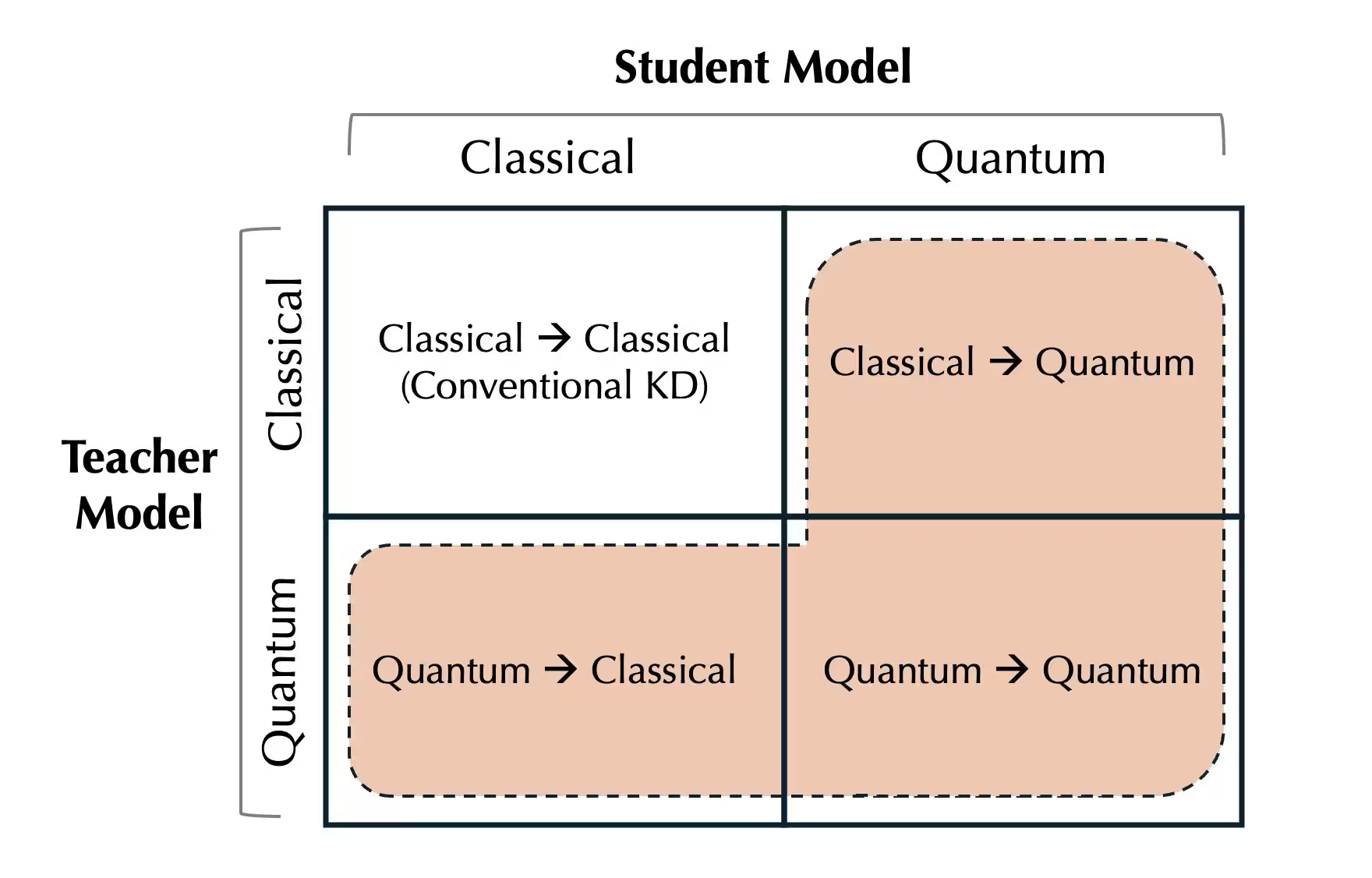
However, physical hardware limitations pose severe obstacles for real-world deployment. Noisy intermediate-scale quantum devices suffer from gate errors, environmental decoherence, and finite measurement sampling noise that can degrade the transferred supervisory signals. Training circuits on actual quantum hardware also requires computationally expensive gradient estimation techniques like the parameter-shift rule, which demands multiple distinct circuit evaluations for every single trainable parameter.
What This Means for Future Computing Systems
The findings indicate that while quantum distillation can improve compact model efficiency, performance gains remain heavily dependent on specific task definitions, circuit ansatz designs, and data encoding choices. Many studies report minimal accuracy improvements that are difficult to separate from random initialization variance. Moving forward, the scientific community emphasizes the urgent need for standardized benchmarking protocols and noise-aware training methods to determine whether quantum machine learning can achieve true practical advantage over conventional hardware.
The study was posted to the arXiv preprint server on November 5, 2026.
This article has been fact checked for accuracy, with information verified against reputable sources. Learn more about us and our editorial process.
Last reviewed on .
Article history
- Latest version
Reference(s)
- Al-Sulaiti, Aldana. “Quantum Knowledge Distillation: State-of-the-art, Applications and Open Problems.” arXiv.org <http://arxiv.org/abs/2611.08461v1>.
Cite this page:
- Posted by Deepak Malhotra