Maglev Trains Experience Surprising Force Shifts During Tilts
New analytical models reveal how roll, pitch, and deviation alter three-dimensional electromagnetic forces in high-speed superconducting maglev systems.
When high-speed maglev trains glide along tracks at velocities reaching 135 meters per second, tiny shifts in train orientation can trigger surprisingly large fluctuations in three-dimensional electromagnetic forces. These sudden force variations, which occur when a train experiences roll, pitch, or lateral deviation, pose significant challenges to overall ride stability and structural safety. Understanding how these transient motion states alter suspension, traction, and guidance forces is essential for making commercial electro-dynamic suspension superconducting maglev systems practical and cost-effective.
To investigate these complex dynamic forces, researchers Huaimiao Zhu and colleagues developed comprehensive analytical models and finite element simulations to map out how multi-axis attitudes influence electromagnetic behavior. Their work, published in PLOS One, details the general topology and three-dimensional distribution of electromagnetic forces within the integrated levitation system. By accounting for both body translation and rotation, the study provides a detailed mathematical framework for calculating how track and superconducting coils interact during irregular motion.
How Train Tilts and Turns Alter Electromagnetic Forces
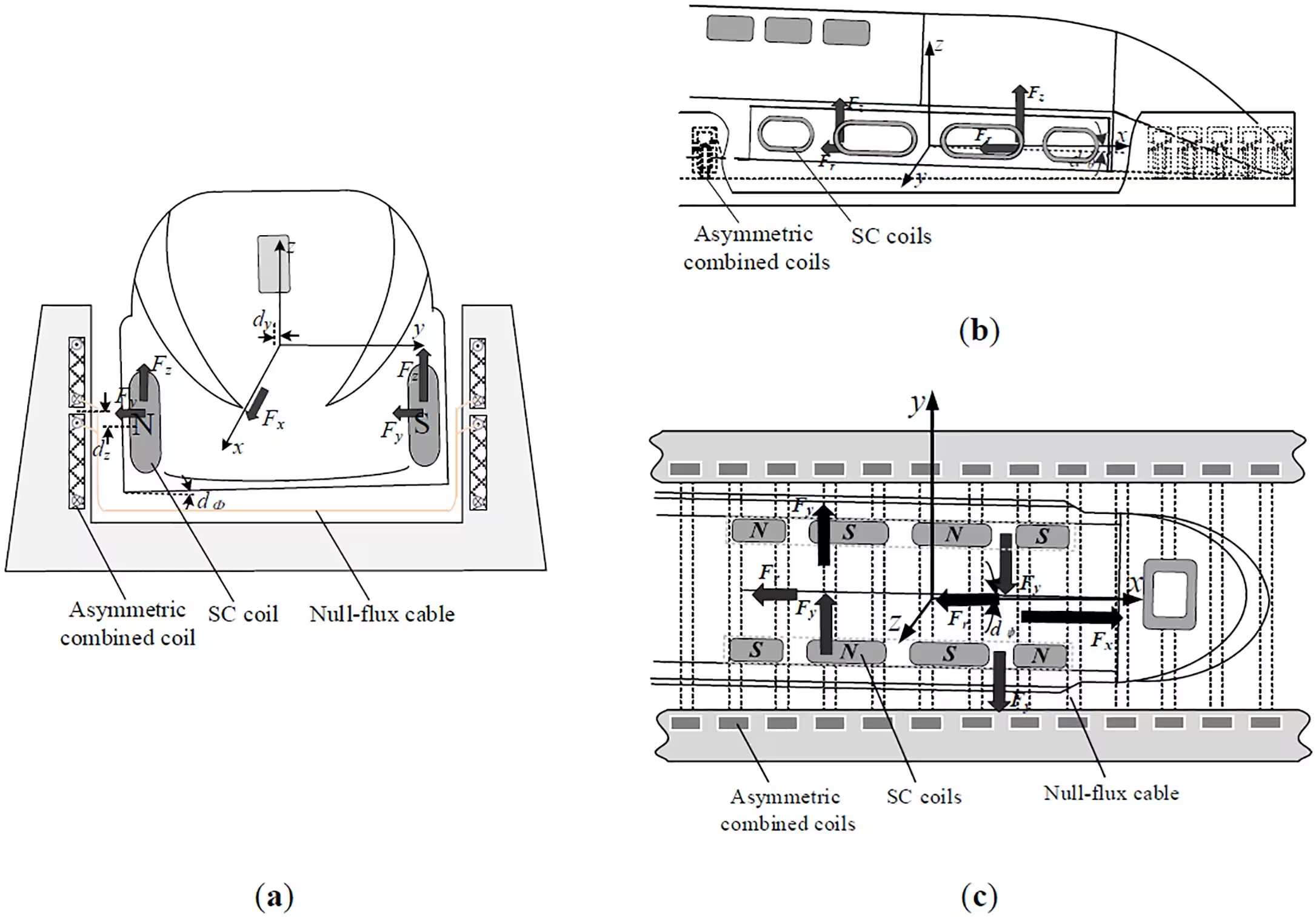
The high-speed maglev system relies on an asymmetric combination of track coils and unequal superconducting coils mounted on each bogie. The track coils feature an eight-shaped zero-flux configuration installed on the side walls to integrate both levitation and guidance functions while achieving a net coupled magnetic flux of zero at the equilibrium position. When the train moves through curves or uneven ground, however, its physical orientation shifts in three rotational directions known as scroll, pitch, and deviation.
Under a scroll attitude, where the bogie experiences a counterclockwise torque, the side of the train nearest to the guideway produces a substantially greater suspension and guidance force than the side farther away. When a pitch torque is applied, the suspension and magnetic drag forces acting on the superconducting coils at the front of the train increase, while those at the rear decrease. Similarly, yaw or deviation angles create pronounced variations in guidance forces and magnetic drag across the front and rear assemblies, while also influencing the primary traction force driving the vehicle forward.
Analytical Calculations Versus Finite Element Simulations
To quantify these effects, the research team established analytical equations based on Lenz’s law of induction, incorporating induced electromotive forces across upper and lower track coils. The structural parameters utilized in the evaluation included track coils measuring 10.8 meters in length with 24 turns, paired with superconducting niobium-titanium coils operating at temperatures below 20 Kelvin and carrying a direct operating current of 500 amperes. The system operates at a synchronous speed of 135 meters per second with a 50 Hertz frequency.
The researchers compared their analytical calculations against finite element analysis simulations performed using software running on a 64-core workstation with 68 gigabytes of memory. While finite element simulations required between 48 and 72 hours of heavy computation time, the newly developed analytical modeling approach yielded results in approximately two minutes while maintaining satisfactory precision.
Key Findings on Force Fluctuations and Future Limitations
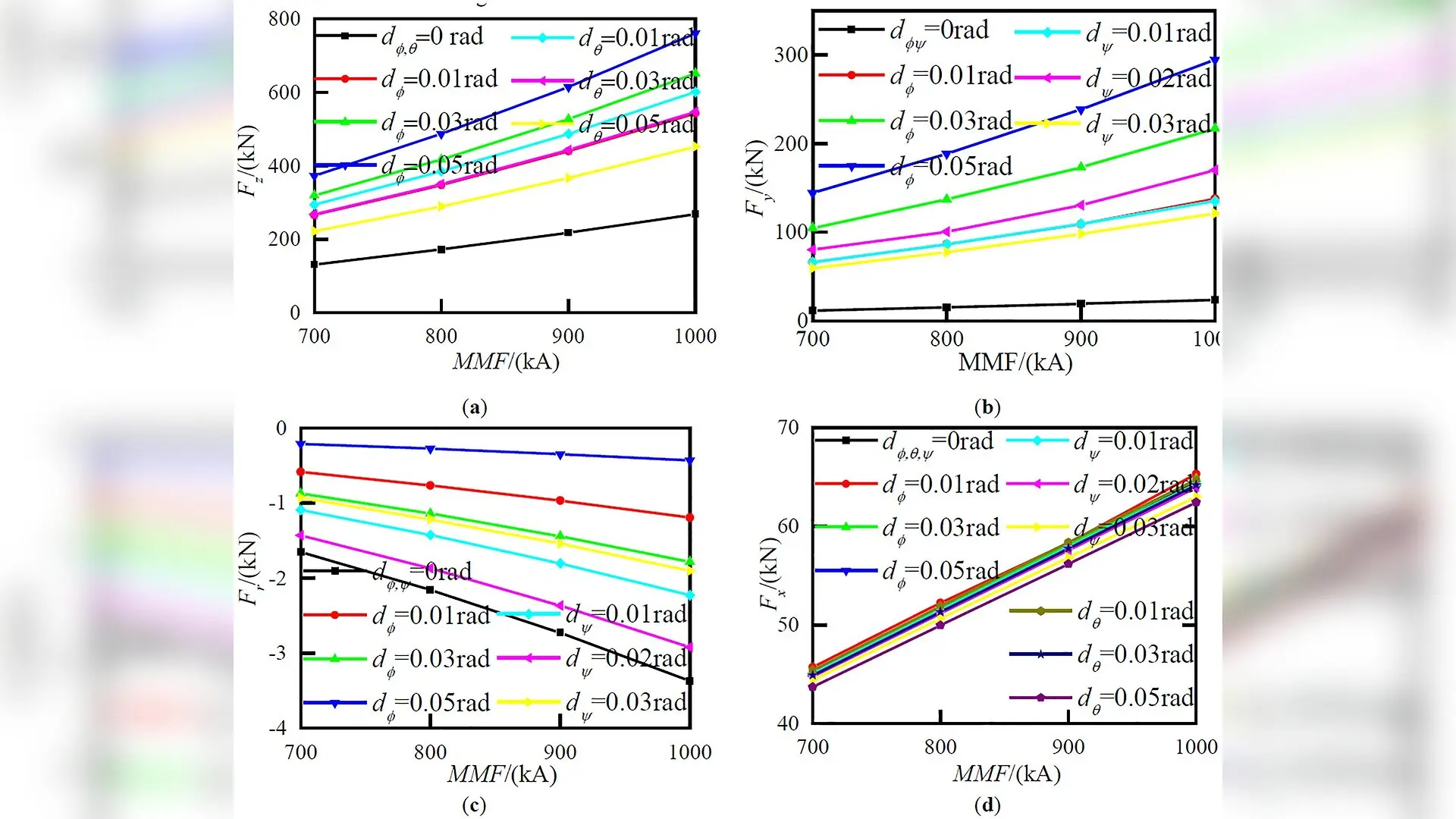
The evaluation revealed distinct behavioral patterns as operational angles change. An increase in the train scroll angle leads to an overall increase in both suspension and guiding forces, while larger pitch angles tend to decrease the suspension force and alter the suspension-to-drag force ratio. Furthermore, increases in the deviation angle produce noticeable spikes in traction force sensitivity and force fluctuations.
Despite the efficiency of the analytical model, the study points out that integrated magnetic levitation systems still face notable hurdles, including amplified electromagnetic force fluctuations, localized coil stress concentrations, and thermal management issues stemming from temperature rises. These operational constraints indicate that further structural optimization of guideway combination coils and shielding materials will be necessary before widespread commercial deployment becomes feasible.
The research was published in PLOS One on November 5, 2026.
This article has been fact checked for accuracy, with information verified against reputable sources. Learn more about us and our editorial process.
Last reviewed on .
Article history
- Latest version
Reference(s)
- Zhu, Huaimiao., et al. “Three-dimensional characteristics analysis of maglev train with rotating operation conditions.” PLOS One, vol. 21, no. 11, November 5, 2026, pp. e0361708 Public Library of Science (PLoS), doi: 10.1371/journal.pone.0361708. <https://doi.org/10.1371/journal.pone.0361708>.
Cite this page:
- Posted by Deepak Malhotra