Why Dense Evergreens And Shrubs Beat Trees At Fighting Summer Heat
New research reveals that physical radiation blocking by plants trumps transpiration, offering a blueprint for campus cooling.
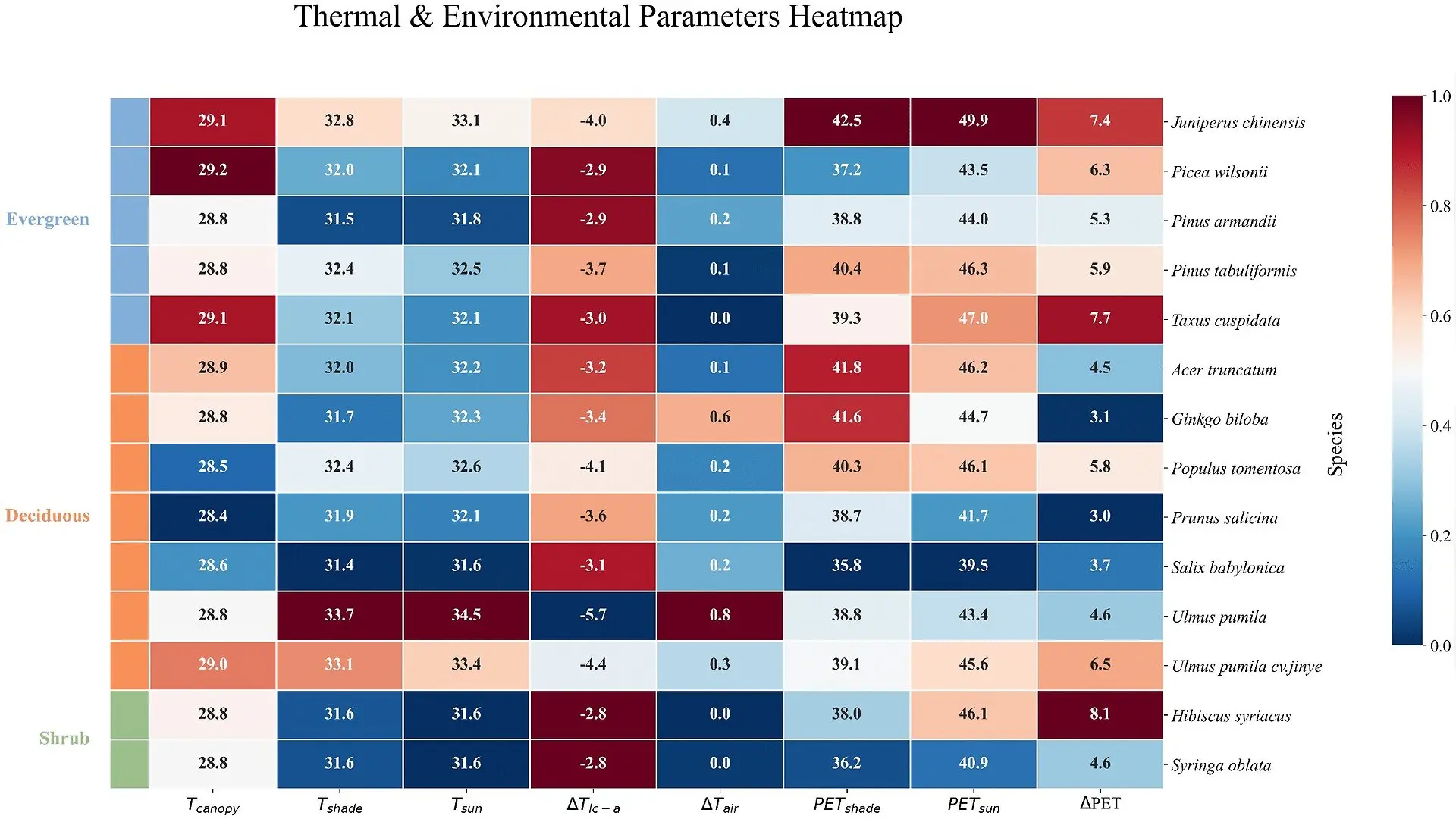
When summer temperatures soar in regions known for freezing winters, towering evergreens and dense shrubs do more than just green the campus, they slash perceived heat by more than 10 degrees Celsius through a process that bypasses simple shade. Researchers studying campus microclimates have found that the secret to beating brutal summer heat and humidity lies in blocking shortwave radiation rather than relying on plant transpiration alone, offering new blueprints for climate-resilient urban design.
The new research, published in PLOS One, investigates the complex thermal interactions of landscape elements on a university campus in Shenyang, China. Located within a temperate monsoon climate zone, the region experiences a severe double whammy during summer. High temperatures combine with high relative humidity, creating a humid-heat environment that hampers human sweating and thermoregulation far more aggressively than dry desert heat.
Why Evergreens and Shrubs Outperform Deciduous Trees
To untangle how different plants affect human comfort, the team tracked microclimatic metrics using a metric called the Physiologically Equivalent Temperature, which merges air temperature, wind, humidity, and radiant heat into a single index. During peak afternoon hours between 12:00 and 14:00, evergreen trees such as spruce and juniper delivered a massive average temperature drop of 10.6 degrees Celsius under their canopies. Unexpectedly, low-growing shrubs performed nearly as well, yielding an average reduction of 10.4 degrees Celsius. This close-to-the-ground performance easily surpassed deciduous trees, which averaged an 8.1 degree drop under identical conditions.
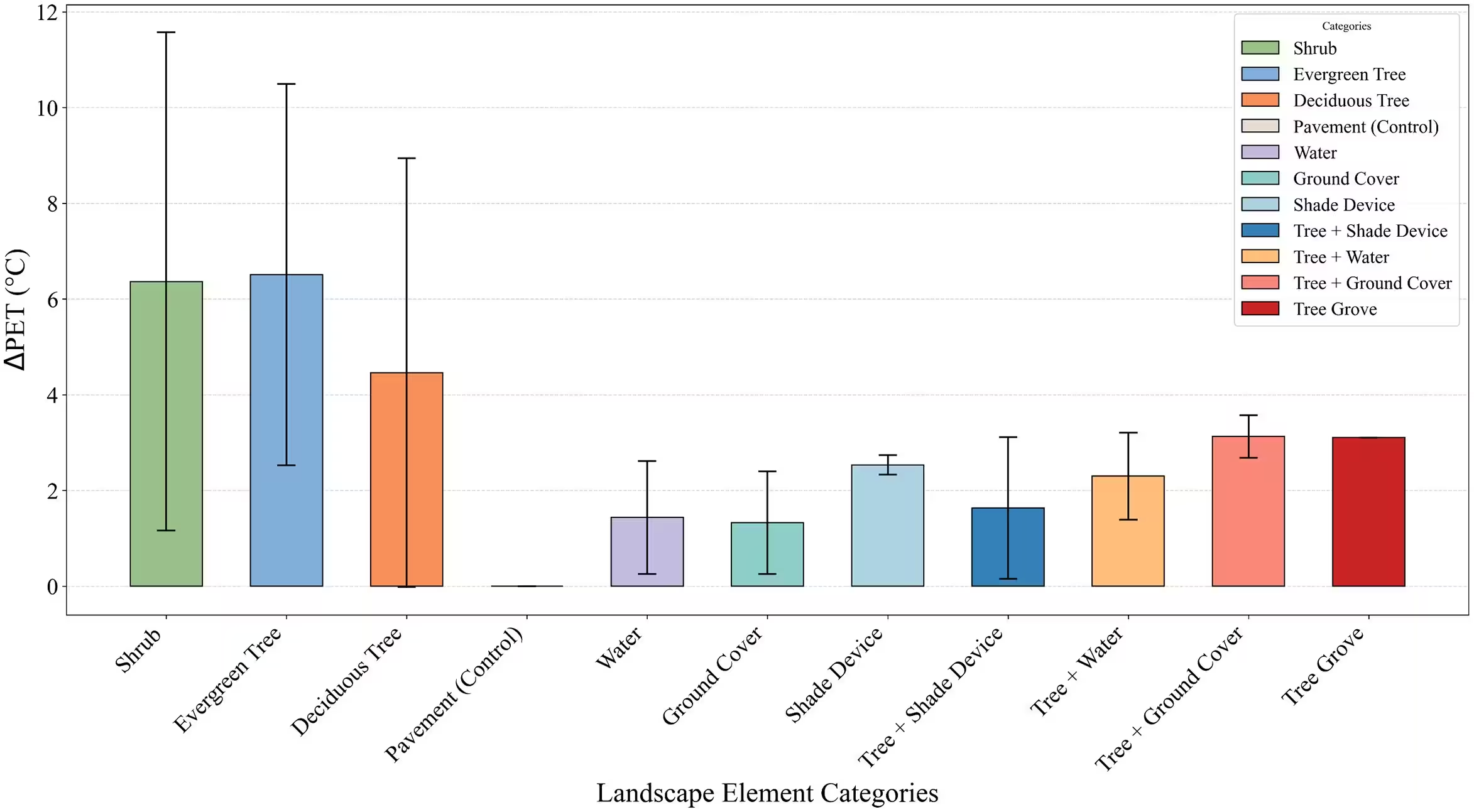
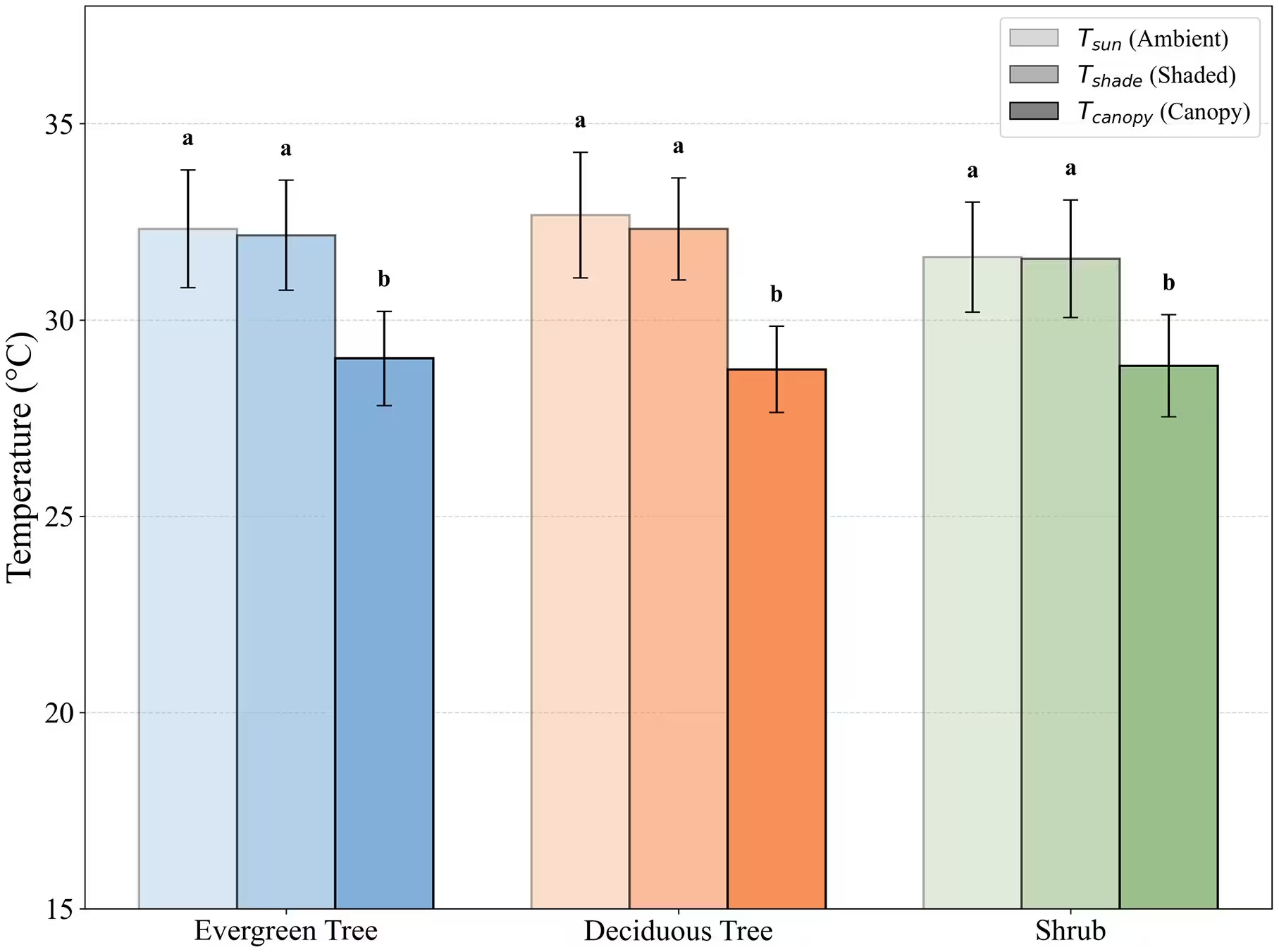
The findings point to a physical phenomenon the authors call radiative blocking dominance. While scientists traditionally assumed that leaf area index and active plant transpiration drove most cooling, the statistical analysis revealed a decoupling between leaf temperature and overall comfort improvement. Dense needle structures in evergreens and thick, low-lying foliage in shrubs act as an immediate physical shield against intense solar radiation, slashing the mean radiant heat that bakes pedestrians.
The Power and Limits of Water and Paving
Beyond plants, the study evaluated the role of water features and ground materials. Static lakes offered modest relief, but dynamic water elements like large fountains supercharged cooling by fragmenting water droplets and accelerating evaporation, boosting comfort index improvements to 3.1 degrees Celsius. In contrast, dark asphalt pavements acted as active heat sources during midday, radiating longwave heat back upward and worsening local heat stress.
When researchers tested high-albedo granite and permeable bricks, they found these surfaces effectively reduced surface heating in open plazas. However, underneath a thick tree canopy, the choice of paving material made almost no difference to human thermal comfort, varying by less than 0.2 degrees Celsius.
Designing Smarter Campuses for a Warming World
Computer simulations modeling different spatial layouts revealed that combining tall evergreens with dynamic water features created the most powerful cooling synergy, dropping daily average heat stress indices significantly. The team suggests that urban planners and campus designers adopt a hierarchy of intervention strategies, prioritizing high-density evergreen skeletons for summer shade and pairing them strategically with water bodies upwind of dominant summer breezes.
At the same time, the authors caution that the findings are specific to the sampled campus morphology and typical summer meteorological conditions. Balancing summer heat mitigation with the need for winter sunlight remains a delicate balancing act, suggesting that asymmetric layouts with deciduous trees on the south and evergreens on the north will be essential for year-round comfort.
The research was published in PLOS One on November 5, 2026.
This article has been fact checked for accuracy, with information verified against reputable sources. Learn more about us and our editorial process.
Last reviewed on .
Article history
- Latest version
Reference(s)
- Fan, Lei., et al. “Microclimatic regulation effects of landscape elements on university campus in a temperate monsoon climate zone: A case study during extreme summer heat.” PLOS One, vol. 21, no. 11, November 5, 2026, pp. e0362099 Public Library of Science (PLoS), doi: 10.1371/journal.pone.0362099. <https://doi.org/10.1371/journal.pone.0362099>.
Cite this page:
- Posted by Deepak Malhotra