Tiny Cracks Slash Soil Strength by 81 Percent Before Slope Collapse
High-resolution CT scans and machine learning reveal how millimeter-scale flaws dictate the earliest stages of catastrophic earth failures.
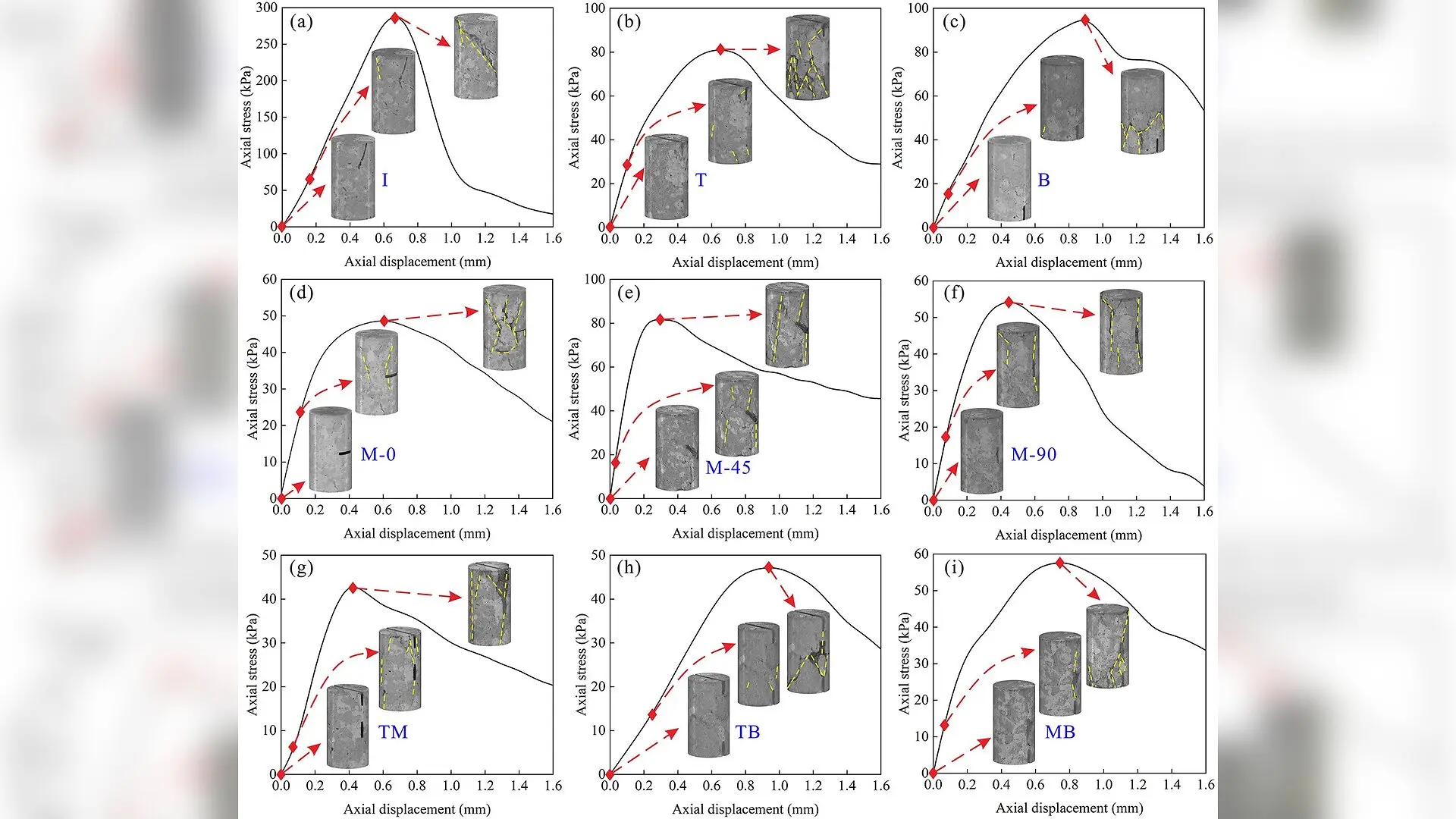
Tiny fractures measuring only millimeters wide can trigger massive slope collapses by slashing soil strength by up to 81 percent, according to laboratory experiments published in PLOS One. These minute initial gaps act as critical structural flaws that concentrate stress when the ground undergoes compression from above, dictating how entire earth layers will eventually fail.
How Small Fractures Weaken Entire Slopes
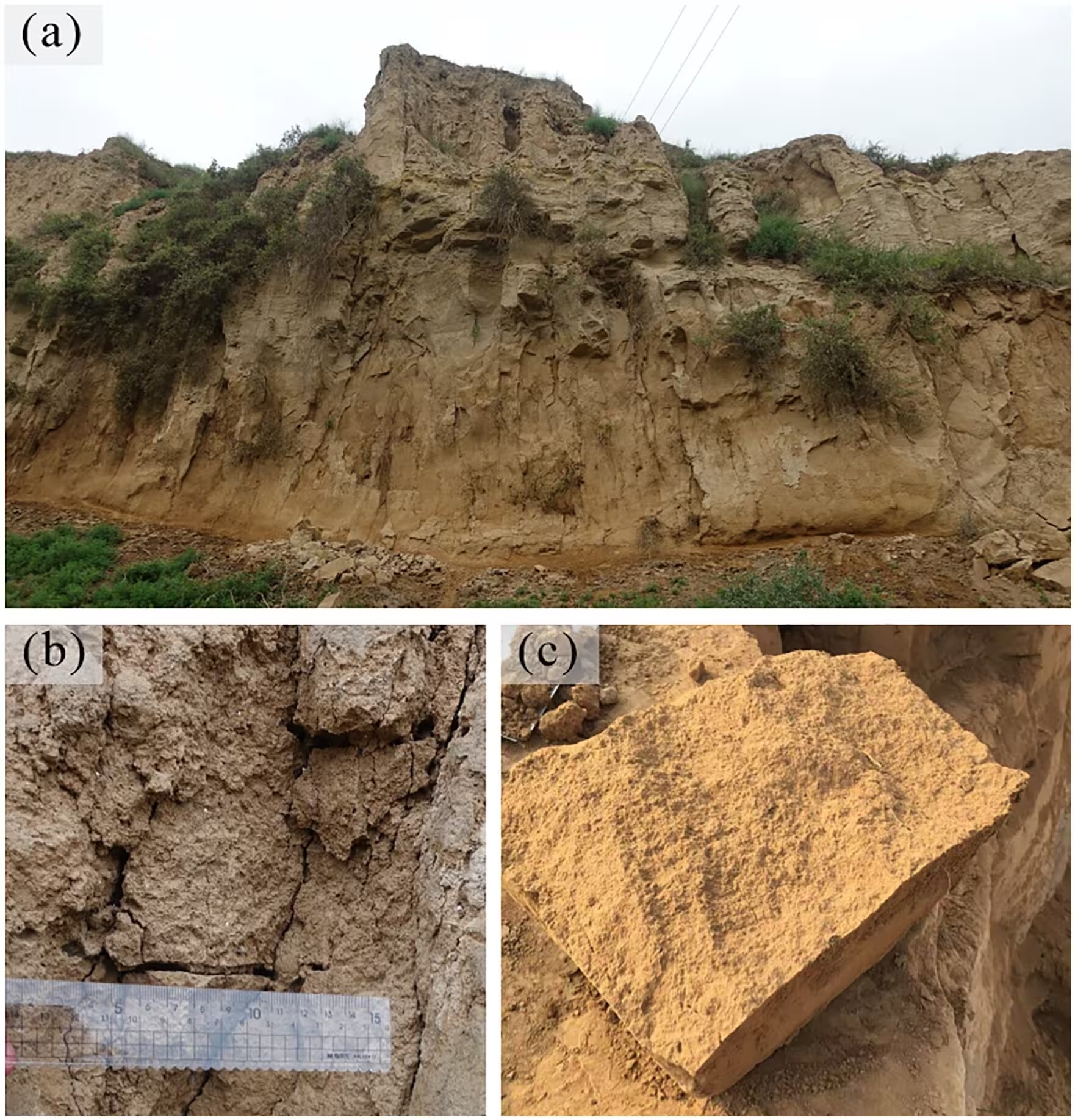
Shallow ground failures in wind-blown soil deposits known as loess create constant hazards for roads, bridges, and pedestrians across regions like the Loess Plateau in China. While previous research investigated how moisture and temperature changes create these initial breaks, researchers understood little about how the specific geometry of a crack dictates the earliest stages of soil collapse. To examine this process, scientists collected intact soil blocks from Jingyang County and trimmed them into cylindrical specimens measuring 50 millimeters in diameter and 100 millimeters in height. They introduced artificial gaps measuring 2 millimeters wide and 20 millimeters long using specialized cutting tools to simulate natural defects.
The team placed these prepared samples into a custom acrylic holder designed for X-ray computed tomography scanning. During uniaxial compression tests, where downward force is applied along a single vertical axis, the researchers recorded stress and displacement at regular strain intervals. Once the first surface microcracks appeared, the specimens were transferred directly to a nanoVoxel-2000 micro-CT scanner to capture internal damage at a 72-micrometer resolution. Using machine learning algorithms built into Dragonfly software, the team reconstructed three-dimensional models that successfully separated the soil matrix, pores, and newly formed failure cracks.
What Happens When Different Crack Patterns Are Compressed
The experiments revealed that the placement, angle, and number of initial flaws drastically change how a soil sample collapses. Intact reference samples without any artificial cracks withstood an axial pressure of about 65 kilopascals before suffering shear slip along a 45-degree plane. In contrast, samples featuring a crack near the top yielded at roughly 28 kilopascals, while those with a crack near the bottom failed at just 16 kilopascals. Soil samples with a single middle crack oriented at a 45-degree angle proved especially vulnerable, yielding at 16 kilopascals compared to 24 kilopascals for horizontal cracks and 18 kilopascals for vertical ones. When multiple cracks were combined, specimens with both top and middle defects yielded at a mere 7 kilopascals, representing an 81 percent drop in compressive strength compared to intact soil.
Quantitative analysis of the CT scans showed that different crack configurations generated distinct types of secondary damage. Vertical initial cracks primarily drove the growth of edge extension cracks that ran parallel to the original gap. Meanwhile, horizontal and 45-degree initial cracks promoted edge wing cracks and lateral wing cracks that branched outward under mixed tensile and shear stresses. Samples containing two initial cracks produced significantly more large-volume failure cracks ranging from 1 trillion to 10 trillion cubic micrometers, as the stress fields between adjacent gaps interacted to create weak zones that facilitated rapid cracking.
Limitations and Next Steps for Hazard Prediction
The authors note that these findings are based on simplified, straight artificial cuts tested under unconfined compression, which cannot fully replicate the irregular roughness, variable continuity, and complex multi-directional confining pressures found in natural hillside environments. Furthermore, identifying the exact onset of initial failure involves operational approximations based on loading intervals and automated image segmentation thresholds. The team emphasizes that future work must incorporate hydrological coupling, rough crack walls, and larger sample sizes to verify whether these laboratory insights can accurately predict real shallow slope disasters in the field.
The research was published in PLOS One on November 5, 2026.
This article has been fact checked for accuracy, with information verified against reputable sources. Learn more about us and our editorial process.
Last reviewed on .
Article history
- Latest version
Reference(s)
- Zhao, Luqing., et al. “Initial failure morphology of shallow loess containing millimeter-scale cracks: Insights from CT 3d imaging.” PLOS One, vol. 21, no. 11, November 5, 2026, pp. e0359832 Public Library of Science (PLoS), doi: 10.1371/journal.pone.0359832. <https://doi.org/10.1371/journal.pone.0359832>.
Cite this page:
- Posted by Deepak Malhotra