Twisting Light Beams at 13.2 Degrees Creates Stable Optical Skyrmion Bags
Physicists have expanded twistronics into free-space optics, generating reconfigurable light lattices that travel without diffraction and heal themselves after encountering obstacles.
Twisting two overlapping fields of structured light by exactly 13.2 degrees can forge intricate, self-healing light patterns known as optical skyrmionium-bag superlattices. Researchers have successfully extended the physics of twistronics, which traditionally manipulates atomically thin solid materials like stacked graphene layers, into freely propagating light beams in empty space. This digital optical technique bypasses the need for physical material interfaces to generate complex topologies, opening up new ways to manipulate high-dimensional wave structures.
The study, published in Light: Science & Applications, details how the superposition of two periodic topological optical lattices creates rich moiré interference patterns. While conventional twistronics relies on static two-dimensional solids and operates mostly at microscopic near-field scales, this free-space approach allows complex topological textures to travel over extended distances without spreading out or losing their shape.
How Light Lattices Mimic Twisting Solid Materials
To create these formations, the authors, Vasu Dev and Yijie Shen, built upon the principle of N-wave interference. They superimposed two structured light lattices that featured binary and helical phase distributions alongside orthogonal polarizations. In the Fourier domain, these structured fields can be approximated as arrays of discrete point sources carrying Gaussian intensity distributions. By introducing a controlled relative twist angle between two identical volumes of these optical lattices, the team produced an array of novel moiré patterns.
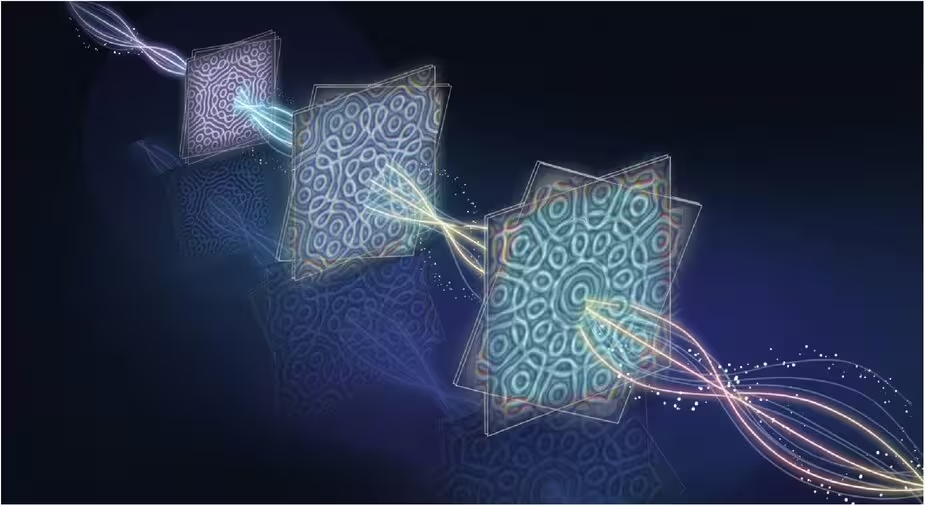
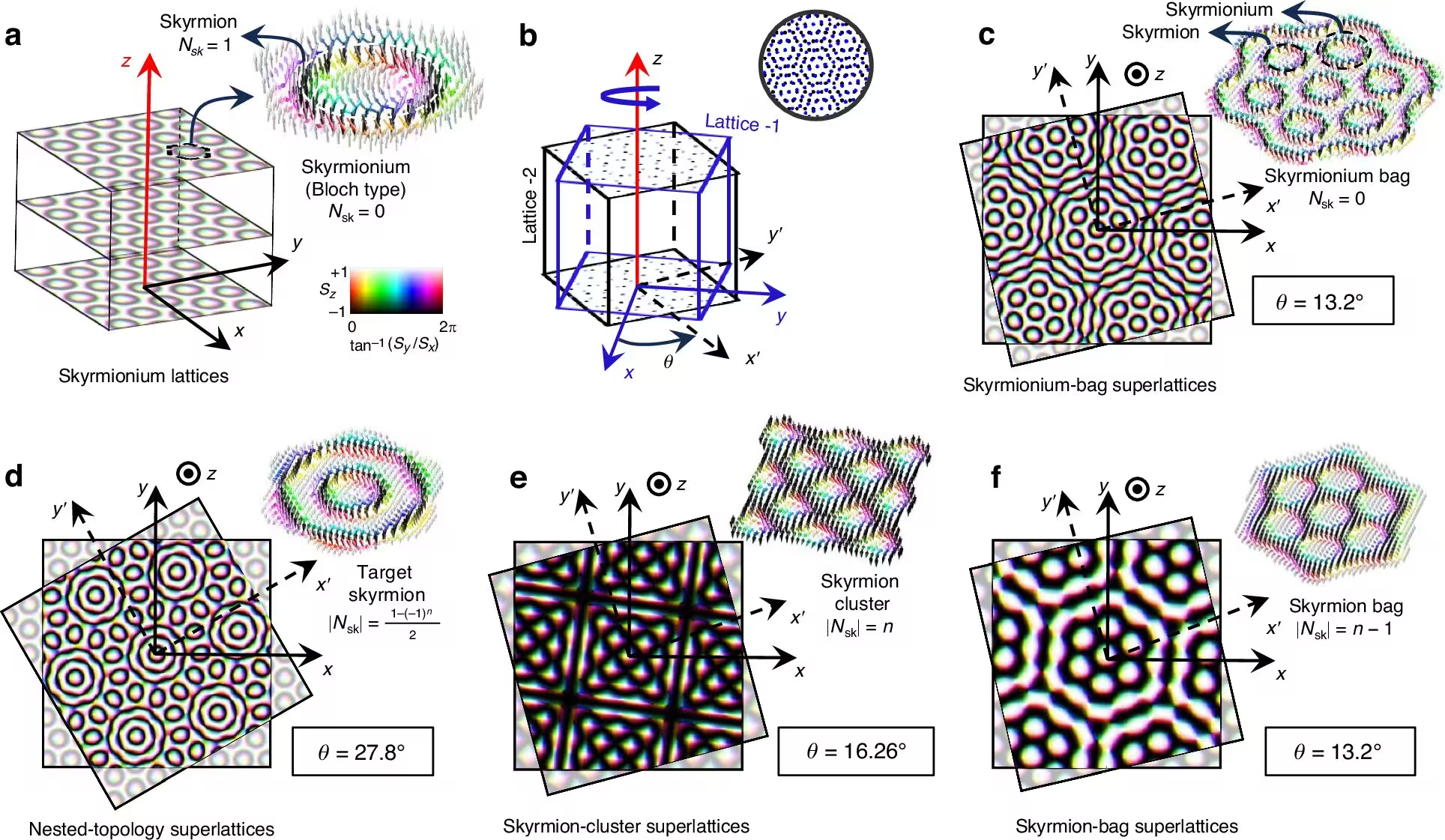
The resulting geometry of the light field depends heavily on the chosen twist angle. Commensurate angles establish regular, repeating periodic superlattices, while other angles yield aperiodic quasicrystalline structures. For example, twisting sixfold rotationally symmetric skyrmionium lattices by 13.2 degrees produces repeating clusters where multiple elementary skyrmionium units are enclosed inside a larger bag of opposite polarity. Adjusting the twist angle to 27.8 degrees transforms the configuration into a nested-topology superlattice, featuring a multi-layered target skyrmion at the center surrounded by organized skyrmionium tiles.
Digital Programmability and Robust Self-Healing Properties
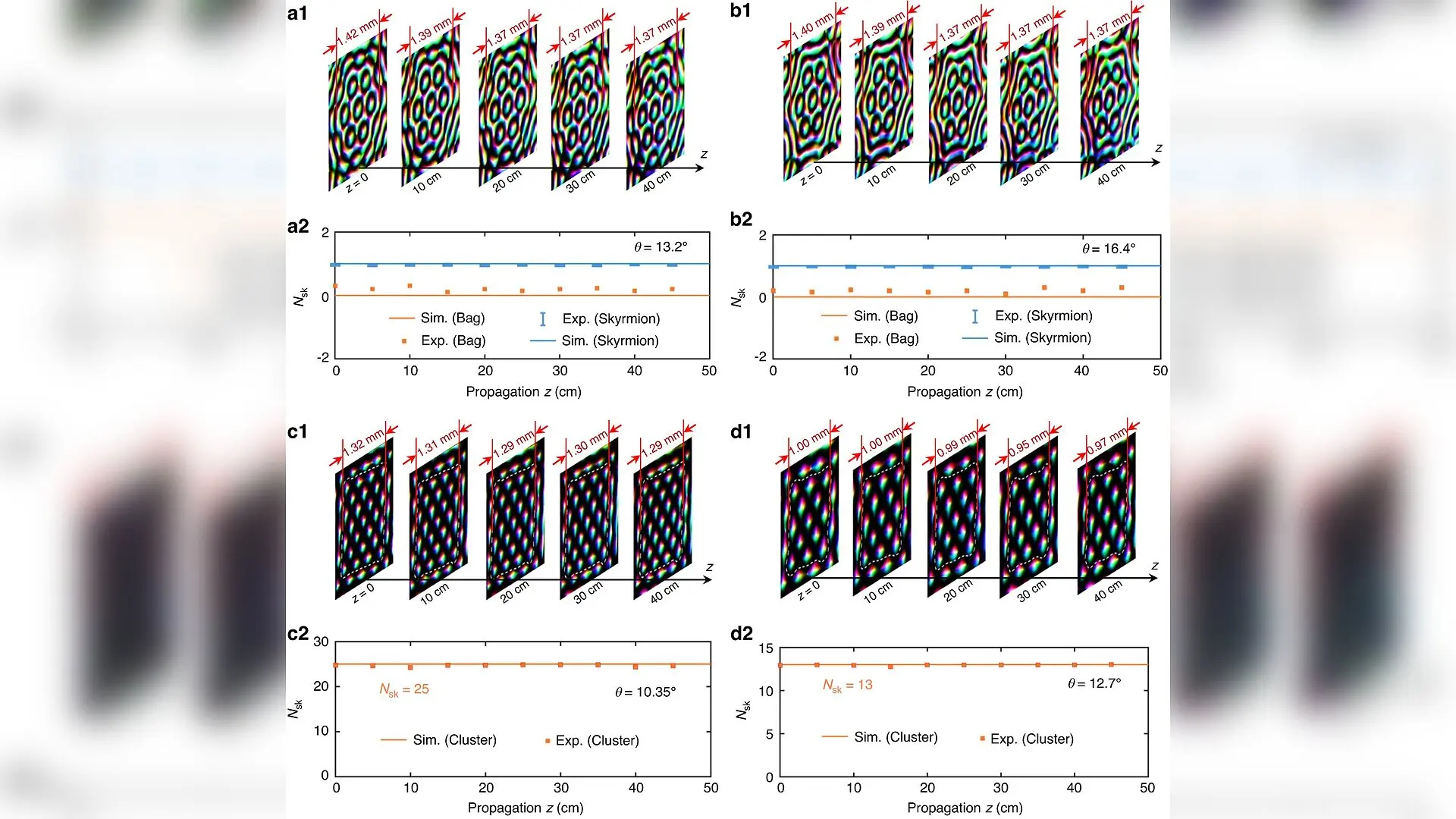
To demonstrate this concept experimentally, the researchers employed a spatial light modulator, a device that uses computer-generated holograms to manipulate light phases digitally. This setup allowed the team to switch rapidly between different supertopological configurations, such as skyrmion-cluster superlattices and nested arrays, without needing to reconfigure physical material samples. When testing four-fold symmetric C4 lattices at twist angles ranging from 10.35 to 22.61 degrees, the supercells successfully formed stable structures containing 25, 13, or 5 individual skyrmions.
Crucially, these optical supertopologies demonstrate remarkable propagation stability. Unlike divergent beams, the generated light patterns traveled across a distance of 50 centimeters without changing their geometric scale or topological integrity. Furthermore, the light fields exhibited strong self-healing behavior when blocked by physical obstacles. When opaque disks obstructed portions of the beam, the remaining wavevector components continued to interfere and reconstruct the local polarization texture during propagation, preserving the overall topological charge.
Despite these promising findings, the technique faces practical limitations imposed by optical apertures and the finite spatial resolution of spatial light modulators, which restrict the maximum propagation distance. The authors note that while current experiments focus primarily on polarization Stokes vectors, the underlying twistronic principles could potentially be extended to other vector fields, such as acoustic waves or water waves, offering a versatile platform for high-dimensional optical communication and robust information encoding.
The research was published in Light: Science & Applications on November 6, 2026.
This article has been fact checked for accuracy, with information verified against reputable sources. Learn more about us and our editorial process.
Last reviewed on .
Article history
- Latest version
Reference(s)
- Dev, Vasu., et al. “Freespace “twistronics”: moiré structured light for optical supertopologies.” Light: Science & Applications, vol. 15, no. 1, November 6, 2026 Springer Science and Business Media LLC, doi: 10.1038/s41377-026-02533-w. <https://doi.org/10.1038/s41377-026-02533-w>.
Cite this page:
- Posted by Farah Siddiqui